Product
Use Cases
How it Works
Pricing
Login
Community showcase

Designs made by our community

Staff-picked ads, product scenes, and brand assets made in Hiding Elephant. See what production-ready creative looks like, then start your own.
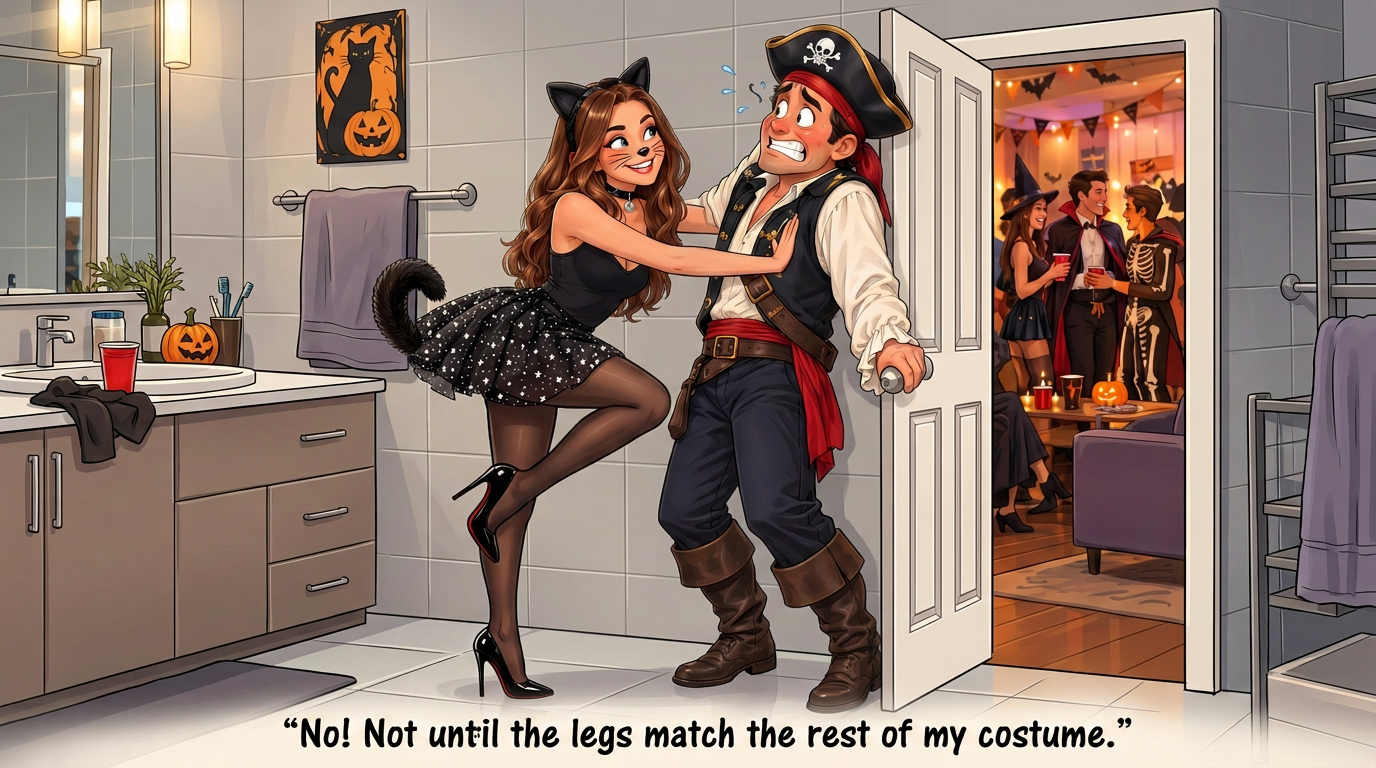
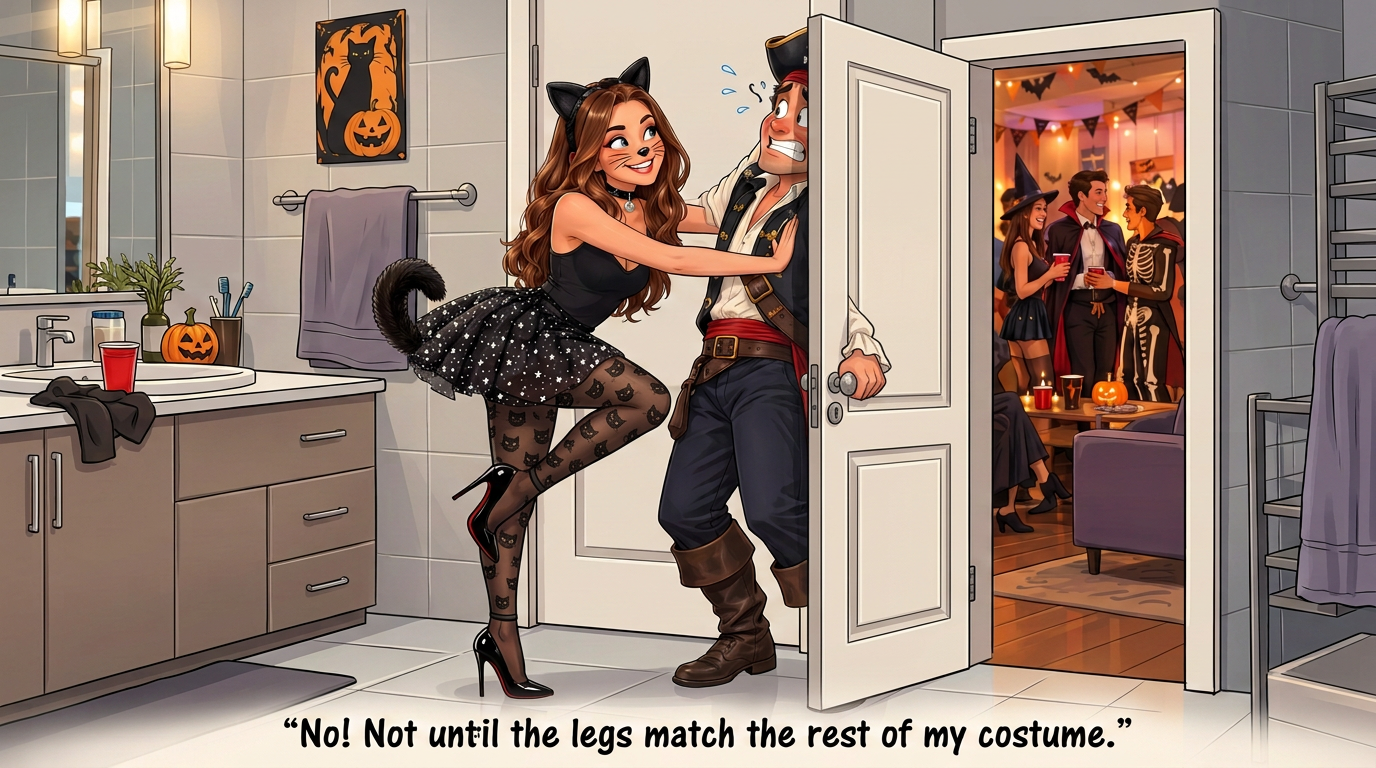
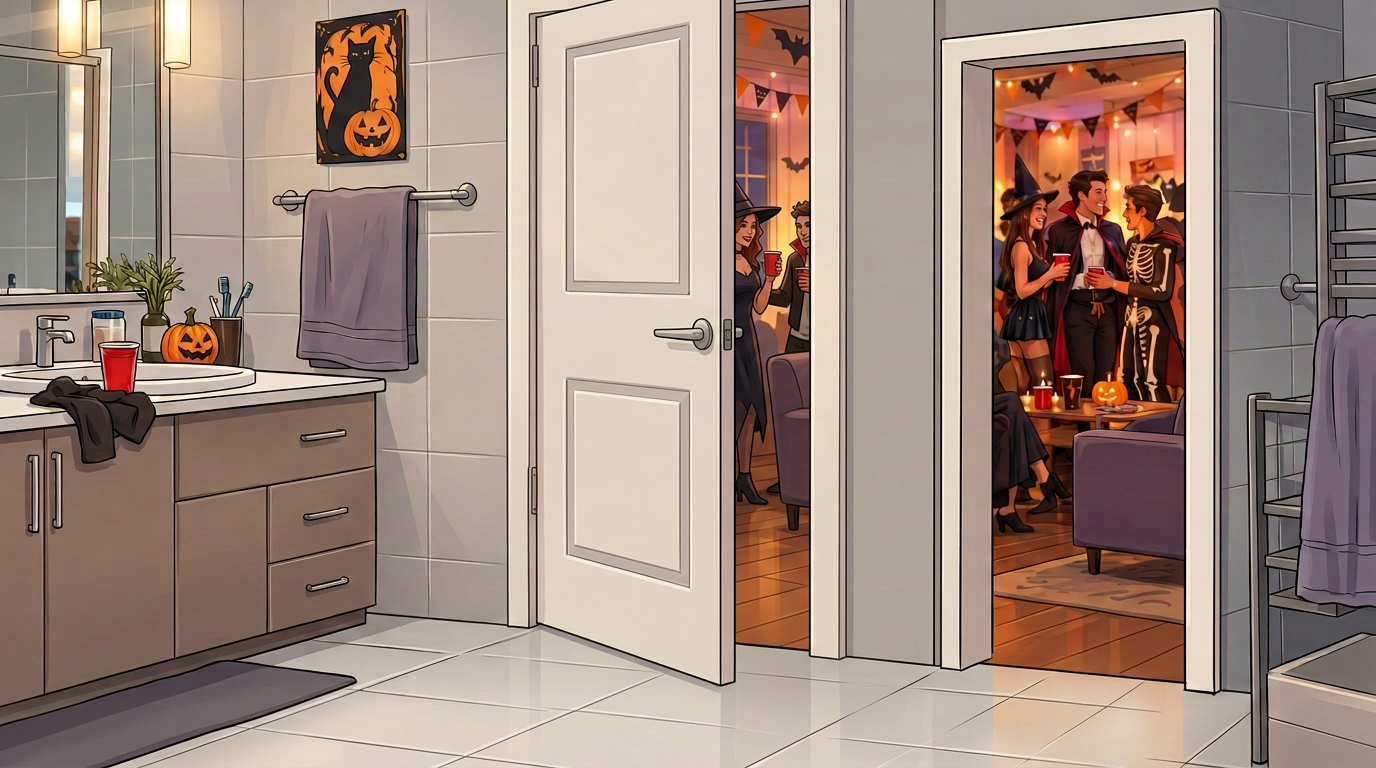
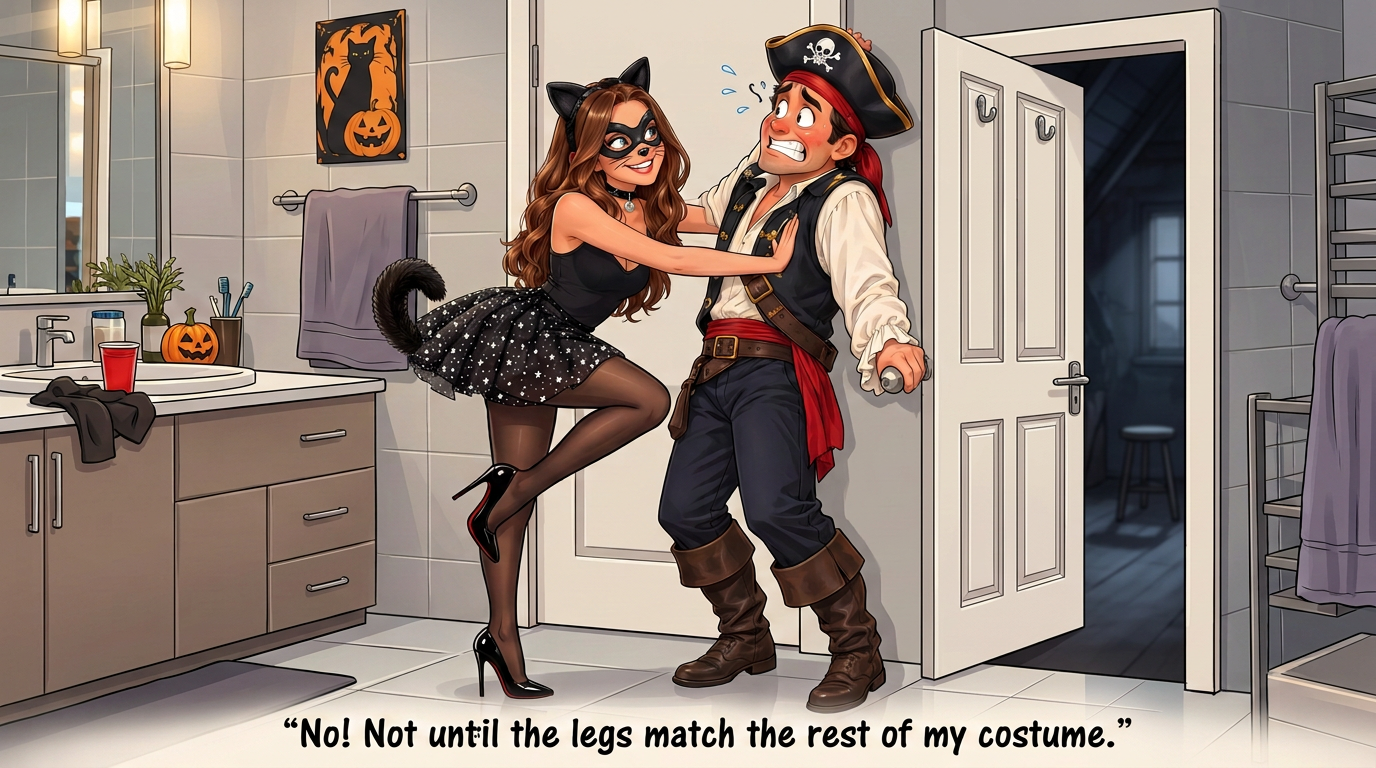
AI Design for i want you to fix the background of the second image by placing a door behind the man in the same angle as the first image, making it look like he is holding the door open halfway, keep in mind there will be only one door on the wall, maintain proportion and coherence

i want you to fix the background of the second image by placing a door behind the man in the same angle as the first image, making it look like he is holding the door open halfway, keep in mind there will be only one door on the wall, maintain proportion and coherence

by @Elephant_1649093

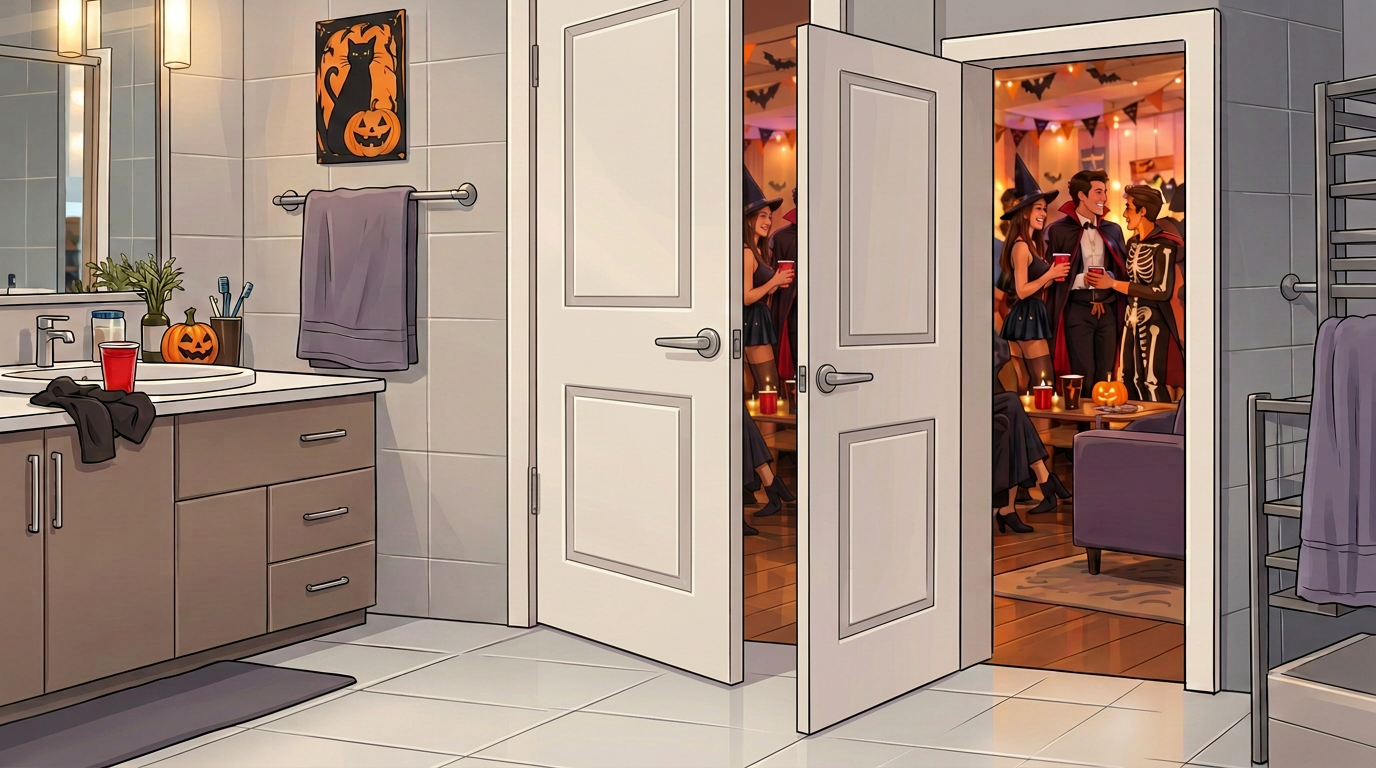
AI Design for fix the first image by using the second reference image to show the position of the door. one door,

fix the first image by using the second reference image to show the position of the door. one door,

by @Elephant_1649093

AI Design for fix the first image by using the second reference image to show the position of the door. one door, half way open

fix the first image by using the second reference image to show the position of the door. one door, half way open

by @Elephant_1649093

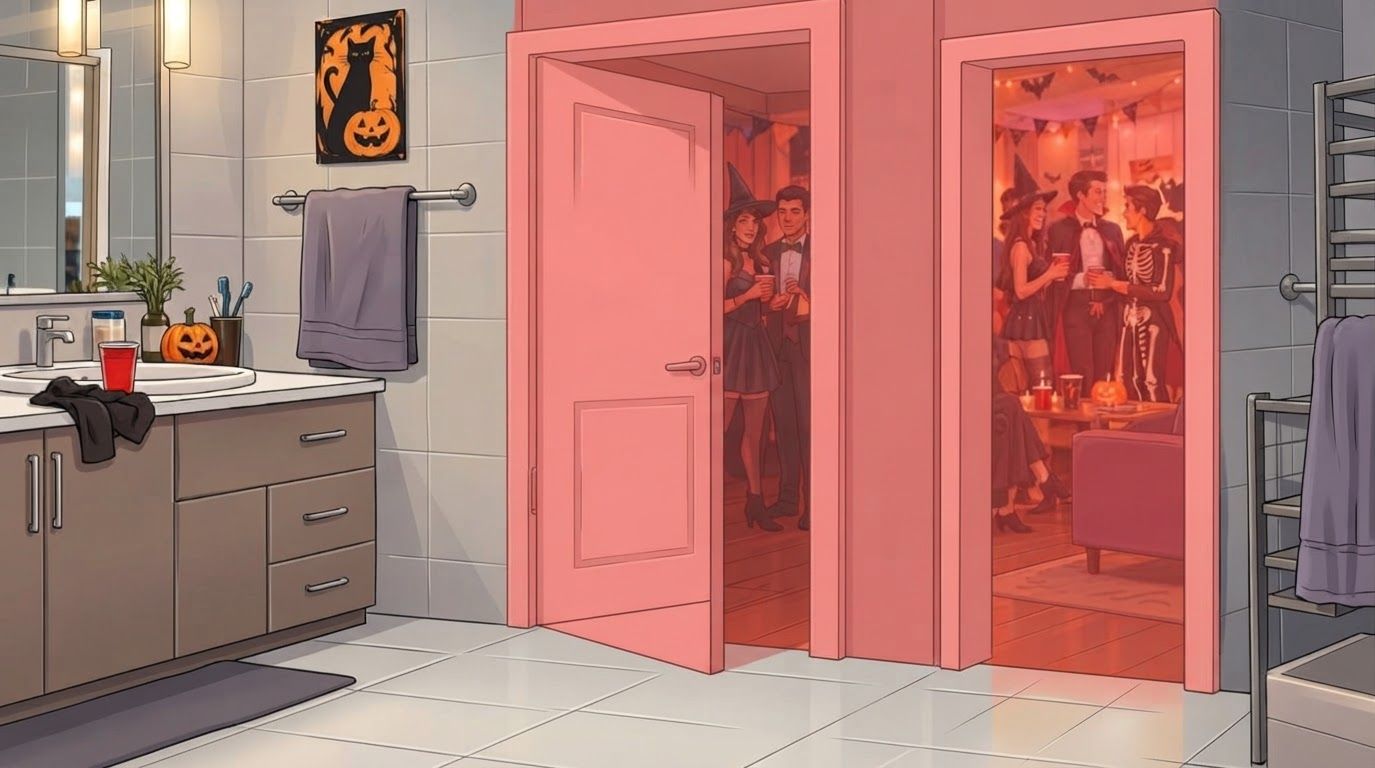
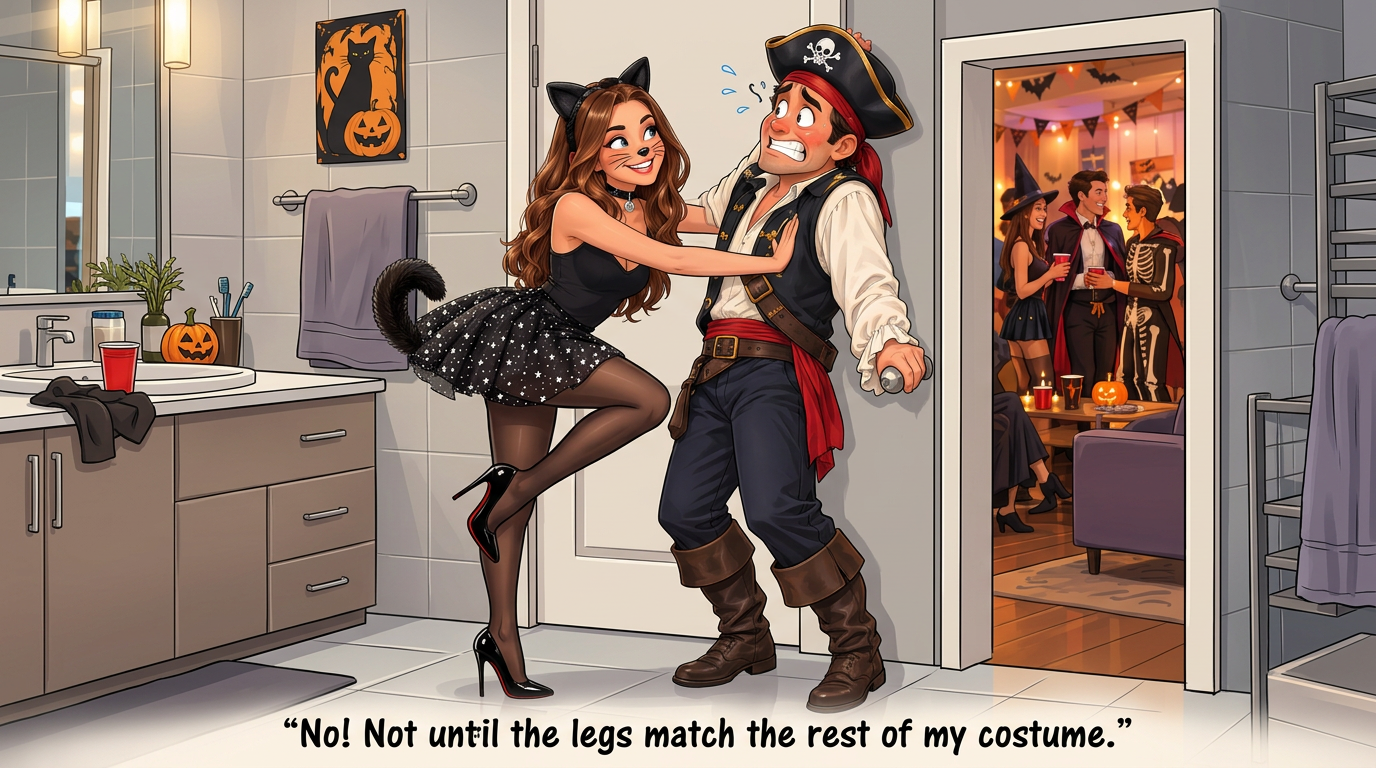
AI Design for This photo has a temporary semi-transparent red marker painted on it. The marker is not part of the scene.

Inside the marked region only, do this: fix the are, show one door half way open towards the inside of the washroom showing the view of the people in the party

Then remove the red marker completely. The finished image must contain no red paint, highlight, or drawing. Keep framing, lighting, and everything outside the marked region identical.

This photo has a temporary semi-transparent red marker painted on it. The marker is not part of the scene. Inside the marked region only, do this: fix the are, show one door half way open towards the inside of the washroom showing the view of the people in the party Then remove the red marker completely. The finished image must contain no red paint, highlight, or drawing. Keep framing, lighting, and everything outside the marked region identical.

by @Elephant_1649093
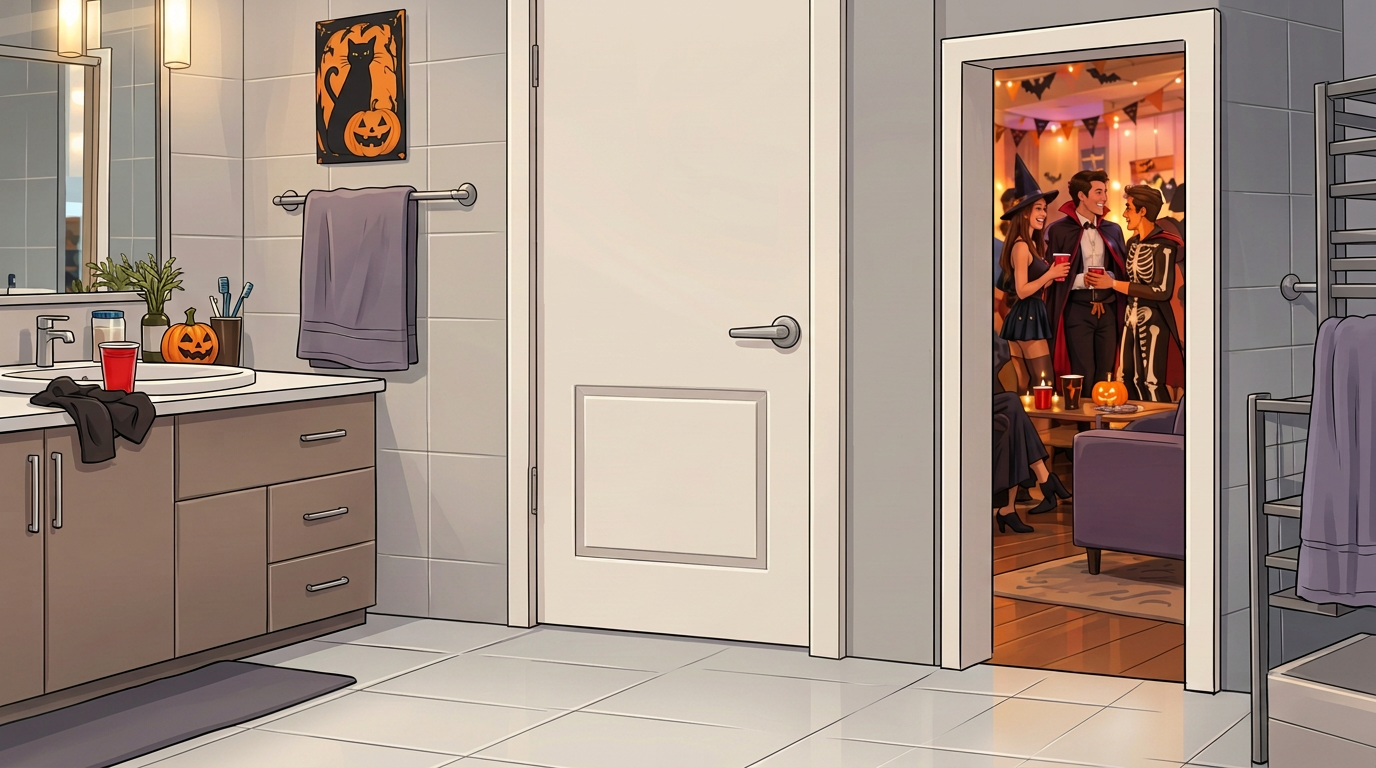
AI Design for remove the two people inside the washroom completely

remove the two people inside the washroom completely

by @Elephant_1649093

AI Design for fix the background, make the guy hold the knob of the door, ensure accuracy of the proportion of the background door area to look exactly like the reference

fix the background, make the guy hold the knob of the door, ensure accuracy of the proportion of the background door area to look exactly like the reference

by @Elephant_1649093

AI Design for fix the background door area to look exactly like the reference

fix the background door area to look exactly like the reference

by @Elephant_1649093

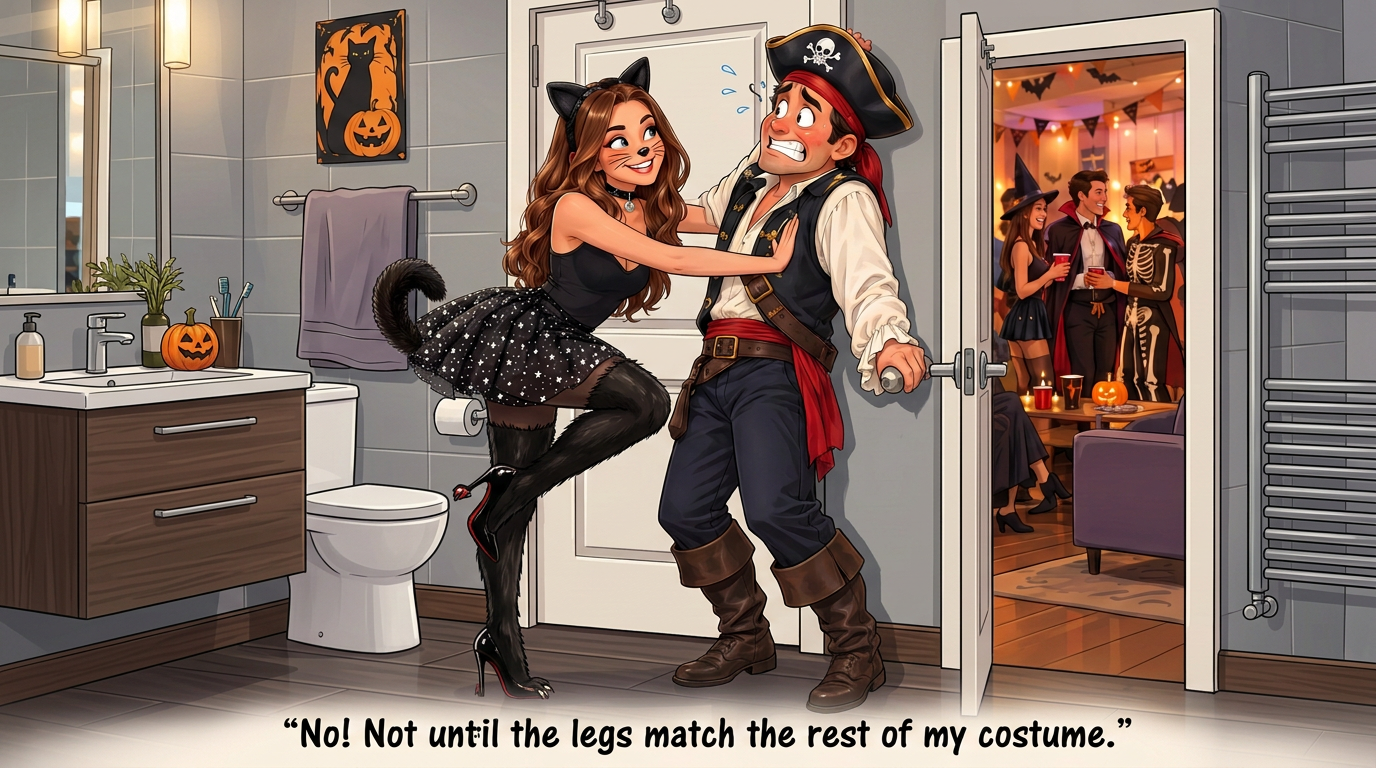
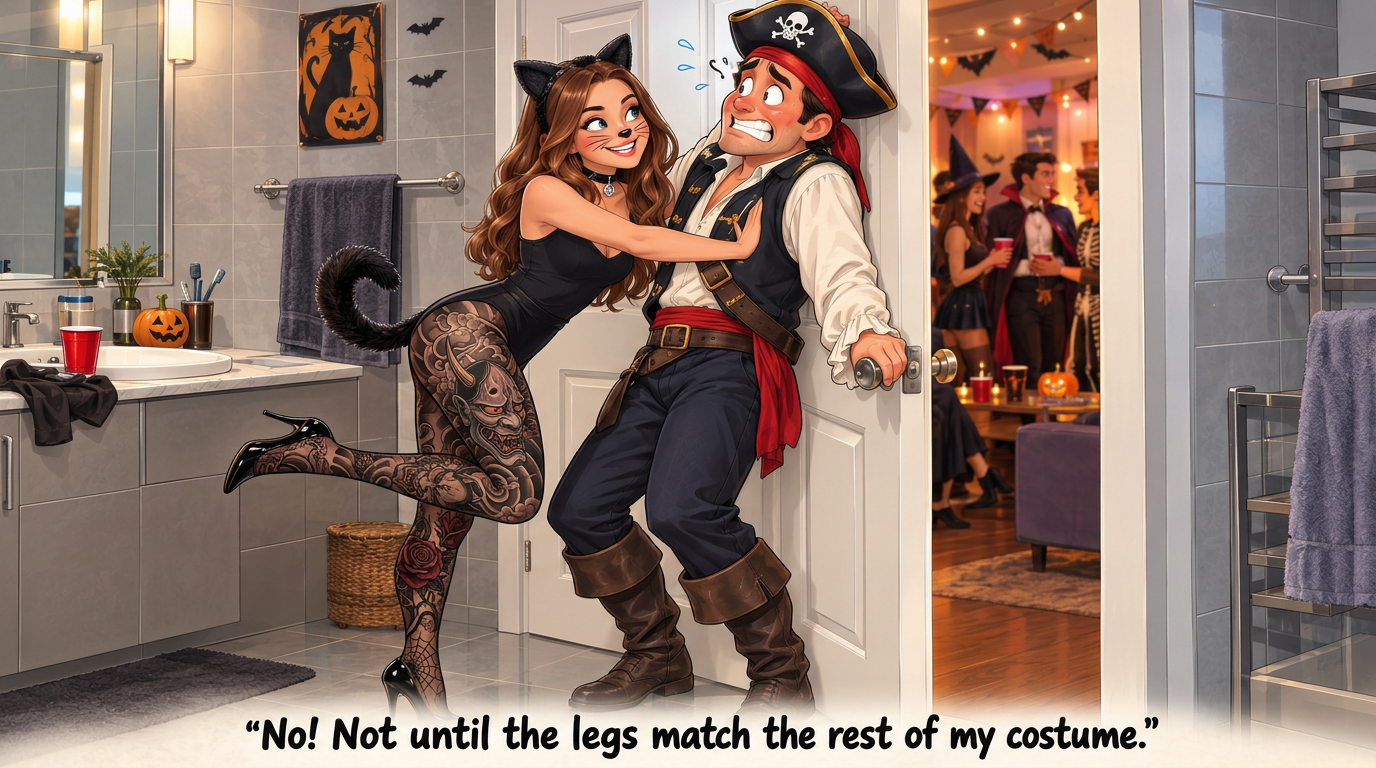
AI Design for make these changes to the first image, change the placement of the legs of the woman like in the second image, This is pretty damn good. I really like it. However, just three items that I see that need corrected. The door behind them looks fake. It almost looks like it's bent in the middle and looks too big. 3. Their surroundings look it bit too AI. Almost like a photo. ensure accuracy and coherence in art style make the surrounds look more cartoonish?

make these changes to the first image, change the placement of the legs of the woman like in the second image, This is pretty damn good. I really like it. However, just three items that I see that need corrected. The door behind them looks fake. It almost looks like it's bent in the middle and looks too big. 3. Their surroundings look it bit too AI. Almost like a photo. ensure accuracy and coherence in art style make the surrounds look more cartoonish?

by @Elephant_1649093
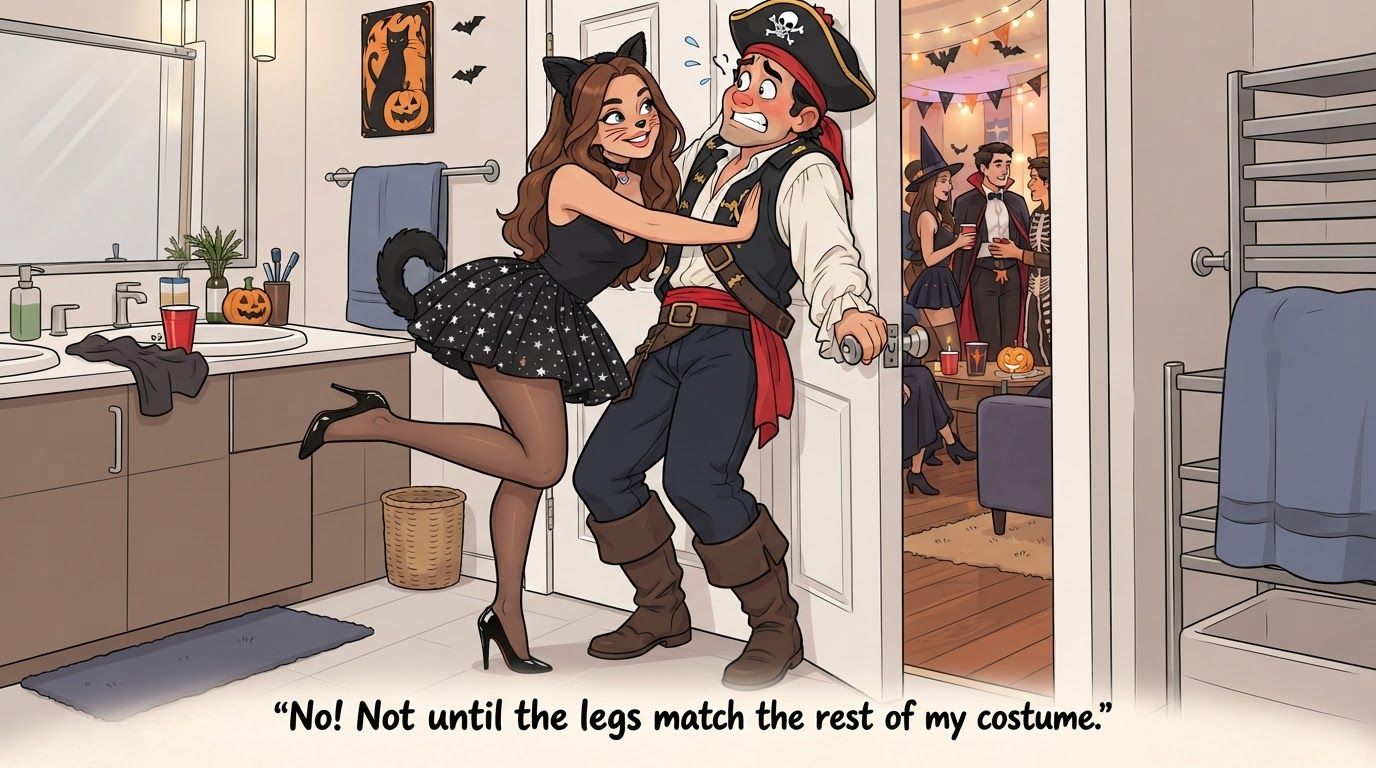
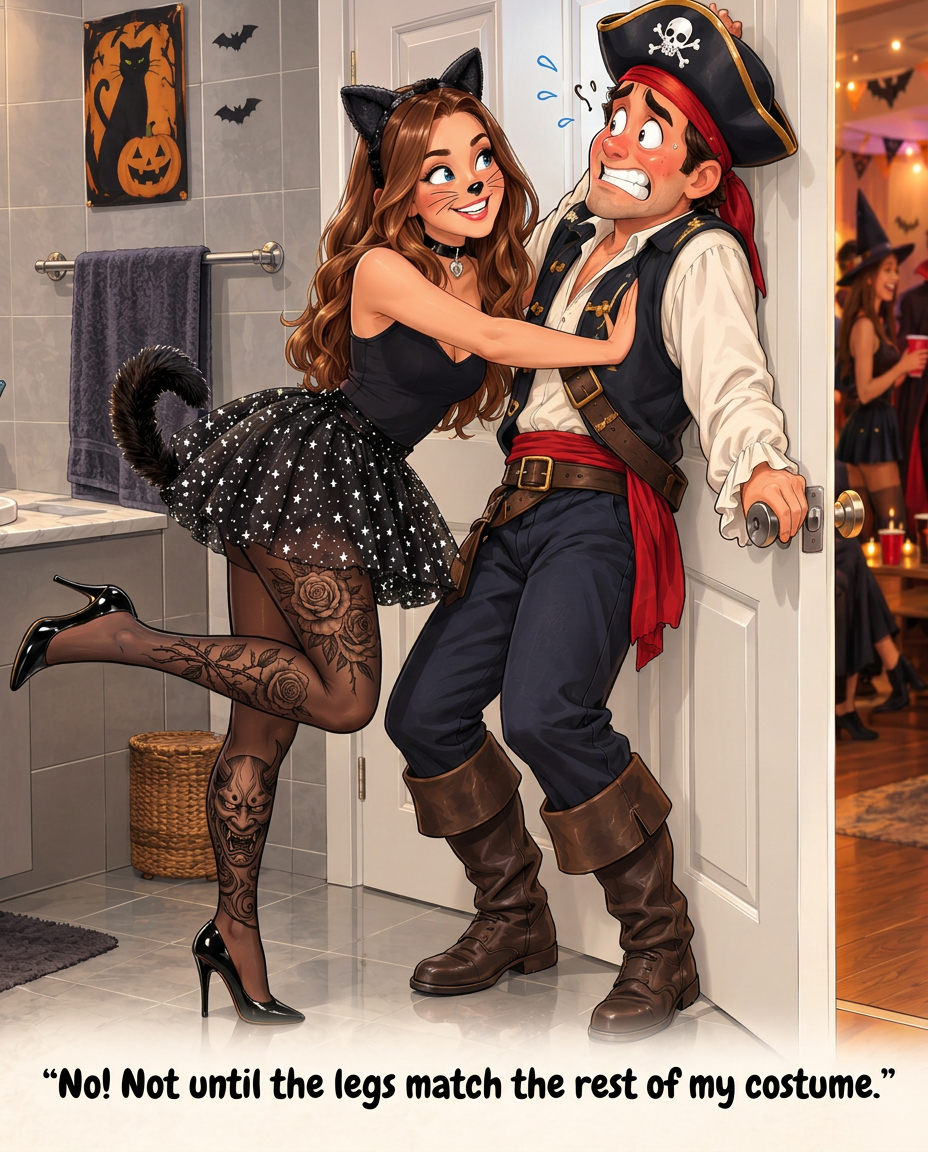
AI Design for make these changes to the first image, change the placement of the legs of the woman like in the second image, This is pretty damn good. I really like it. However, just three items that I see that need corrected. The door behind them looks fake. It almost looks like it's bent in the middle and looks too big. 3. Their surroundings look it bit too AI. Almost like a photo. ensure accuracy and coherence in art style make the surrounds look more cartoonish?

make these changes to the first image, change the placement of the legs of the woman like in the second image, This is pretty damn good. I really like it. However, just three items that I see that need corrected. The door behind them looks fake. It almost looks like it's bent in the middle and looks too big. 3. Their surroundings look it bit too AI. Almost like a photo. ensure accuracy and coherence in art style make the surrounds look more cartoonish?

by @Elephant_3756952
AI Design for follow the other reference images to ensure placement of the tattoos accurately on the illustration 
This first ones are the only close up pictures I have of the ones on my leg lol the demons on my left thigh and the roses are on my right side. The arm with the bad is on my left and the one with the snake is my right. ensure accuracy of the tattoos and high detail please

follow the other reference images to ensure placement of the tattoos accurately on the illustration This first ones are the only close up pictures I have of the ones on my leg lol the demons on my left thigh and the roses are on my right side. The arm with the bad is on my left and the one with the snake is my right. ensure accuracy of the tattoos and high detail please

by @Elephant_1649093
AI Design for follow the other reference images to ensure placement of the tattoos accurately on the illustration 
This first ones are the only close up pictures I have of the ones on my leg lol the demons on my left thigh and the roses are on my right side. The arm with the bad is on my left and the one with the snake is my right. ensure accuracy of the tattoos and high detail please

follow the other reference images to ensure placement of the tattoos accurately on the illustration This first ones are the only close up pictures I have of the ones on my leg lol the demons on my left thigh and the roses are on my right side. The arm with the bad is on my left and the one with the snake is my right. ensure accuracy of the tattoos and high detail please

by @Elephant_1649093
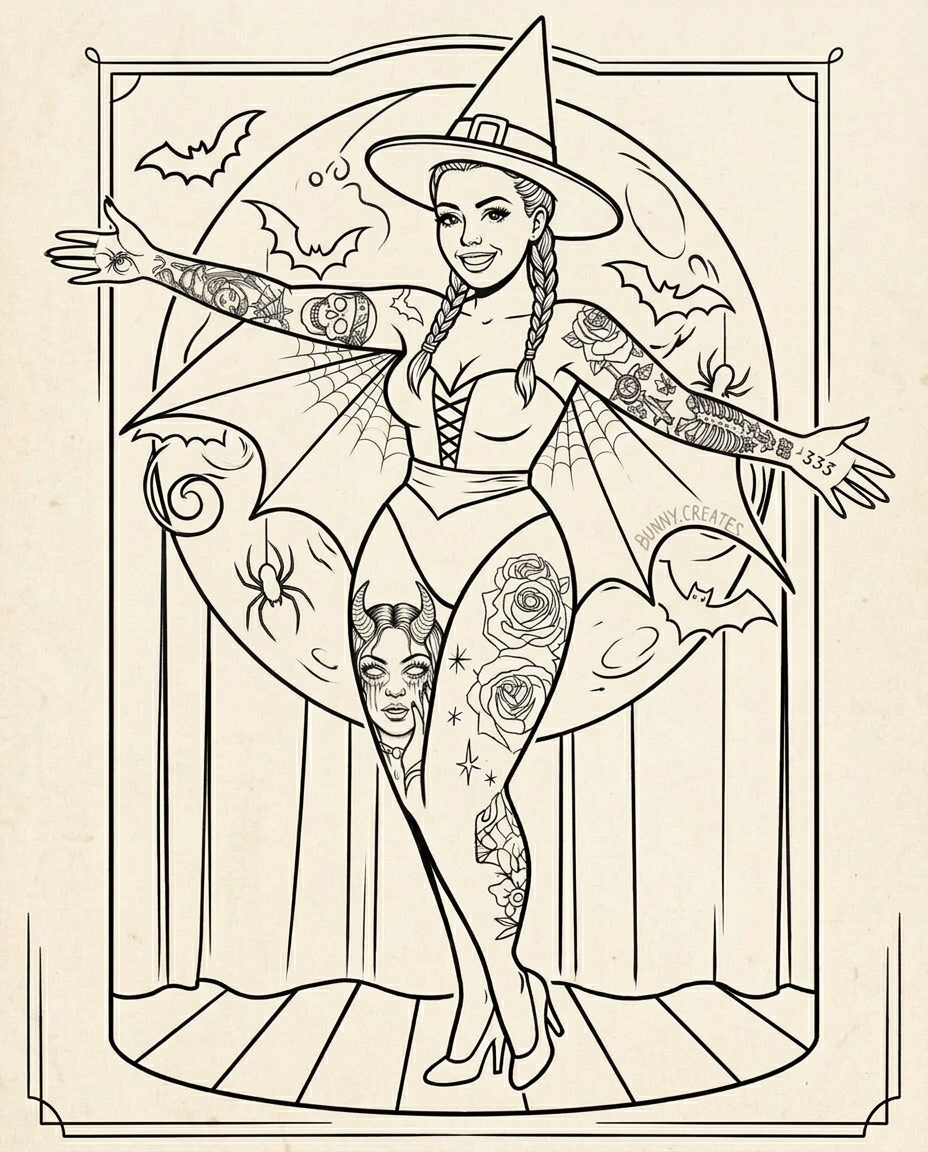
AI Design for create a highly detailed clean lineart illustration of this image

no shading only lineart

create a highly detailed clean lineart illustration of this image no shading only lineart

by @Elephant_1649093

AI Design for follow the second reference images to ensure placement of the tattoos accurately on the illustration 
This first ones are the only close up pictures I have of the ones on my leg lol the demons on my left thigh and the roses are on my right side. The arm with the bad is on my left and the one with the snake is my right. ensure accuracy of the tattoos and high detail please

follow the second reference images to ensure placement of the tattoos accurately on the illustration This first ones are the only close up pictures I have of the ones on my leg lol the demons on my left thigh and the roses are on my right side. The arm with the bad is on my left and the one with the snake is my right. ensure accuracy of the tattoos and high detail please

by @Elephant_1649093
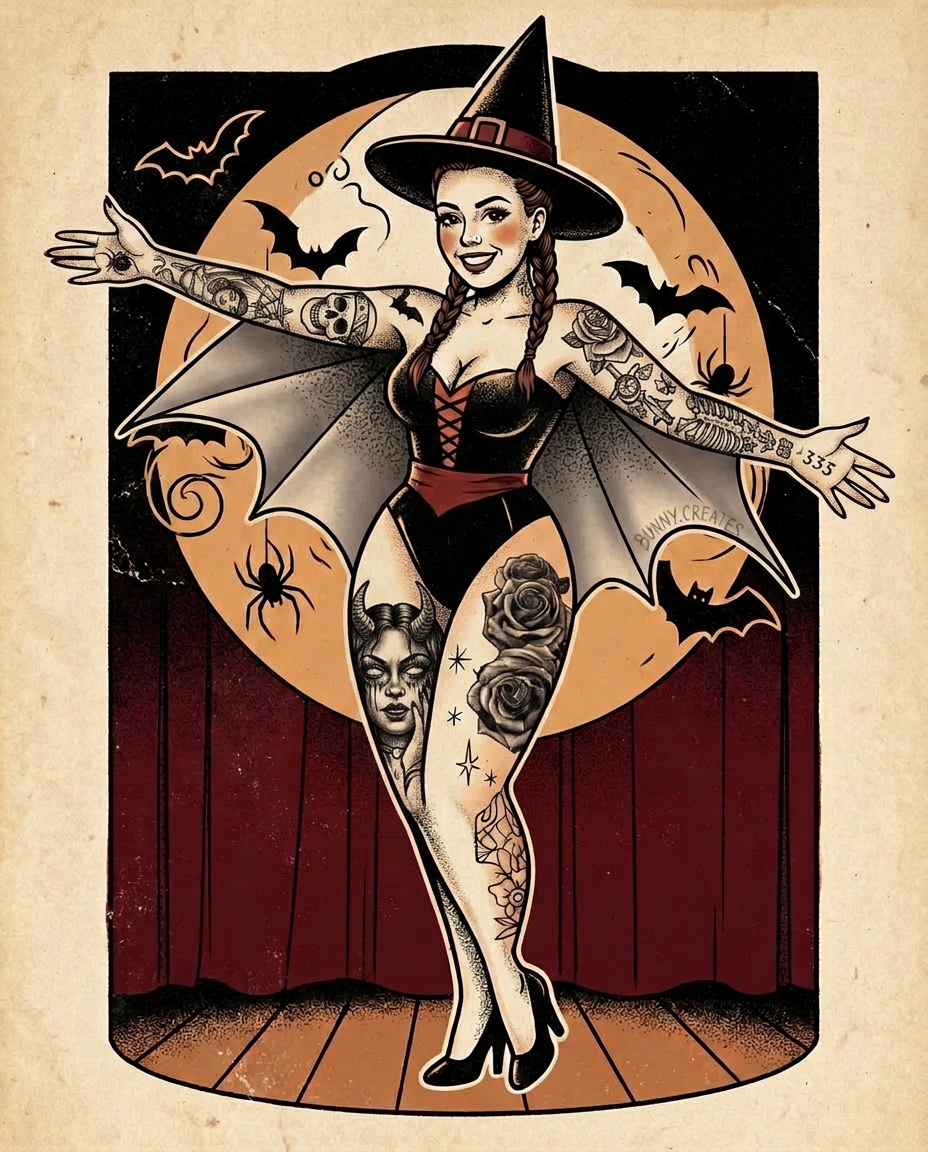
AI Design for redraw the woman in the first image so that she is wearing the same outfit as in the second reference picture

follow the other reference images to ensure placement of the tattoos accurately on the illustration 
This first ones are the only close up pictures I have of the ones on my leg lol the demons on my left thigh and the roses are on my right side. The arm with the bad is on my left and the one with the snake is my right

redraw the woman in the first image so that she is wearing the same outfit as in the second reference picture follow the other reference images to ensure placement of the tattoos accurately on the illustration This first ones are the only close up pictures I have of the ones on my leg lol the demons on my left thigh and the roses are on my right side. The arm with the bad is on my left and the one with the snake is my right

by @Elephant_3756952
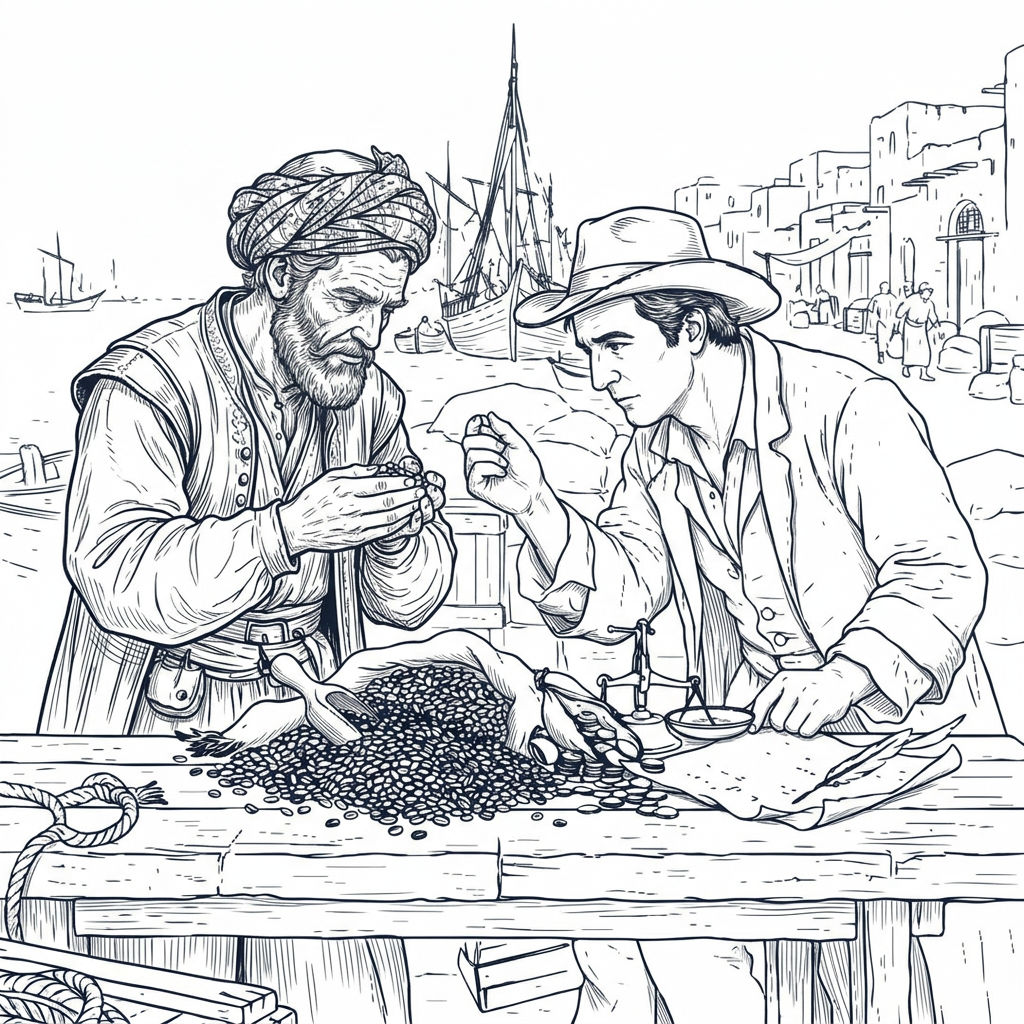
AI Design for redraw the image make the merchant on the left look less modern and more from the  XVII century.
like the one in the second reference image.

redraw the image make the merchant on the left look less modern and more from the XVII century. like the one in the second reference image.

by @Elephant_1649093

AI Design for I WANT THIS DESGIN IN VECTOR STYLE

I WANT THIS DESGIN IN VECTOR STYLE

by @Elephant_6719252

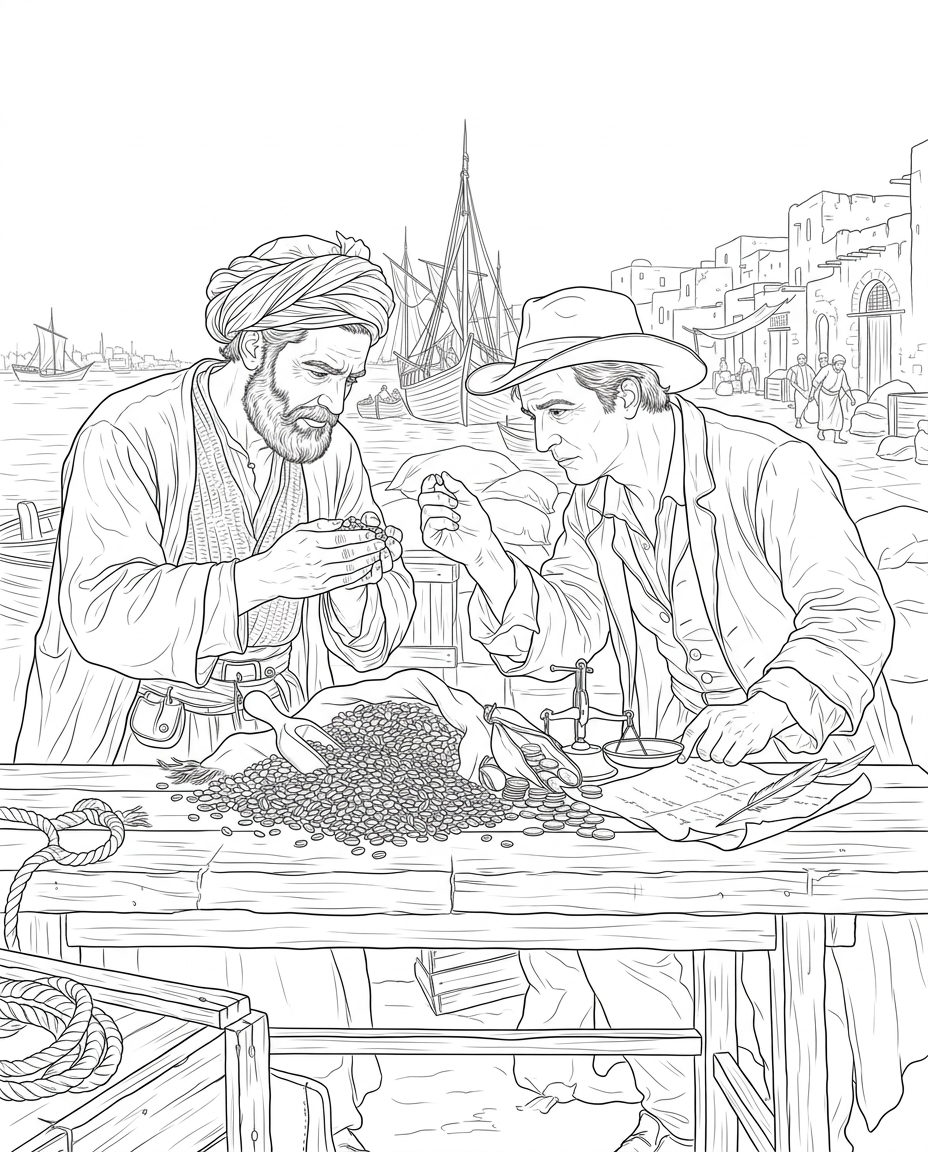
AI Design for create a highly detailed clean lineart illustration of this image

no shading only lineart

create a highly detailed clean lineart illustration of this image no shading only lineart

by @Elephant_1649093

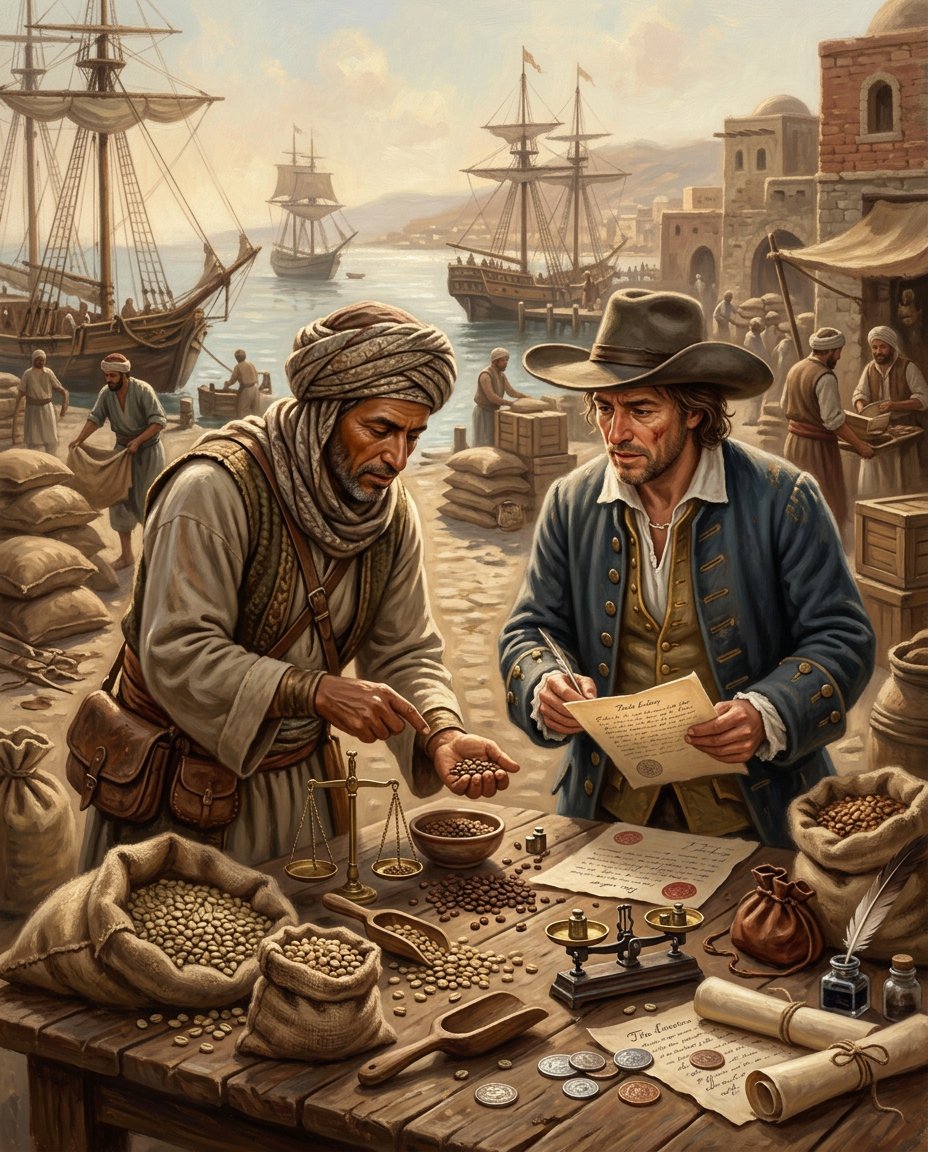
AI Design for Create a highly detailed, historically evocative digital oil painting depicting the 17th-century coffee trade, designed as premium artwork for a sophisticated historical strategy board game. Use the attached reference image only as a visual and compositional inspiration, while creating a distinctly original scene.

The composition should be a vertical portrait-oriented historical illustration, centered on two 17th-century coffee merchants engaged in the trading and inspection of coffee. Place them at a weathered wooden trading table in a bustling 17th-century port associated with the coffee trade, inspired by Mocha, Yemen, during the height of maritime coffee commerce.

The two merchants should appear deeply engaged in examining, weighing, sorting, and negotiating over a valuable shipment of coffee. One merchant can be a Middle Eastern or Yemeni trader wearing historically appropriate layered robes, a wrapped turban, textured vest, and weathered leather accessories. The second can be a European maritime merchant or trader wearing historically appropriate 17th-century clothing such as a loose linen shirt, dark waistcoat, long coat, breeches, and a period-appropriate broad-brimmed hat. Their clothing should feel practical, worn, dusty, and authentic rather than theatrical or costume-like.

On the wooden table, show rich quantities of coffee beans, partially opened burlap or woven sacks, small brass weighing scales, wooden scoops, parchment trade records, leather pouches, scattered coins, and simple merchant tools. The coffee beans should be rendered with exceptional tactile detail, with variations in color, shape, texture, and natural imperfections. Include subtle evidence of the trading process, such as a merchant inspecting beans closely while another weighs a portion.

In the background, establish a historically convincing 17th-century maritime coffee port. Show wooden sailing ships with tall masts and canvas sails anchored beyond the harbor, cargo being transported, stacked burlap sacks and wooden crates, dock workers and distant merchants, wooden warehouses, simple Middle Eastern architectural forms, and a hazy coastal atmosphere. Keep the background slightly softer and less detailed than the foreground so the merchants remain the visual focus.

The scene should communicate commerce, exploration, maritime trade, cultural exchange, and the growing value of coffee as a global commodity. Introduce subtle narrative details that make the image feel like a moment captured from a larger historical story: merchants negotiating prices, coins changing hands, cargo awaiting shipment, and ships preparing to carry coffee across the sea.

Visual Style

Render the entire image as a museum-quality digital oil painting with the richness and tactile character of traditional historical oil painting. Use visible but refined painterly brushwork, layered translucent glazing, subtle impasto, natural pigment variation, softly blended atmospheric perspective, and carefully controlled edges.

Use a sophisticated historical palette of warm ochre, burnt umber, raw sienna, muted terracotta, deep brown, weathered cream, dusty blue, muted green, and subdued crimson, with restrained highlights of aged brass and warm gold. Avoid overly saturated modern colors.

Lighting should be warm late-afternoon sunlight filtered through coastal haze, creating soft highlights across faces, hands, coffee beans, fabrics, wooden surfaces, and brass objects. Use dramatic but natural chiaroscuro, with luminous faces and foreground objects emerging from a slightly darker environment.

Faces should be expressive and believable, showing concentration, calculation, curiosity, and fatigue. Hands should be anatomically accurate and carefully rendered, particularly where the merchants handle coffee beans, coins, scales, and documents.

The painting should have the atmosphere of a premium historical board-game illustration, combining archaeological authenticity with cinematic storytelling. The viewer should immediately understand that coffee is a valuable commodity being traded between cultures and transported through an international maritime network.

Composition
Vertical portrait composition, approximately 2:3 aspect ratio
Two primary merchants occupying the central and lower-middle portion
Trading table and coffee shipment forming a strong foreground anchor
Coffee beans and trading objects highly detailed
Sailing ships and harbor visible through the atmospheric background
Strong foreground-to-background depth
Natural diagonal composition created by arms, sacks, table, and ship masts
Faces positioned prominently enough to establish character and narrative
Background populated but visually subordinate
Generous atmospheric space toward the upper portion of the image
No modern objects or contemporary visual elements
No typography, labels, logos, borders, UI elements, or board-game text
Historical Authenticity

Maintain 17th-century material culture and clothing, with historically plausible textiles, architecture, ships, tools, containers, coins, trade documents, and merchant equipment. Avoid anachronistic clothing, modern coffee cups, modern sacks, modern machinery, contemporary buildings, or fantasy pirate stereotypes.

The overall image should feel like a lost historical painting depicting the early international coffee trade, but rendered with the clarity, richness, and cinematic detail expected from contemporary premium digital concept art.

Quality keywords:
ultra-detailed digital oil painting, historical realism, 17th-century maritime trade, coffee trade, Mocha port, Yemen, Ottoman-era atmosphere, European merchant, Middle Eastern merchant, period-authentic clothing, cinematic composition, museum-quality painting, tactile brushwork, realistic faces, expressive hands, detailed coffee beans, aged wood, burlap texture, brass weighing scale, sailing ships, atmospheric perspective, warm chiaroscuro, natural pigments, sophisticated color harmony, painterly realism, narrative historical illustration, premium board-game artwork, highly refined detail, cinematic depth, 8k quality.

Negative Prompt

Modern clothing, modern coffee cups, espresso machines, modern packaging, plastic, modern buildings, modern ships, steam engines, fantasy pirates, pirate clichés, treasure chests, exaggerated costumes, fantasy weapons, anachronistic architecture, cartoon style, anime, photorealistic photography, 3D render, glossy CGI, overly saturated colors, excessive sharpness, artificial faces, distorted anatomy, malformed hands, extra fingers, duplicated objects, repetitive faces, text, lettering, watermark, logo, border, frame, contemporary typography.

Create a highly detailed, historically evocative digital oil painting depicting the 17th-century coffee trade, designed as premium artwork for a sophisticated historical strategy board game. Use the attached reference image only as a visual and compositional inspiration, while creating a distinctly original scene. The composition should be a vertical portrait-oriented historical illustration, centered on two 17th-century coffee merchants engaged in the trading and inspection of coffee. Place them at a weathered wooden trading table in a bustling 17th-century port associated with the coffee trade, inspired by Mocha, Yemen, during the height of maritime coffee commerce. The two merchants should appear deeply engaged in examining, weighing, sorting, and negotiating over a valuable shipment of coffee. One merchant can be a Middle Eastern or Yemeni trader wearing historically appropriate layered robes, a wrapped turban, textured vest, and weathered leather accessories. The second can be a European maritime merchant or trader wearing historically appropriate 17th-century clothing such as a loose linen shirt, dark waistcoat, long coat, breeches, and a period-appropriate broad-brimmed hat. Their clothing should feel practical, worn, dusty, and authentic rather than theatrical or costume-like. On the wooden table, show rich quantities of coffee beans, partially opened burlap or woven sacks, small brass weighing scales, wooden scoops, parchment trade records, leather pouches, scattered coins, and simple merchant tools. The coffee beans should be rendered with exceptional tactile detail, with variations in color, shape, texture, and natural imperfections. Include subtle evidence of the trading process, such as a merchant inspecting beans closely while another weighs a portion. In the background, establish a historically convincing 17th-century maritime coffee port. Show wooden sailing ships with tall masts and canvas sails anchored beyond the harbor, cargo being transported, stacked burlap sacks and wooden crates, dock workers and distant merchants, wooden warehouses, simple Middle Eastern architectural forms, and a hazy coastal atmosphere. Keep the background slightly softer and less detailed than the foreground so the merchants remain the visual focus. The scene should communicate commerce, exploration, maritime trade, cultural exchange, and the growing value of coffee as a global commodity. Introduce subtle narrative details that make the image feel like a moment captured from a larger historical story: merchants negotiating prices, coins changing hands, cargo awaiting shipment, and ships preparing to carry coffee across the sea. Visual Style Render the entire image as a museum-quality digital oil painting with the richness and tactile character of traditional historical oil painting. Use visible but refined painterly brushwork, layered translucent glazing, subtle impasto, natural pigment variation, softly blended atmospheric perspective, and carefully controlled edges. Use a sophisticated historical palette of warm ochre, burnt umber, raw sienna, muted terracotta, deep brown, weathered cream, dusty blue, muted green, and subdued crimson, with restrained highlights of aged brass and warm gold. Avoid overly saturated modern colors. Lighting should be warm late-afternoon sunlight filtered through coastal haze, creating soft highlights across faces, hands, coffee beans, fabrics, wooden surfaces, and brass objects. Use dramatic but natural chiaroscuro, with luminous faces and foreground objects emerging from a slightly darker environment. Faces should be expressive and believable, showing concentration, calculation, curiosity, and fatigue. Hands should be anatomically accurate and carefully rendered, particularly where the merchants handle coffee beans, coins, scales, and documents. The painting should have the atmosphere of a premium historical board-game illustration, combining archaeological authenticity with cinematic storytelling. The viewer should immediately understand that coffee is a valuable commodity being traded between cultures and transported through an international maritime network. Composition Vertical portrait composition, approximately 2:3 aspect ratio Two primary merchants occupying the central and lower-middle portion Trading table and coffee shipment forming a strong foreground anchor Coffee beans and trading objects highly detailed Sailing ships and harbor visible through the atmospheric background Strong foreground-to-background depth Natural diagonal composition created by arms, sacks, table, and ship masts Faces positioned prominently enough to establish character and narrative Background populated but visually subordinate Generous atmospheric space toward the upper portion of the image No modern objects or contemporary visual elements No typography, labels, logos, borders, UI elements, or board-game text Historical Authenticity Maintain 17th-century material culture and clothing, with historically plausible textiles, architecture, ships, tools, containers, coins, trade documents, and merchant equipment. Avoid anachronistic clothing, modern coffee cups, modern sacks, modern machinery, contemporary buildings, or fantasy pirate stereotypes. The overall image should feel like a lost historical painting depicting the early international coffee trade, but rendered with the clarity, richness, and cinematic detail expected from contemporary premium digital concept art. Quality keywords: ultra-detailed digital oil painting, historical realism, 17th-century maritime trade, coffee trade, Mocha port, Yemen, Ottoman-era atmosphere, European merchant, Middle Eastern merchant, period-authentic clothing, cinematic composition, museum-quality painting, tactile brushwork, realistic faces, expressive hands, detailed coffee beans, aged wood, burlap texture, brass weighing scale, sailing ships, atmospheric perspective, warm chiaroscuro, natural pigments, sophisticated color harmony, painterly realism, narrative historical illustration, premium board-game artwork, highly refined detail, cinematic depth, 8k quality. Negative Prompt Modern clothing, modern coffee cups, espresso machines, modern packaging, plastic, modern buildings, modern ships, steam engines, fantasy pirates, pirate clichés, treasure chests, exaggerated costumes, fantasy weapons, anachronistic architecture, cartoon style, anime, photorealistic photography, 3D render, glossy CGI, overly saturated colors, excessive sharpness, artificial faces, distorted anatomy, malformed hands, extra fingers, duplicated objects, repetitive faces, text, lettering, watermark, logo, border, frame, contemporary typography.

by @Elephant_1649093
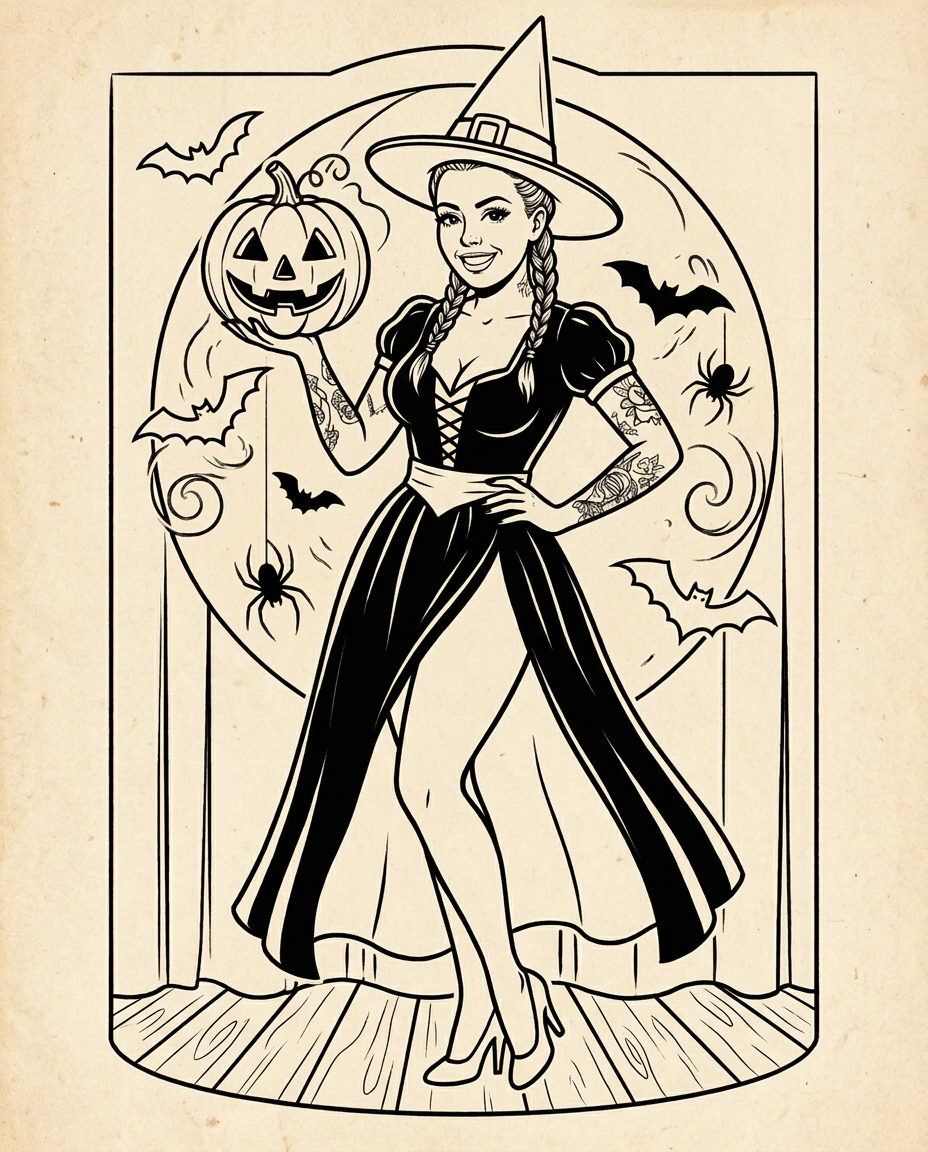
AI Design for create a highly detailed clean lineart illustration of this image

no shading only lineart

create a highly detailed clean lineart illustration of this image no shading only lineart

by @Elephant_1649093

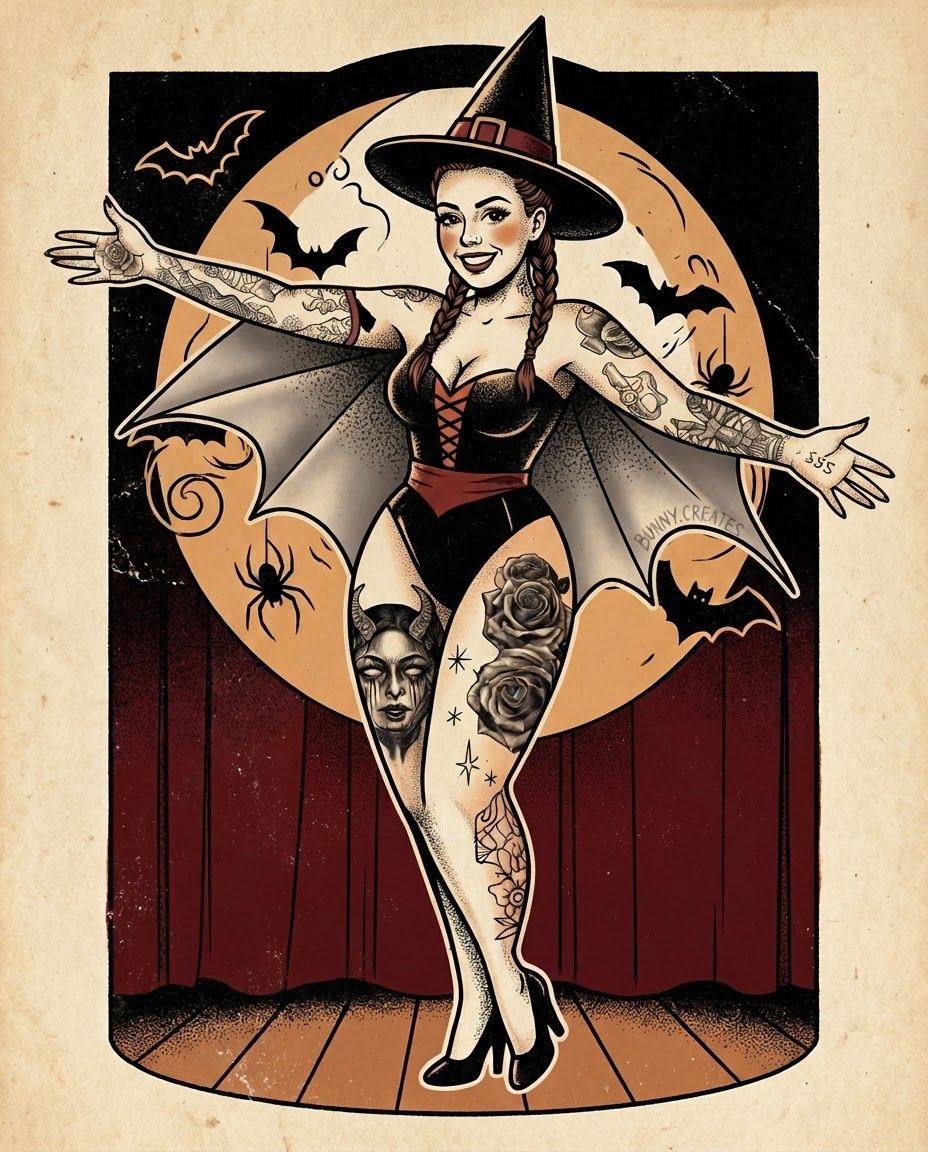
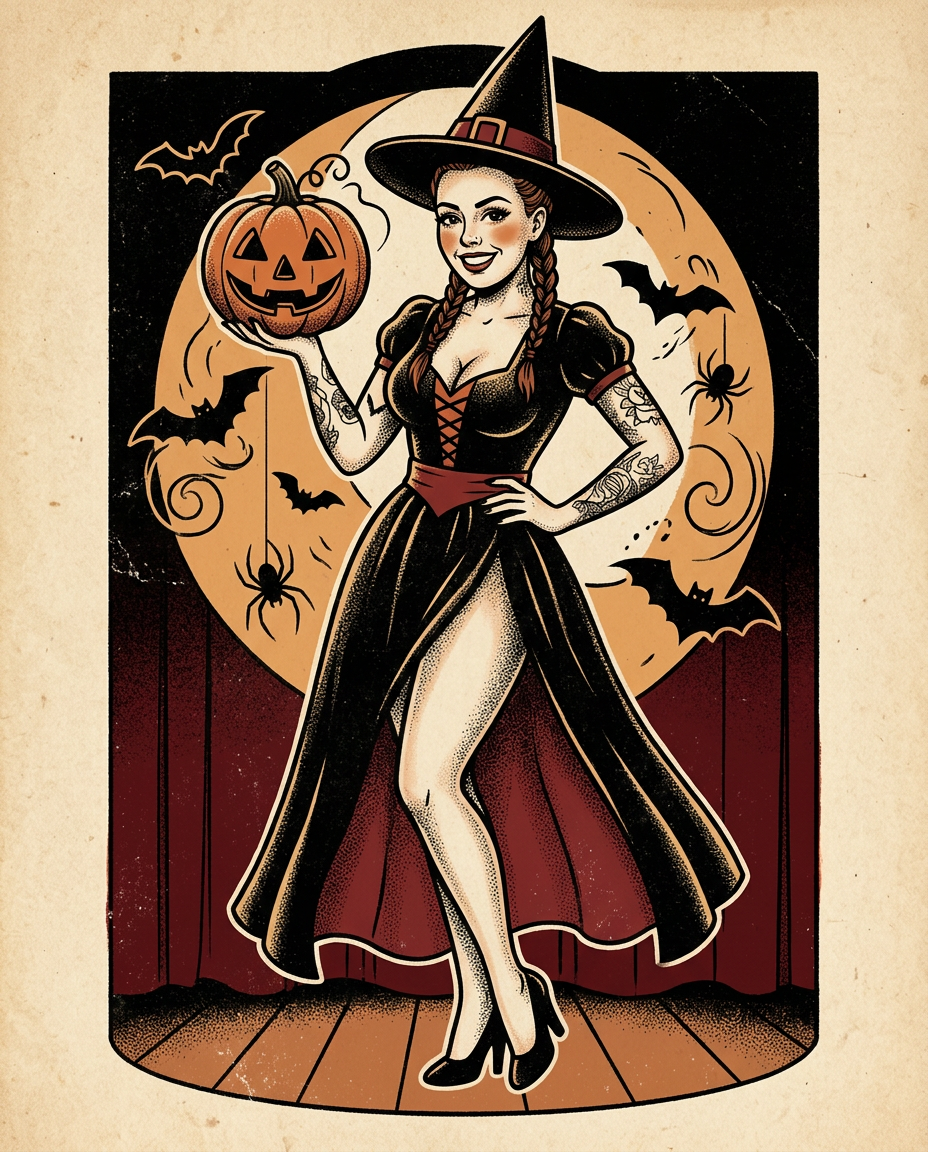
AI Design for Create a highly detailed full-body vintage Halloween glamour illustration based directly on the supplied photographs of the woman. Use the photographs as the primary reference for her identity and likeness, and the supplied vintage tattoo artwork as the primary stylistic reference.
FACE & IDENTITY — ABSOLUTE PRIORITY: Preserve her facial likeness with exceptional accuracy. Match her actual eye shape, eyebrow structure, nose, lips, jawline, cheekbones, smile, facial proportions, complexion, and distinctive features. Do not turn her into a generic illustrated model or alter her facial structure. Her face should remain immediately recognizable as the same person. Preserve her braided hairstyle and natural hair texture.
POSE: Place her in a classic mid-century Halloween pin-up-inspired standing pose, interpreted as playful vintage glamour rather than sexualized imagery. Full body visible from head to toe, with both feet completely inside the frame. Use an elegant contrapposto stance, one leg slightly angled forward, one arm resting naturally at her side and the other raised or lightly interacting with a Halloween prop. Give her a confident, mischievous expression and charming vintage theatrical attitude.
HALLOWEEN THEME: Surround her with classic Halloween imagery—large crescent moon, stylized bats, curling spiderwebs, carved jack-o'-lanterns, small stars, wisps of smoke, black cats, autumn leaves, and subtle vintage ornamental shapes. Keep the decorations balanced and secondary to the figure.
COSTUME: Dress her in a retro Halloween goth bodysuit costume inspired by classic 1950s Halloween illustration, such as a sophisticated witch-inspired outfit with a fitted  vintage dress, gloves, ankle boots, and a small pointed witch hat. Keep the costume playful, and theatrical .
TATTOOS: Accurately preserve the visible tattoos from the supplied photographs, maintaining their placement, scale, orientation, and recognizable characteristics. Do not invent large unrelated tattoos.
ART STYLE: Classic vintage tattoo flash / Americana poster illustration. Strong black contour lines, elegant line-weight variation, graphic shapes, selective solid-black areas, stippling, subtle crosshatching, restrained halftone shading, slightly imperfect hand-printed texture, and aged paper grain. The supplied artwork should guide the linework, composition, shading, and graphic language, without copying its exact character or composition.
COLOUR PALETTE: Warm ivory paper, black, muted pumpkin orange, burnt orange, deep charcoal, soft cream, and restrained warm skin tones. Slightly aged screen-print appearance with crisp professional linework.
FULL-BODY COMPOSITION: Center the woman prominently with her entire body visible, including head, hands, legs, and both shoes. Maintain anatomically correct proportions, natural hands and fingers, believable posture, and a clean readable silhouette.
FINAL IMAGE: polished professional vintage Halloween illustration, charming retro Americana atmosphere, confident classic glamour pose, highly accurate facial likeness, accurate hairstyle and tattoos, sophisticated hand-drawn tattoo aesthetic, crisp linework, subtle print texture, full-body artwork, clean uncluttered composition.
NO TEXT: absolutely no lettering, typography, captions, logos, signatures, watermark, labels, UI elements, or written Halloween phrases anywhere in the artwork.
NEGATIVE PROMPT: altered face, generic face, different person, inaccurate facial proportions, exaggerated features, missing tattoos, invented tattoos, distorted hands, extra fingers, extra limbs, cropped feet, cropped body, malformed anatomy, overly exaggerated proportions, revealing costume, explicit pose, photorealistic rendering, 3D CGI, glossy digital painting, text, lettering, logo, watermark, signature.

Create a highly detailed full-body vintage Halloween glamour illustration based directly on the supplied photographs of the woman. Use the photographs as the primary reference for her identity and likeness, and the supplied vintage tattoo artwork as the primary stylistic reference. FACE & IDENTITY — ABSOLUTE PRIORITY: Preserve her facial likeness with exceptional accuracy. Match her actual eye shape, eyebrow structure, nose, lips, jawline, cheekbones, smile, facial proportions, complexion, and distinctive features. Do not turn her into a generic illustrated model or alter her facial structure. Her face should remain immediately recognizable as the same person. Preserve her braided hairstyle and natural hair texture. POSE: Place her in a classic mid-century Halloween pin-up-inspired standing pose, interpreted as playful vintage glamour rather than sexualized imagery. Full body visible from head to toe, with both feet completely inside the frame. Use an elegant contrapposto stance, one leg slightly angled forward, one arm resting naturally at her side and the other raised or lightly interacting with a Halloween prop. Give her a confident, mischievous expression and charming vintage theatrical attitude. HALLOWEEN THEME: Surround her with classic Halloween imagery—large crescent moon, stylized bats, curling spiderwebs, carved jack-o'-lanterns, small stars, wisps of smoke, black cats, autumn leaves, and subtle vintage ornamental shapes. Keep the decorations balanced and secondary to the figure. COSTUME: Dress her in a retro Halloween goth bodysuit costume inspired by classic 1950s Halloween illustration, such as a sophisticated witch-inspired outfit with a fitted vintage dress, gloves, ankle boots, and a small pointed witch hat. Keep the costume playful, and theatrical . TATTOOS: Accurately preserve the visible tattoos from the supplied photographs, maintaining their placement, scale, orientation, and recognizable characteristics. Do not invent large unrelated tattoos. ART STYLE: Classic vintage tattoo flash / Americana poster illustration. Strong black contour lines, elegant line-weight variation, graphic shapes, selective solid-black areas, stippling, subtle crosshatching, restrained halftone shading, slightly imperfect hand-printed texture, and aged paper grain. The supplied artwork should guide the linework, composition, shading, and graphic language, without copying its exact character or composition. COLOUR PALETTE: Warm ivory paper, black, muted pumpkin orange, burnt orange, deep charcoal, soft cream, and restrained warm skin tones. Slightly aged screen-print appearance with crisp professional linework. FULL-BODY COMPOSITION: Center the woman prominently with her entire body visible, including head, hands, legs, and both shoes. Maintain anatomically correct proportions, natural hands and fingers, believable posture, and a clean readable silhouette. FINAL IMAGE: polished professional vintage Halloween illustration, charming retro Americana atmosphere, confident classic glamour pose, highly accurate facial likeness, accurate hairstyle and tattoos, sophisticated hand-drawn tattoo aesthetic, crisp linework, subtle print texture, full-body artwork, clean uncluttered composition. NO TEXT: absolutely no lettering, typography, captions, logos, signatures, watermark, labels, UI elements, or written Halloween phrases anywhere in the artwork. NEGATIVE PROMPT: altered face, generic face, different person, inaccurate facial proportions, exaggerated features, missing tattoos, invented tattoos, distorted hands, extra fingers, extra limbs, cropped feet, cropped body, malformed anatomy, overly exaggerated proportions, revealing costume, explicit pose, photorealistic rendering, 3D CGI, glossy digital painting, text, lettering, logo, watermark, signature.

by @Elephant_1649093
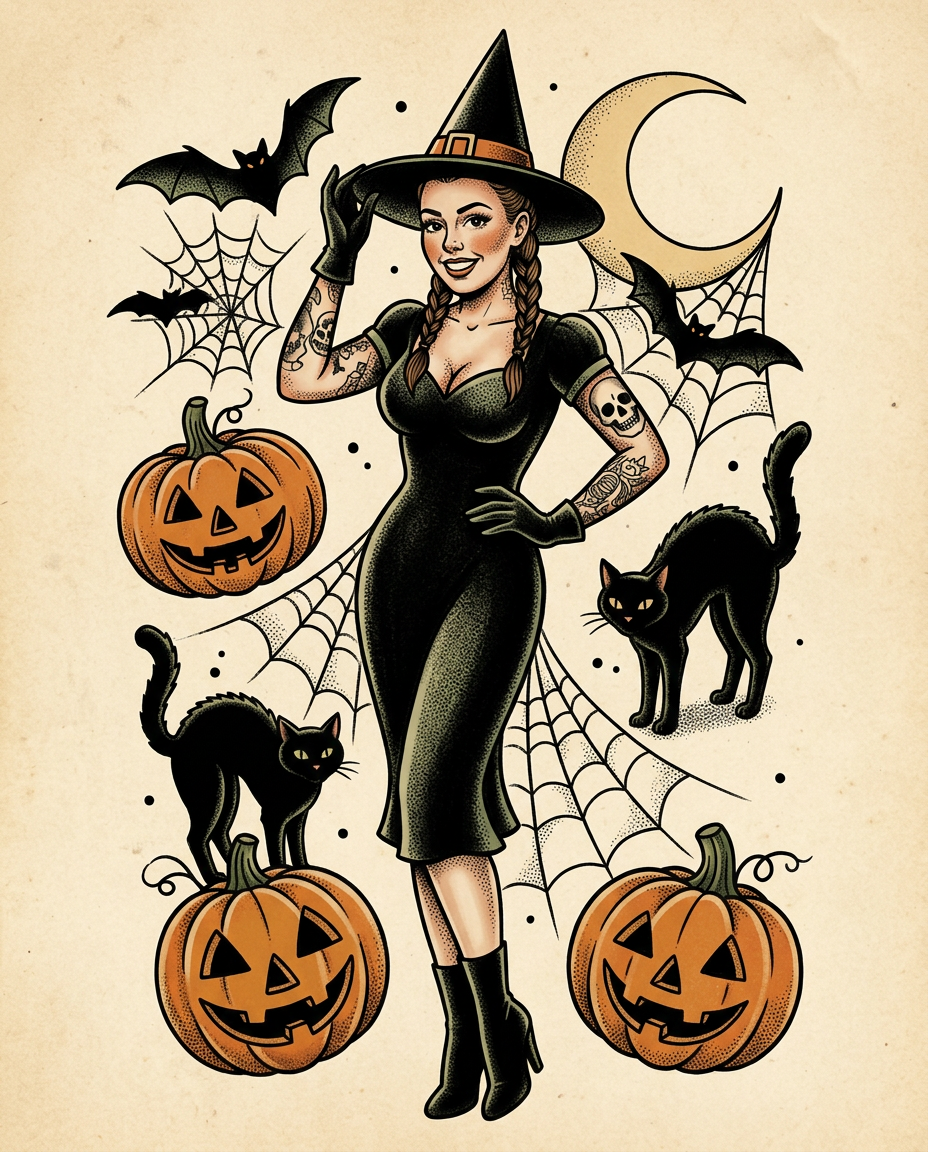
AI Design for Create a highly detailed full-body vintage Halloween glamour illustration based directly on the supplied photographs of the woman. Use the photographs as the primary reference for her identity and likeness, and the supplied vintage tattoo artwork as the primary stylistic reference.
FACE & IDENTITY — ABSOLUTE PRIORITY: Preserve her facial likeness with exceptional accuracy. Match her actual eye shape, eyebrow structure, nose, lips, jawline, cheekbones, smile, facial proportions, complexion, and distinctive features. Do not turn her into a generic illustrated model or alter her facial structure. Her face should remain immediately recognizable as the same person. Preserve her braided hairstyle and natural hair texture.
POSE: Place her in a classic mid-century Halloween pin-up-inspired standing pose, interpreted as playful vintage glamour rather than sexualized imagery. Full body visible from head to toe, with both feet completely inside the frame. Use an elegant contrapposto stance, one leg slightly angled forward, one arm resting naturally at her side and the other raised or lightly interacting with a Halloween prop. Give her a confident, mischievous expression and charming vintage theatrical attitude.
HALLOWEEN THEME: Surround her with classic Halloween imagery—large crescent moon, stylized bats, curling spiderwebs, carved jack-o'-lanterns, small stars, wisps of smoke, black cats, autumn leaves, and subtle vintage ornamental shapes. Keep the decorations balanced and secondary to the figure.
COSTUME: Dress her in a tasteful retro Halloween costume inspired by classic 1950s Halloween illustration, such as a sophisticated witch-inspired outfit with a fitted but non-revealing vintage dress, gloves, ankle boots, and a small pointed witch hat. Keep the costume playful, elegant, and theatrical rather than revealing.
TATTOOS: Accurately preserve the visible tattoos from the supplied photographs, maintaining their placement, scale, orientation, and recognizable characteristics. Do not invent large unrelated tattoos.
ART STYLE: Classic vintage tattoo flash / Americana poster illustration. Strong black contour lines, elegant line-weight variation, graphic shapes, selective solid-black areas, stippling, subtle crosshatching, restrained halftone shading, slightly imperfect hand-printed texture, and aged paper grain. The supplied artwork should guide the linework, composition, shading, and graphic language, without copying its exact character or composition.
COLOUR PALETTE: Warm ivory paper, black, muted pumpkin orange, burnt orange, deep charcoal, soft cream, and restrained warm skin tones. Slightly aged screen-print appearance with crisp professional linework.
FULL-BODY COMPOSITION: Center the woman prominently with her entire body visible, including head, hands, legs, and both shoes. Maintain anatomically correct proportions, natural hands and fingers, believable posture, and a clean readable silhouette.
FINAL IMAGE: polished professional vintage Halloween illustration, charming retro Americana atmosphere, confident classic glamour pose, highly accurate facial likeness, accurate hairstyle and tattoos, sophisticated hand-drawn tattoo aesthetic, crisp linework, subtle print texture, full-body artwork, clean uncluttered composition.
NO TEXT: absolutely no lettering, typography, captions, logos, signatures, watermark, labels, UI elements, or written Halloween phrases anywhere in the artwork.
NEGATIVE PROMPT: altered face, generic face, different person, inaccurate facial proportions, exaggerated features, missing tattoos, invented tattoos, distorted hands, extra fingers, extra limbs, cropped feet, cropped body, malformed anatomy, overly exaggerated proportions, revealing costume, explicit pose, photorealistic rendering, 3D CGI, glossy digital painting, text, lettering, logo, watermark, signature.

Create a highly detailed full-body vintage Halloween glamour illustration based directly on the supplied photographs of the woman. Use the photographs as the primary reference for her identity and likeness, and the supplied vintage tattoo artwork as the primary stylistic reference. FACE & IDENTITY — ABSOLUTE PRIORITY: Preserve her facial likeness with exceptional accuracy. Match her actual eye shape, eyebrow structure, nose, lips, jawline, cheekbones, smile, facial proportions, complexion, and distinctive features. Do not turn her into a generic illustrated model or alter her facial structure. Her face should remain immediately recognizable as the same person. Preserve her braided hairstyle and natural hair texture. POSE: Place her in a classic mid-century Halloween pin-up-inspired standing pose, interpreted as playful vintage glamour rather than sexualized imagery. Full body visible from head to toe, with both feet completely inside the frame. Use an elegant contrapposto stance, one leg slightly angled forward, one arm resting naturally at her side and the other raised or lightly interacting with a Halloween prop. Give her a confident, mischievous expression and charming vintage theatrical attitude. HALLOWEEN THEME: Surround her with classic Halloween imagery—large crescent moon, stylized bats, curling spiderwebs, carved jack-o'-lanterns, small stars, wisps of smoke, black cats, autumn leaves, and subtle vintage ornamental shapes. Keep the decorations balanced and secondary to the figure. COSTUME: Dress her in a tasteful retro Halloween costume inspired by classic 1950s Halloween illustration, such as a sophisticated witch-inspired outfit with a fitted but non-revealing vintage dress, gloves, ankle boots, and a small pointed witch hat. Keep the costume playful, elegant, and theatrical rather than revealing. TATTOOS: Accurately preserve the visible tattoos from the supplied photographs, maintaining their placement, scale, orientation, and recognizable characteristics. Do not invent large unrelated tattoos. ART STYLE: Classic vintage tattoo flash / Americana poster illustration. Strong black contour lines, elegant line-weight variation, graphic shapes, selective solid-black areas, stippling, subtle crosshatching, restrained halftone shading, slightly imperfect hand-printed texture, and aged paper grain. The supplied artwork should guide the linework, composition, shading, and graphic language, without copying its exact character or composition. COLOUR PALETTE: Warm ivory paper, black, muted pumpkin orange, burnt orange, deep charcoal, soft cream, and restrained warm skin tones. Slightly aged screen-print appearance with crisp professional linework. FULL-BODY COMPOSITION: Center the woman prominently with her entire body visible, including head, hands, legs, and both shoes. Maintain anatomically correct proportions, natural hands and fingers, believable posture, and a clean readable silhouette. FINAL IMAGE: polished professional vintage Halloween illustration, charming retro Americana atmosphere, confident classic glamour pose, highly accurate facial likeness, accurate hairstyle and tattoos, sophisticated hand-drawn tattoo aesthetic, crisp linework, subtle print texture, full-body artwork, clean uncluttered composition. NO TEXT: absolutely no lettering, typography, captions, logos, signatures, watermark, labels, UI elements, or written Halloween phrases anywhere in the artwork. NEGATIVE PROMPT: altered face, generic face, different person, inaccurate facial proportions, exaggerated features, missing tattoos, invented tattoos, distorted hands, extra fingers, extra limbs, cropped feet, cropped body, malformed anatomy, overly exaggerated proportions, revealing costume, explicit pose, photorealistic rendering, 3D CGI, glossy digital painting, text, lettering, logo, watermark, signature.

by @Elephant_1649093
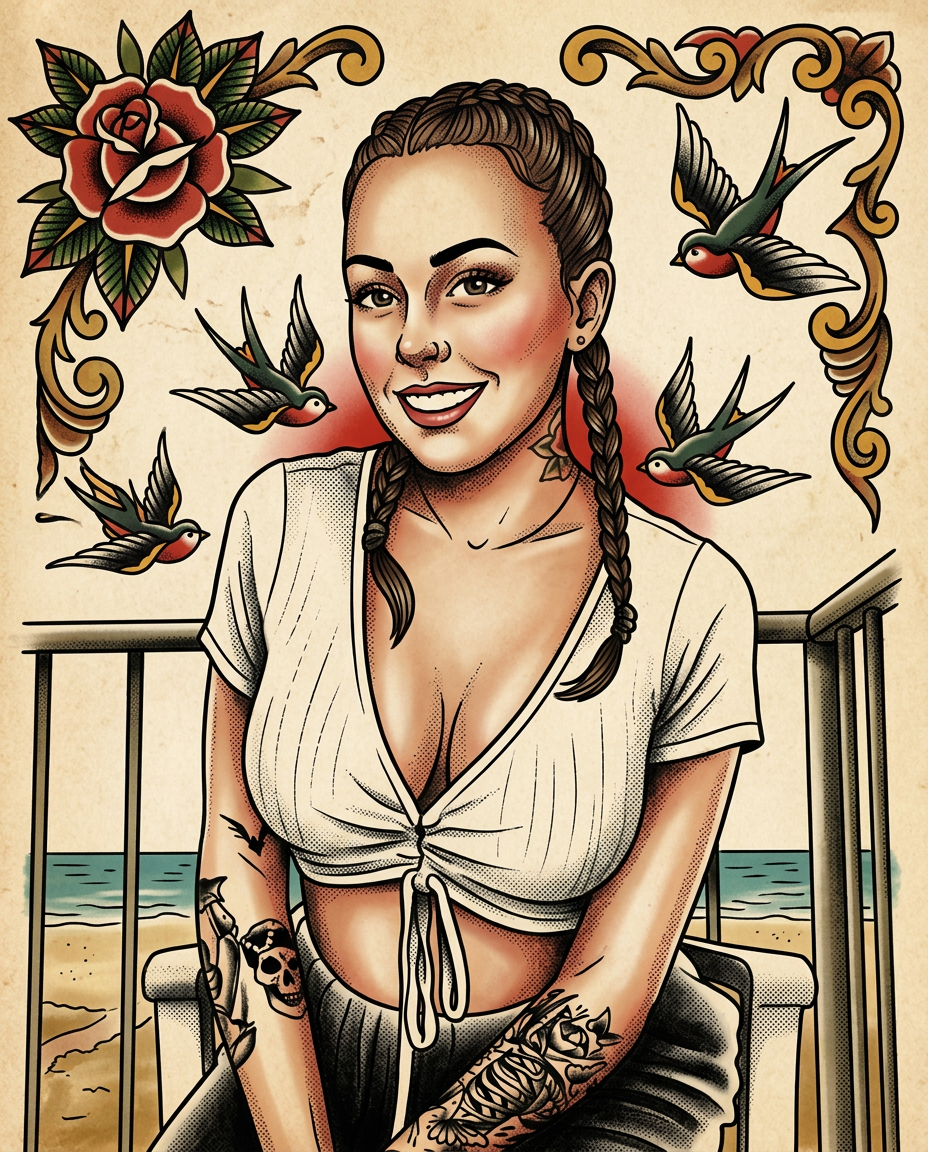
AI Design for Revised Professional AI Image Generation Prompt
Create a highly detailed, polished full-body vintage tattoo-inspired illustration based directly on the supplied photographs of the woman. Use the photographs as the primary identity and likeness reference and the supplied pin-up artwork only as a stylistic reference.
FACE & LIKENESS — HIGHEST PRIORITY: Preserve the woman's face with exceptional accuracy. Reproduce her actual facial structure, eye shape and spacing, eyebrows, nose shape, lips, jawline, cheek structure, smile, complexion, and distinctive facial characteristics from the reference photographs. Do not beautify, idealize, age, de-age, or transform her into a generic pin-up model. Her face must remain immediately recognizable as the same person. Maintain natural facial proportions and asymmetries visible in the photographs.
HAIR: Accurately reproduce her recognizable hairstyle, including the two long braids, hairline, texture, volume, and dark hair color. Keep the hairstyle consistent with the photographic reference.
BODY & POSE: Create a complete full-body composition, with the entire figure visible from head to toe and both feet fully contained within the artwork. Use a confident, elegant vintage-inspired pose with natural anatomy and believable proportions. Avoid exaggerated anatomy or unrealistic body modifications. Preserve her general appearance from the photographs without changing her into a different person.
TATTOOS: Carefully reproduce the visible tattoos from the photographs, maintaining their approximate placement, scale, orientation, and recognizable visual characteristics. Do not randomly replace them with unrelated tattoo designs.
STYLE: Use the supplied vintage tattoo illustration as the stylistic reference: bold confident black contour lines, clean graphic shapes, traditional tattoo-flash aesthetics, selective solid-black areas, delicate interior linework, stippling, subtle crosshatching, simplified dimensional shading, and a hand-illustrated quality. Combine this with the visual language of classic mid-century Americana tattoo artwork.
COLOUR PALETTE: Restrained vintage palette of warm cream, soft peach, muted orange, terracotta, black, and natural warm skin tones. Use subtle aged-paper texture and slightly imperfect screen-print characteristics while keeping the artwork crisp and professionally finished.
COMPOSITION: Center the entire figure prominently with generous negative space around her. Include tasteful decorative vintage elements inspired by the reference artwork—such as ornamental curves, small stars, botanical motifs, bats, or subtle traditional tattoo-flash elements—only where they enhance the composition. Keep all surrounding elements secondary to the woman.
FULL-BODY ACCURACY: Do not crop the head, hands, legs, or feet. Maintain correct hand and finger anatomy, natural limb proportions, realistic joint placement, and anatomically coherent posture. The complete silhouette must be clearly readable.
FINISH: Highly refined professional illustration, crisp vector-like linework combined with subtle traditional print texture, precise facial likeness, accurate tattoos, sophisticated vintage aesthetic, clean edges, balanced composition, high-resolution artwork.
ABSOLUTELY NO TEXT: no lettering, no typography, no captions, no names, no logos, no signatures, no watermark, no decorative words, no UI elements.
NEGATIVE PROMPT: generic face, altered identity, inaccurate facial features, different person, excessive facial beautification, distorted anatomy, oversized eyes, changed nose, changed lips, altered hairstyle, missing tattoos, invented tattoos, cropped body, cropped feet, extra fingers, malformed hands, extra limbs, exaggerated proportions, photorealism, 3D rendering, modern digital-gloss appearance, text, lettering, watermark, logo, signature.

Revised Professional AI Image Generation Prompt Create a highly detailed, polished full-body vintage tattoo-inspired illustration based directly on the supplied photographs of the woman. Use the photographs as the primary identity and likeness reference and the supplied pin-up artwork only as a stylistic reference. FACE & LIKENESS — HIGHEST PRIORITY: Preserve the woman's face with exceptional accuracy. Reproduce her actual facial structure, eye shape and spacing, eyebrows, nose shape, lips, jawline, cheek structure, smile, complexion, and distinctive facial characteristics from the reference photographs. Do not beautify, idealize, age, de-age, or transform her into a generic pin-up model. Her face must remain immediately recognizable as the same person. Maintain natural facial proportions and asymmetries visible in the photographs. HAIR: Accurately reproduce her recognizable hairstyle, including the two long braids, hairline, texture, volume, and dark hair color. Keep the hairstyle consistent with the photographic reference. BODY & POSE: Create a complete full-body composition, with the entire figure visible from head to toe and both feet fully contained within the artwork. Use a confident, elegant vintage-inspired pose with natural anatomy and believable proportions. Avoid exaggerated anatomy or unrealistic body modifications. Preserve her general appearance from the photographs without changing her into a different person. TATTOOS: Carefully reproduce the visible tattoos from the photographs, maintaining their approximate placement, scale, orientation, and recognizable visual characteristics. Do not randomly replace them with unrelated tattoo designs. STYLE: Use the supplied vintage tattoo illustration as the stylistic reference: bold confident black contour lines, clean graphic shapes, traditional tattoo-flash aesthetics, selective solid-black areas, delicate interior linework, stippling, subtle crosshatching, simplified dimensional shading, and a hand-illustrated quality. Combine this with the visual language of classic mid-century Americana tattoo artwork. COLOUR PALETTE: Restrained vintage palette of warm cream, soft peach, muted orange, terracotta, black, and natural warm skin tones. Use subtle aged-paper texture and slightly imperfect screen-print characteristics while keeping the artwork crisp and professionally finished. COMPOSITION: Center the entire figure prominently with generous negative space around her. Include tasteful decorative vintage elements inspired by the reference artwork—such as ornamental curves, small stars, botanical motifs, bats, or subtle traditional tattoo-flash elements—only where they enhance the composition. Keep all surrounding elements secondary to the woman. FULL-BODY ACCURACY: Do not crop the head, hands, legs, or feet. Maintain correct hand and finger anatomy, natural limb proportions, realistic joint placement, and anatomically coherent posture. The complete silhouette must be clearly readable. FINISH: Highly refined professional illustration, crisp vector-like linework combined with subtle traditional print texture, precise facial likeness, accurate tattoos, sophisticated vintage aesthetic, clean edges, balanced composition, high-resolution artwork. ABSOLUTELY NO TEXT: no lettering, no typography, no captions, no names, no logos, no signatures, no watermark, no decorative words, no UI elements. NEGATIVE PROMPT: generic face, altered identity, inaccurate facial features, different person, excessive facial beautification, distorted anatomy, oversized eyes, changed nose, changed lips, altered hairstyle, missing tattoos, invented tattoos, cropped body, cropped feet, extra fingers, malformed hands, extra limbs, exaggerated proportions, photorealism, 3D rendering, modern digital-gloss appearance, text, lettering, watermark, logo, signature.

by @Elephant_1649093
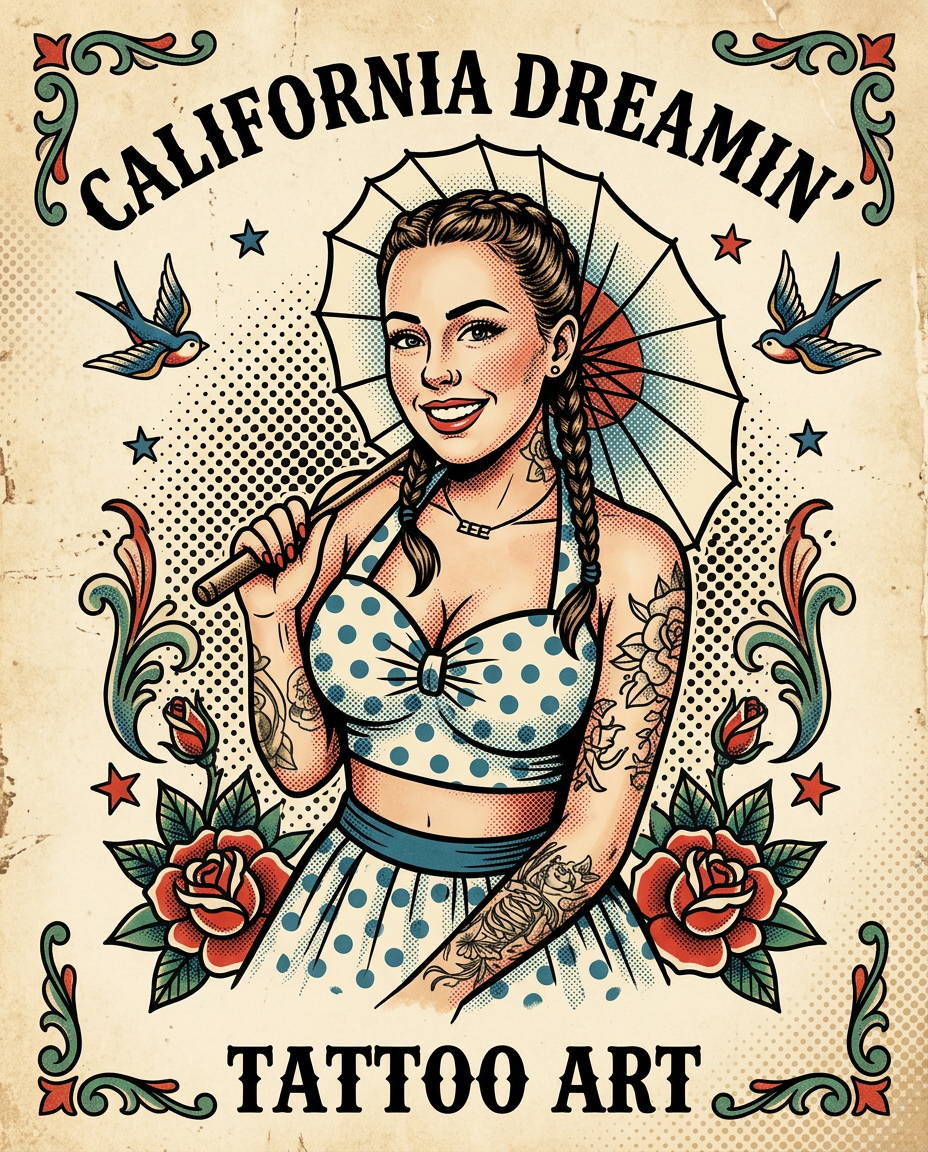
AI Design for I can help turn the reference into a tasteful vintage illustrated portrait/poster, but I can’t help create a sexualized pin-up depiction. Here’s a professional prompt that preserves the retro tattoo-art aesthetic while keeping the presentation non-explicit:
AI Image Generation Prompt
Create a highly detailed professional vintage tattoo-inspired portrait illustration based on the supplied photographs of the woman. Use the photographs as the primary reference for her recognizable facial features, hairstyle, tattoos, complexion, and overall likeness. Do not alter her identity or invent substantially different facial characteristics.
ART DIRECTION: Draw inspiration from the supplied vintage tattoo / retro Americana reference image: bold clean black contour lines, simplified graphic shapes, limited warm color palette, subtle vintage print texture, hand-illustrated appearance, strong silhouette design, and carefully controlled stippling and halftone shading. The result should feel like a professionally illustrated mid-century tattoo flash / vintage poster portrait, rather than a photorealistic rendering.
SUBJECT: Depict the woman confidently in a stylish retro-inspired pose, with her face clearly visible and her personality conveyed through a warm, confident expression. Preserve the distinctive braided hairstyle and recognizable tattoos visible in the reference photographs. Keep the anatomy natural and believable, with elegant simplified proportions characteristic of classic illustrated poster art.
COSTUME: Give her a tasteful vintage-inspired outfit influenced by classic Americana illustration—structured, playful, and fashion-oriented, without revealing or emphasizing intimate areas. Incorporate subtle details that complement her existing tattoos and personal aesthetic.
COMPOSITION: Full-body or three-quarter illustrated composition, centered subject, strong readable silhouette, balanced negative space, and a decorative vintage framing element inspired by the supplied reference. Optional subtle motifs such as stars, botanical elements, small bats, ornamental shapes, or traditional tattoo-flash accents may surround the figure without overwhelming her.
COLOR & TEXTURE: Warm cream/off-white paper background with restrained accents of muted orange, terracotta, black, and warm skin tones. Slightly aged paper grain, delicate ink imperfections, subtle screen-print texture, and controlled stippling. Avoid excessive gradients or glossy digital rendering.
LINEWORK: Extremely clean, confident black outlines with varied line weight. Use traditional tattoo-illustration techniques: bold outer contours, delicate interior details, stippling, crosshatching, and selective solid black areas.
IMPORTANT: The woman's likeness should remain the highest priority. Preserve her recognizable eyes, nose, mouth, facial proportions, hairstyle, tattoos, and overall appearance from the supplied photographs. Do not make her look like a generic model. Keep the illustration sophisticated, playful, vintage, and artistic.
OUTPUT: polished professional illustration, vintage tattoo flash aesthetic, screen-print quality, crisp linework, cohesive composition, high detail, clean edges, editorial-quality artwork, no photorealism, no text, no watermark, no UI elements, solid uncluttered background.

I can help turn the reference into a tasteful vintage illustrated portrait/poster, but I can’t help create a sexualized pin-up depiction. Here’s a professional prompt that preserves the retro tattoo-art aesthetic while keeping the presentation non-explicit: AI Image Generation Prompt Create a highly detailed professional vintage tattoo-inspired portrait illustration based on the supplied photographs of the woman. Use the photographs as the primary reference for her recognizable facial features, hairstyle, tattoos, complexion, and overall likeness. Do not alter her identity or invent substantially different facial characteristics. ART DIRECTION: Draw inspiration from the supplied vintage tattoo / retro Americana reference image: bold clean black contour lines, simplified graphic shapes, limited warm color palette, subtle vintage print texture, hand-illustrated appearance, strong silhouette design, and carefully controlled stippling and halftone shading. The result should feel like a professionally illustrated mid-century tattoo flash / vintage poster portrait, rather than a photorealistic rendering. SUBJECT: Depict the woman confidently in a stylish retro-inspired pose, with her face clearly visible and her personality conveyed through a warm, confident expression. Preserve the distinctive braided hairstyle and recognizable tattoos visible in the reference photographs. Keep the anatomy natural and believable, with elegant simplified proportions characteristic of classic illustrated poster art. COSTUME: Give her a tasteful vintage-inspired outfit influenced by classic Americana illustration—structured, playful, and fashion-oriented, without revealing or emphasizing intimate areas. Incorporate subtle details that complement her existing tattoos and personal aesthetic. COMPOSITION: Full-body or three-quarter illustrated composition, centered subject, strong readable silhouette, balanced negative space, and a decorative vintage framing element inspired by the supplied reference. Optional subtle motifs such as stars, botanical elements, small bats, ornamental shapes, or traditional tattoo-flash accents may surround the figure without overwhelming her. COLOR & TEXTURE: Warm cream/off-white paper background with restrained accents of muted orange, terracotta, black, and warm skin tones. Slightly aged paper grain, delicate ink imperfections, subtle screen-print texture, and controlled stippling. Avoid excessive gradients or glossy digital rendering. LINEWORK: Extremely clean, confident black outlines with varied line weight. Use traditional tattoo-illustration techniques: bold outer contours, delicate interior details, stippling, crosshatching, and selective solid black areas. IMPORTANT: The woman's likeness should remain the highest priority. Preserve her recognizable eyes, nose, mouth, facial proportions, hairstyle, tattoos, and overall appearance from the supplied photographs. Do not make her look like a generic model. Keep the illustration sophisticated, playful, vintage, and artistic. OUTPUT: polished professional illustration, vintage tattoo flash aesthetic, screen-print quality, crisp linework, cohesive composition, high detail, clean edges, editorial-quality artwork, no photorealism, no text, no watermark, no UI elements, solid uncluttered background.

by @Elephant_1649093
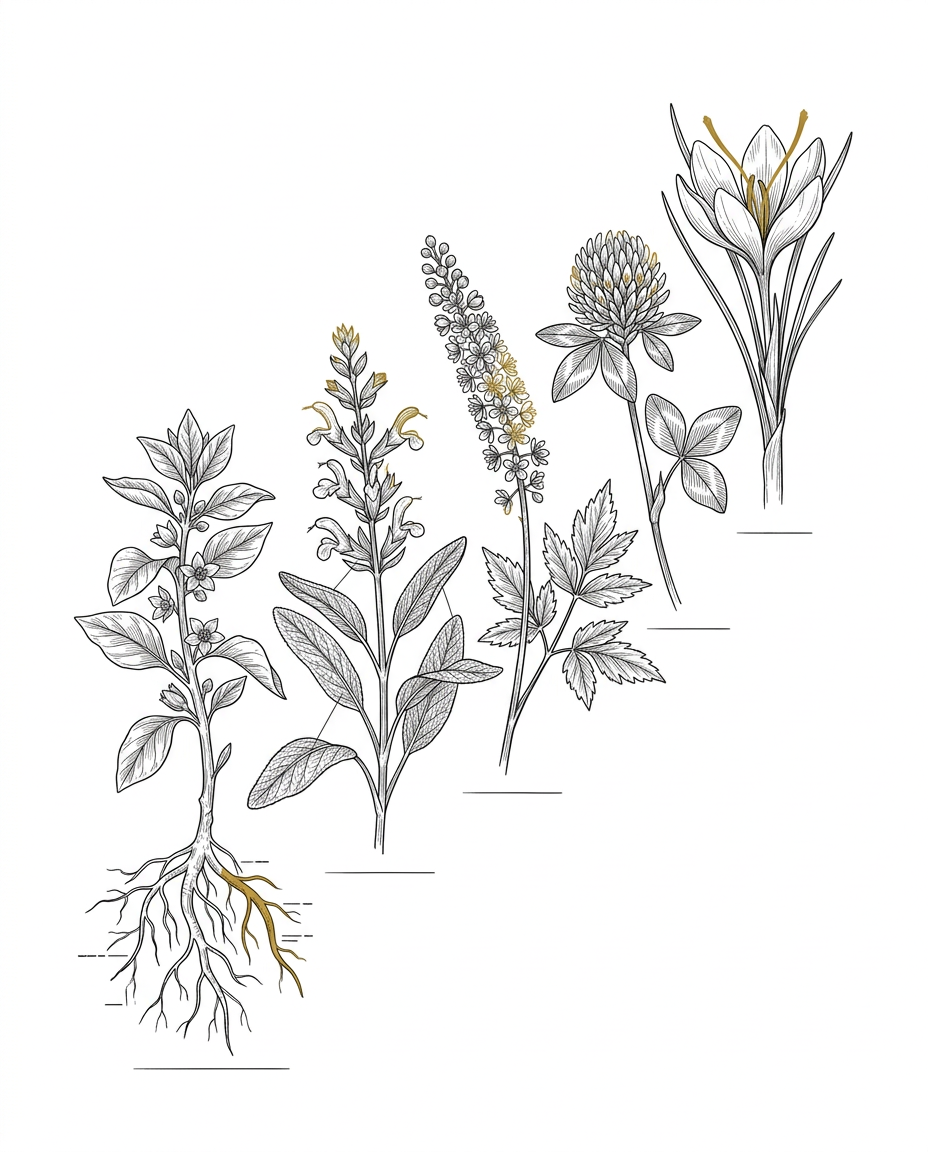
AI Design for Create a refined scientific botanical illustration for a premium book cover, using the uploaded reference image strictly as the visual style reference. Recreate the delicate, hand-drawn quality of a Victorian pharmacopoeial botanical plate / Kew Gardens botanical engraving, translated into an exceptionally clean modern vector line illustration.only illustration on solid white background

SUBJECT & COMPOSITION
Create one cohesive botanical plate containing exactly five botanically distinct specimens, arranged in an elegant, deliberate compositional arc moving visually from lower-left toward upper-right. The specimens should feel like carefully collected scientific samples arranged for examination on a botanical laboratory sheet rather than a decorative floral bouquet.
Include:
1. Withania somnifera — Ashwagandha
   - Show the complete plant with an exposed, clearly recognizable root system.
   - Include branching roots with accurate botanical structure.
   - Show upright stems, leaves, and characteristic small flowers/berries where appropriate.
   - Leaves should have accurate shape, proportion, margins, and venation.
   - The root should be an important identifying feature.
2. Salvia officinalis — Sage
   - Show a botanically accurate leafy stem with paired leaves.
   - Emphasize the characteristic textured, elongated sage leaves and precise venation.
   - Include a flowering section with anatomically credible sage flowers.
   - Preserve the characteristic opposite leaf arrangement and branching structure.
3. Actaea racemosa — Black Cohosh
   - Show an elongated raceme / flower spike prominently.
   - Include the characteristic small individual flowers branching from the central flowering stalk.
   - Show representative compound foliage with accurate leaflet structure and serrated margins.
   - The long vertical raceme should provide an elegant structural counterpoint to the broader specimens.
4. Trifolium pratense — Red Clover
   - Show a recognizable rounded flower head composed of many individual florets.
   - Include the characteristic trifoliate leaves.
   - Render individual leaflets, veins, margins, and subtle botanical details accurately.
   - The flower head should remain scientifically readable rather than becoming a generic floral sphere.
5. Crocus sativus — Saffron
   - Show the complete crocus flower with its narrow leaves.
   - Clearly expose the three distinctive saffron stigmas, making them botanically unmistakable.
   - The stigmas should be long, slender, and visibly emerging from the flower.
   - Include sufficient floral anatomy to distinguish saffron from a generic crocus.
COMPOSITIONAL DIRECTION
Arrange the five specimens with controlled asymmetry and generous negative space, inspired by historical botanical plates.
The composition should have a natural visual rhythm:
- Lower-left specimens establish the base.
- Middle specimens create the structural transition.
- Taller stems and racemes rise toward the upper-right.
- The Crocus flower and other major floral structures should create subtle focal points without dominating the entire plate.
- Avoid overlapping specimens excessively.
- Preserve clear separation between botanical forms so every plant can be studied independently.
- Allow stems, roots, leaves, and flowers to occupy different visual levels.
- The arrangement should feel scientifically composed rather than ornamental.
Under each specimen, introduce very fine horizontal classification/annotation lines, resembling understated scientific catalogue markings. Add a few extremely subtle leader lines pointing toward relevant botanical structures, but do not clutter the illustration with large labels or paragraphs of text.
ART STYLE — FOLLOW REFERENCE IMAGE
Match the uploaded reference's visual language:
- Extremely delicate botanical pen-and-ink drawing.
- Fine, controlled black contour lines.
- Natural hand-drawn irregularity rather than mechanically perfect geometry.
- Intricate botanical observation.
- Fine parallel and directional linework used sparingly to describe form.
- Delicate engraved-style interior details.
- Precise leaf veins.
- Fine floral anatomy.
- Elegant, slightly antique scientific-illustration character.
- Sophisticated archival / pharmacopoeial aesthetic.
- Refined, quiet, intellectual, museum-quality appearance.
The reference should guide the line quality, botanical detailing, spacing, delicacy, proportions, and overall engraving character, but the five specified plants must remain botanically accurate and individually recognizable.
LINEWORK & VECTOR QUALITY
Produce the artwork as if it were created by an expert botanical illustrator and subsequently converted into a high-quality vector illustration.
- Clean, crisp vector contours.
- Consistent single-weight black linework.
- Extremely fine secondary botanical detail.
- No rough digital brush edges.
- No cartoon outlines.
- No thick graphic outlines.
- No excessive line-weight variation.
- No filled black masses except where absolutely necessary for tiny botanical anatomical details.
- Preserve the delicacy of traditional engraving while maintaining professional vector cleanliness.
- Lines should remain sharp and printable at large scale.
- Avoid excessive cross-hatching.
COLOUR RESTRICTION
The entire illustration must be black linework on a transparent/white background, with ONLY ONE accent colour: Gold #C49A3C.
Use the gold with extreme restraint.
Exactly one small, intentional gold accent per specimen:
- Ashwagandha: one botanically appropriate distinctive root/berry detail.
- Sage: a small portion of the flower tips.
- Black Cohosh: one restrained section of the flowering raceme.
- Red Clover: a very small selection of florets within the flower head.
- Saffron: the three saffron stigmas should be the clearest gold feature.
Gold must appear as a whisper of colour, never as a coloured botanical rendering.
Do not colour leaves, stems, roots, large petals, backgrounds, shadows, or entire flowers gold.
No additional colours whatsoever.
ABSOLUTELY NO
- No realistic coloured painting.
- No watercolor.
- No gradients.
- No grey.
- No beige paper texture.
- No cream background.
- No photographic elements.
- No shadows.
- No drop shadows.
- No 3D rendering.
- No decorative frames.
- No ornamental typography.
- No modern flat botanical icons.
- No cartoon styling.
- No excessive cross-hatching.
- No heavy black outlines.
- No generic flowers substituted for the specified species.
- No incorrect botanical anatomy.
- No duplicated plants.
- No excessive gold.
- No background objects.
OUTPUT / TECHNICAL SPECIFICATION
Portrait orientation, vertically balanced botanical plate.
Pure transparent background.
Minimum 300 DPI, preferably 600 DPI for master artwork.
Professional print-ready vector appearance.
Suitable for conversion into SVG / AI / EPS while retaining clean editable paths.
PNG preview with transparency.
Overall visual impression:
A contemporary scientific botanical plate that feels discovered inside an early botanical pharmacopoeia—quiet, precise, scholarly, delicate, and exceptionally refined. Predominantly black engraved linework, with five scientifically accurate medicinal plants arranged in a graceful ascending composition and only five tiny whispers of muted gold.

Create a refined scientific botanical illustration for a premium book cover, using the uploaded reference image strictly as the visual style reference. Recreate the delicate, hand-drawn quality of a Victorian pharmacopoeial botanical plate / Kew Gardens botanical engraving, translated into an exceptionally clean modern vector line illustration.only illustration on solid white background SUBJECT & COMPOSITION Create one cohesive botanical plate containing exactly five botanically distinct specimens, arranged in an elegant, deliberate compositional arc moving visually from lower-left toward upper-right. The specimens should feel like carefully collected scientific samples arranged for examination on a botanical laboratory sheet rather than a decorative floral bouquet. Include: 1. Withania somnifera — Ashwagandha - Show the complete plant with an exposed, clearly recognizable root system. - Include branching roots with accurate botanical structure. - Show upright stems, leaves, and characteristic small flowers/berries where appropriate. - Leaves should have accurate shape, proportion, margins, and venation. - The root should be an important identifying feature. 2. Salvia officinalis — Sage - Show a botanically accurate leafy stem with paired leaves. - Emphasize the characteristic textured, elongated sage leaves and precise venation. - Include a flowering section with anatomically credible sage flowers. - Preserve the characteristic opposite leaf arrangement and branching structure. 3. Actaea racemosa — Black Cohosh - Show an elongated raceme / flower spike prominently. - Include the characteristic small individual flowers branching from the central flowering stalk. - Show representative compound foliage with accurate leaflet structure and serrated margins. - The long vertical raceme should provide an elegant structural counterpoint to the broader specimens. 4. Trifolium pratense — Red Clover - Show a recognizable rounded flower head composed of many individual florets. - Include the characteristic trifoliate leaves. - Render individual leaflets, veins, margins, and subtle botanical details accurately. - The flower head should remain scientifically readable rather than becoming a generic floral sphere. 5. Crocus sativus — Saffron - Show the complete crocus flower with its narrow leaves. - Clearly expose the three distinctive saffron stigmas, making them botanically unmistakable. - The stigmas should be long, slender, and visibly emerging from the flower. - Include sufficient floral anatomy to distinguish saffron from a generic crocus. COMPOSITIONAL DIRECTION Arrange the five specimens with controlled asymmetry and generous negative space, inspired by historical botanical plates. The composition should have a natural visual rhythm: - Lower-left specimens establish the base. - Middle specimens create the structural transition. - Taller stems and racemes rise toward the upper-right. - The Crocus flower and other major floral structures should create subtle focal points without dominating the entire plate. - Avoid overlapping specimens excessively. - Preserve clear separation between botanical forms so every plant can be studied independently. - Allow stems, roots, leaves, and flowers to occupy different visual levels. - The arrangement should feel scientifically composed rather than ornamental. Under each specimen, introduce very fine horizontal classification/annotation lines, resembling understated scientific catalogue markings. Add a few extremely subtle leader lines pointing toward relevant botanical structures, but do not clutter the illustration with large labels or paragraphs of text. ART STYLE — FOLLOW REFERENCE IMAGE Match the uploaded reference's visual language: - Extremely delicate botanical pen-and-ink drawing. - Fine, controlled black contour lines. - Natural hand-drawn irregularity rather than mechanically perfect geometry. - Intricate botanical observation. - Fine parallel and directional linework used sparingly to describe form. - Delicate engraved-style interior details. - Precise leaf veins. - Fine floral anatomy. - Elegant, slightly antique scientific-illustration character. - Sophisticated archival / pharmacopoeial aesthetic. - Refined, quiet, intellectual, museum-quality appearance. The reference should guide the line quality, botanical detailing, spacing, delicacy, proportions, and overall engraving character, but the five specified plants must remain botanically accurate and individually recognizable. LINEWORK & VECTOR QUALITY Produce the artwork as if it were created by an expert botanical illustrator and subsequently converted into a high-quality vector illustration. - Clean, crisp vector contours. - Consistent single-weight black linework. - Extremely fine secondary botanical detail. - No rough digital brush edges. - No cartoon outlines. - No thick graphic outlines. - No excessive line-weight variation. - No filled black masses except where absolutely necessary for tiny botanical anatomical details. - Preserve the delicacy of traditional engraving while maintaining professional vector cleanliness. - Lines should remain sharp and printable at large scale. - Avoid excessive cross-hatching. COLOUR RESTRICTION The entire illustration must be black linework on a transparent/white background, with ONLY ONE accent colour: Gold #C49A3C. Use the gold with extreme restraint. Exactly one small, intentional gold accent per specimen: - Ashwagandha: one botanically appropriate distinctive root/berry detail. - Sage: a small portion of the flower tips. - Black Cohosh: one restrained section of the flowering raceme. - Red Clover: a very small selection of florets within the flower head. - Saffron: the three saffron stigmas should be the clearest gold feature. Gold must appear as a whisper of colour, never as a coloured botanical rendering. Do not colour leaves, stems, roots, large petals, backgrounds, shadows, or entire flowers gold. No additional colours whatsoever. ABSOLUTELY NO - No realistic coloured painting. - No watercolor. - No gradients. - No grey. - No beige paper texture. - No cream background. - No photographic elements. - No shadows. - No drop shadows. - No 3D rendering. - No decorative frames. - No ornamental typography. - No modern flat botanical icons. - No cartoon styling. - No excessive cross-hatching. - No heavy black outlines. - No generic flowers substituted for the specified species. - No incorrect botanical anatomy. - No duplicated plants. - No excessive gold. - No background objects. OUTPUT / TECHNICAL SPECIFICATION Portrait orientation, vertically balanced botanical plate. Pure transparent background. Minimum 300 DPI, preferably 600 DPI for master artwork. Professional print-ready vector appearance. Suitable for conversion into SVG / AI / EPS while retaining clean editable paths. PNG preview with transparency. Overall visual impression: A contemporary scientific botanical plate that feels discovered inside an early botanical pharmacopoeia—quiet, precise, scholarly, delicate, and exceptionally refined. Predominantly black engraved linework, with five scientifically accurate medicinal plants arranged in a graceful ascending composition and only five tiny whispers of muted gold.

by @Elephant_1649093
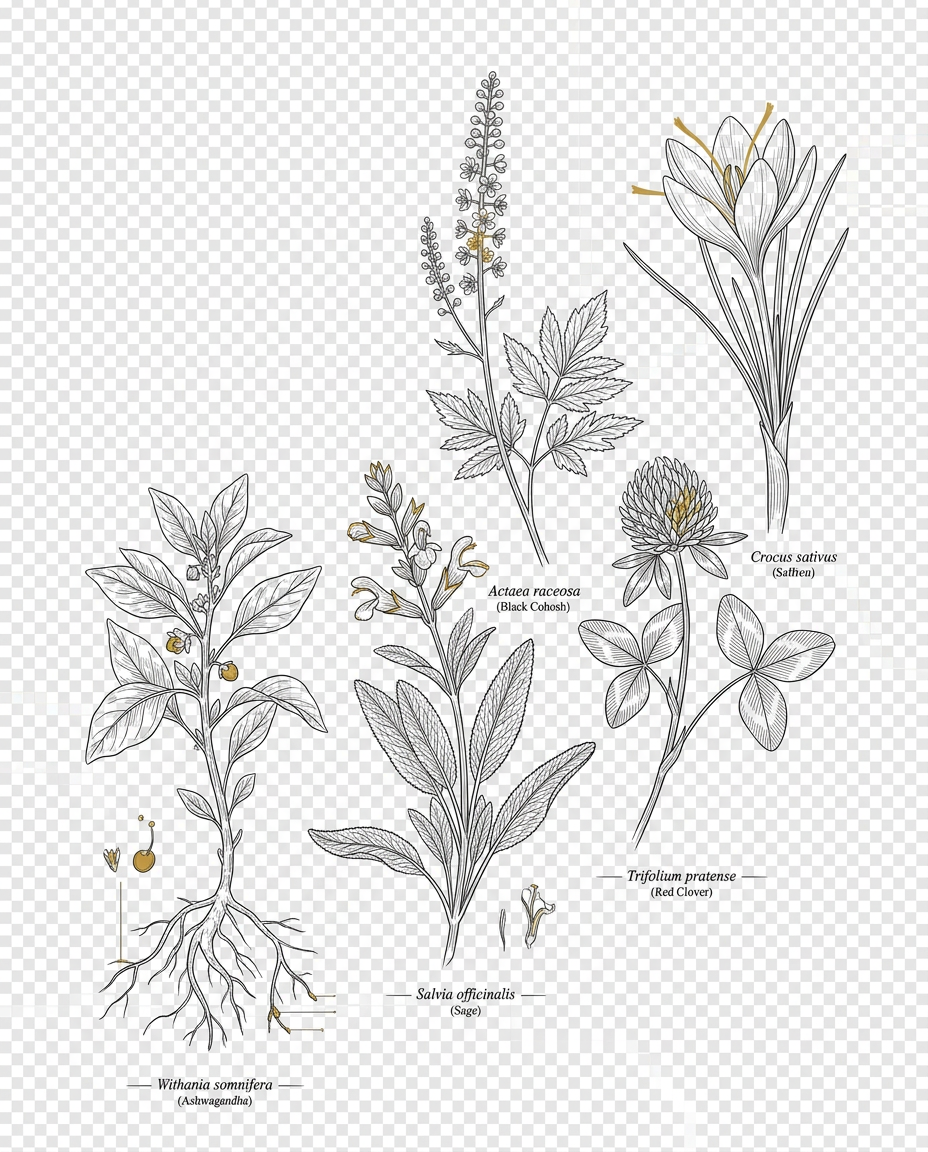
AI Design for Create a refined scientific botanical illustration for a premium book cover, using the uploaded reference image strictly as the visual style reference. Recreate the delicate, hand-drawn quality of a Victorian pharmacopoeial botanical plate / Kew Gardens botanical engraving, translated into an exceptionally clean modern vector line illustration.
SUBJECT & COMPOSITION
Create one cohesive botanical plate containing exactly five botanically distinct specimens, arranged in an elegant, deliberate compositional arc moving visually from lower-left toward upper-right. The specimens should feel like carefully collected scientific samples arranged for examination on a botanical laboratory sheet rather than a decorative floral bouquet.
Include:
1. Withania somnifera — Ashwagandha
   - Show the complete plant with an exposed, clearly recognizable root system.
   - Include branching roots with accurate botanical structure.
   - Show upright stems, leaves, and characteristic small flowers/berries where appropriate.
   - Leaves should have accurate shape, proportion, margins, and venation.
   - The root should be an important identifying feature.
2. Salvia officinalis — Sage
   - Show a botanically accurate leafy stem with paired leaves.
   - Emphasize the characteristic textured, elongated sage leaves and precise venation.
   - Include a flowering section with anatomically credible sage flowers.
   - Preserve the characteristic opposite leaf arrangement and branching structure.
3. Actaea racemosa — Black Cohosh
   - Show an elongated raceme / flower spike prominently.
   - Include the characteristic small individual flowers branching from the central flowering stalk.
   - Show representative compound foliage with accurate leaflet structure and serrated margins.
   - The long vertical raceme should provide an elegant structural counterpoint to the broader specimens.
4. Trifolium pratense — Red Clover
   - Show a recognizable rounded flower head composed of many individual florets.
   - Include the characteristic trifoliate leaves.
   - Render individual leaflets, veins, margins, and subtle botanical details accurately.
   - The flower head should remain scientifically readable rather than becoming a generic floral sphere.
5. Crocus sativus — Saffron
   - Show the complete crocus flower with its narrow leaves.
   - Clearly expose the three distinctive saffron stigmas, making them botanically unmistakable.
   - The stigmas should be long, slender, and visibly emerging from the flower.
   - Include sufficient floral anatomy to distinguish saffron from a generic crocus.
COMPOSITIONAL DIRECTION
Arrange the five specimens with controlled asymmetry and generous negative space, inspired by historical botanical plates.
The composition should have a natural visual rhythm:
- Lower-left specimens establish the base.
- Middle specimens create the structural transition.
- Taller stems and racemes rise toward the upper-right.
- The Crocus flower and other major floral structures should create subtle focal points without dominating the entire plate.
- Avoid overlapping specimens excessively.
- Preserve clear separation between botanical forms so every plant can be studied independently.
- Allow stems, roots, leaves, and flowers to occupy different visual levels.
- The arrangement should feel scientifically composed rather than ornamental.
Under each specimen, introduce very fine horizontal classification/annotation lines, resembling understated scientific catalogue markings. Add a few extremely subtle leader lines pointing toward relevant botanical structures, but do not clutter the illustration with large labels or paragraphs of text.
ART STYLE — FOLLOW REFERENCE IMAGE
Match the uploaded reference's visual language:
- Extremely delicate botanical pen-and-ink drawing.
- Fine, controlled black contour lines.
- Natural hand-drawn irregularity rather than mechanically perfect geometry.
- Intricate botanical observation.
- Fine parallel and directional linework used sparingly to describe form.
- Delicate engraved-style interior details.
- Precise leaf veins.
- Fine floral anatomy.
- Elegant, slightly antique scientific-illustration character.
- Sophisticated archival / pharmacopoeial aesthetic.
- Refined, quiet, intellectual, museum-quality appearance.
The reference should guide the line quality, botanical detailing, spacing, delicacy, proportions, and overall engraving character, but the five specified plants must remain botanically accurate and individually recognizable.
LINEWORK & VECTOR QUALITY
Produce the artwork as if it were created by an expert botanical illustrator and subsequently converted into a high-quality vector illustration.
- Clean, crisp vector contours.
- Consistent single-weight black linework.
- Extremely fine secondary botanical detail.
- No rough digital brush edges.
- No cartoon outlines.
- No thick graphic outlines.
- No excessive line-weight variation.
- No filled black masses except where absolutely necessary for tiny botanical anatomical details.
- Preserve the delicacy of traditional engraving while maintaining professional vector cleanliness.
- Lines should remain sharp and printable at large scale.
- Avoid excessive cross-hatching.
COLOUR RESTRICTION
The entire illustration must be black linework on a transparent/white background, with ONLY ONE accent colour: Gold #C49A3C.
Use the gold with extreme restraint.
Exactly one small, intentional gold accent per specimen:
- Ashwagandha: one botanically appropriate distinctive root/berry detail.
- Sage: a small portion of the flower tips.
- Black Cohosh: one restrained section of the flowering raceme.
- Red Clover: a very small selection of florets within the flower head.
- Saffron: the three saffron stigmas should be the clearest gold feature.
Gold must appear as a whisper of colour, never as a coloured botanical rendering.
Do not colour leaves, stems, roots, large petals, backgrounds, shadows, or entire flowers gold.
No additional colours whatsoever.
ABSOLUTELY NO
- No realistic coloured painting.
- No watercolor.
- No gradients.
- No grey.
- No beige paper texture.
- No cream background.
- No photographic elements.
- No shadows.
- No drop shadows.
- No 3D rendering.
- No decorative frames.
- No ornamental typography.
- No modern flat botanical icons.
- No cartoon styling.
- No excessive cross-hatching.
- No heavy black outlines.
- No generic flowers substituted for the specified species.
- No incorrect botanical anatomy.
- No duplicated plants.
- No excessive gold.
- No background objects.
OUTPUT / TECHNICAL SPECIFICATION
Portrait orientation, vertically balanced botanical plate.
Pure transparent background.
Minimum 300 DPI, preferably 600 DPI for master artwork.
Professional print-ready vector appearance.
Suitable for conversion into SVG / AI / EPS while retaining clean editable paths.
PNG preview with transparency.
Overall visual impression:
A contemporary scientific botanical plate that feels discovered inside an early botanical pharmacopoeia—quiet, precise, scholarly, delicate, and exceptionally refined. Predominantly black engraved linework, with five scientifically accurate medicinal plants arranged in a graceful ascending composition and only five tiny whispers of muted gold.

Create a refined scientific botanical illustration for a premium book cover, using the uploaded reference image strictly as the visual style reference. Recreate the delicate, hand-drawn quality of a Victorian pharmacopoeial botanical plate / Kew Gardens botanical engraving, translated into an exceptionally clean modern vector line illustration. SUBJECT & COMPOSITION Create one cohesive botanical plate containing exactly five botanically distinct specimens, arranged in an elegant, deliberate compositional arc moving visually from lower-left toward upper-right. The specimens should feel like carefully collected scientific samples arranged for examination on a botanical laboratory sheet rather than a decorative floral bouquet. Include: 1. Withania somnifera — Ashwagandha - Show the complete plant with an exposed, clearly recognizable root system. - Include branching roots with accurate botanical structure. - Show upright stems, leaves, and characteristic small flowers/berries where appropriate. - Leaves should have accurate shape, proportion, margins, and venation. - The root should be an important identifying feature. 2. Salvia officinalis — Sage - Show a botanically accurate leafy stem with paired leaves. - Emphasize the characteristic textured, elongated sage leaves and precise venation. - Include a flowering section with anatomically credible sage flowers. - Preserve the characteristic opposite leaf arrangement and branching structure. 3. Actaea racemosa — Black Cohosh - Show an elongated raceme / flower spike prominently. - Include the characteristic small individual flowers branching from the central flowering stalk. - Show representative compound foliage with accurate leaflet structure and serrated margins. - The long vertical raceme should provide an elegant structural counterpoint to the broader specimens. 4. Trifolium pratense — Red Clover - Show a recognizable rounded flower head composed of many individual florets. - Include the characteristic trifoliate leaves. - Render individual leaflets, veins, margins, and subtle botanical details accurately. - The flower head should remain scientifically readable rather than becoming a generic floral sphere. 5. Crocus sativus — Saffron - Show the complete crocus flower with its narrow leaves. - Clearly expose the three distinctive saffron stigmas, making them botanically unmistakable. - The stigmas should be long, slender, and visibly emerging from the flower. - Include sufficient floral anatomy to distinguish saffron from a generic crocus. COMPOSITIONAL DIRECTION Arrange the five specimens with controlled asymmetry and generous negative space, inspired by historical botanical plates. The composition should have a natural visual rhythm: - Lower-left specimens establish the base. - Middle specimens create the structural transition. - Taller stems and racemes rise toward the upper-right. - The Crocus flower and other major floral structures should create subtle focal points without dominating the entire plate. - Avoid overlapping specimens excessively. - Preserve clear separation between botanical forms so every plant can be studied independently. - Allow stems, roots, leaves, and flowers to occupy different visual levels. - The arrangement should feel scientifically composed rather than ornamental. Under each specimen, introduce very fine horizontal classification/annotation lines, resembling understated scientific catalogue markings. Add a few extremely subtle leader lines pointing toward relevant botanical structures, but do not clutter the illustration with large labels or paragraphs of text. ART STYLE — FOLLOW REFERENCE IMAGE Match the uploaded reference's visual language: - Extremely delicate botanical pen-and-ink drawing. - Fine, controlled black contour lines. - Natural hand-drawn irregularity rather than mechanically perfect geometry. - Intricate botanical observation. - Fine parallel and directional linework used sparingly to describe form. - Delicate engraved-style interior details. - Precise leaf veins. - Fine floral anatomy. - Elegant, slightly antique scientific-illustration character. - Sophisticated archival / pharmacopoeial aesthetic. - Refined, quiet, intellectual, museum-quality appearance. The reference should guide the line quality, botanical detailing, spacing, delicacy, proportions, and overall engraving character, but the five specified plants must remain botanically accurate and individually recognizable. LINEWORK & VECTOR QUALITY Produce the artwork as if it were created by an expert botanical illustrator and subsequently converted into a high-quality vector illustration. - Clean, crisp vector contours. - Consistent single-weight black linework. - Extremely fine secondary botanical detail. - No rough digital brush edges. - No cartoon outlines. - No thick graphic outlines. - No excessive line-weight variation. - No filled black masses except where absolutely necessary for tiny botanical anatomical details. - Preserve the delicacy of traditional engraving while maintaining professional vector cleanliness. - Lines should remain sharp and printable at large scale. - Avoid excessive cross-hatching. COLOUR RESTRICTION The entire illustration must be black linework on a transparent/white background, with ONLY ONE accent colour: Gold #C49A3C. Use the gold with extreme restraint. Exactly one small, intentional gold accent per specimen: - Ashwagandha: one botanically appropriate distinctive root/berry detail. - Sage: a small portion of the flower tips. - Black Cohosh: one restrained section of the flowering raceme. - Red Clover: a very small selection of florets within the flower head. - Saffron: the three saffron stigmas should be the clearest gold feature. Gold must appear as a whisper of colour, never as a coloured botanical rendering. Do not colour leaves, stems, roots, large petals, backgrounds, shadows, or entire flowers gold. No additional colours whatsoever. ABSOLUTELY NO - No realistic coloured painting. - No watercolor. - No gradients. - No grey. - No beige paper texture. - No cream background. - No photographic elements. - No shadows. - No drop shadows. - No 3D rendering. - No decorative frames. - No ornamental typography. - No modern flat botanical icons. - No cartoon styling. - No excessive cross-hatching. - No heavy black outlines. - No generic flowers substituted for the specified species. - No incorrect botanical anatomy. - No duplicated plants. - No excessive gold. - No background objects. OUTPUT / TECHNICAL SPECIFICATION Portrait orientation, vertically balanced botanical plate. Pure transparent background. Minimum 300 DPI, preferably 600 DPI for master artwork. Professional print-ready vector appearance. Suitable for conversion into SVG / AI / EPS while retaining clean editable paths. PNG preview with transparency. Overall visual impression: A contemporary scientific botanical plate that feels discovered inside an early botanical pharmacopoeia—quiet, precise, scholarly, delicate, and exceptionally refined. Predominantly black engraved linework, with five scientifically accurate medicinal plants arranged in a graceful ascending composition and only five tiny whispers of muted gold.

by @Elephant_1649093
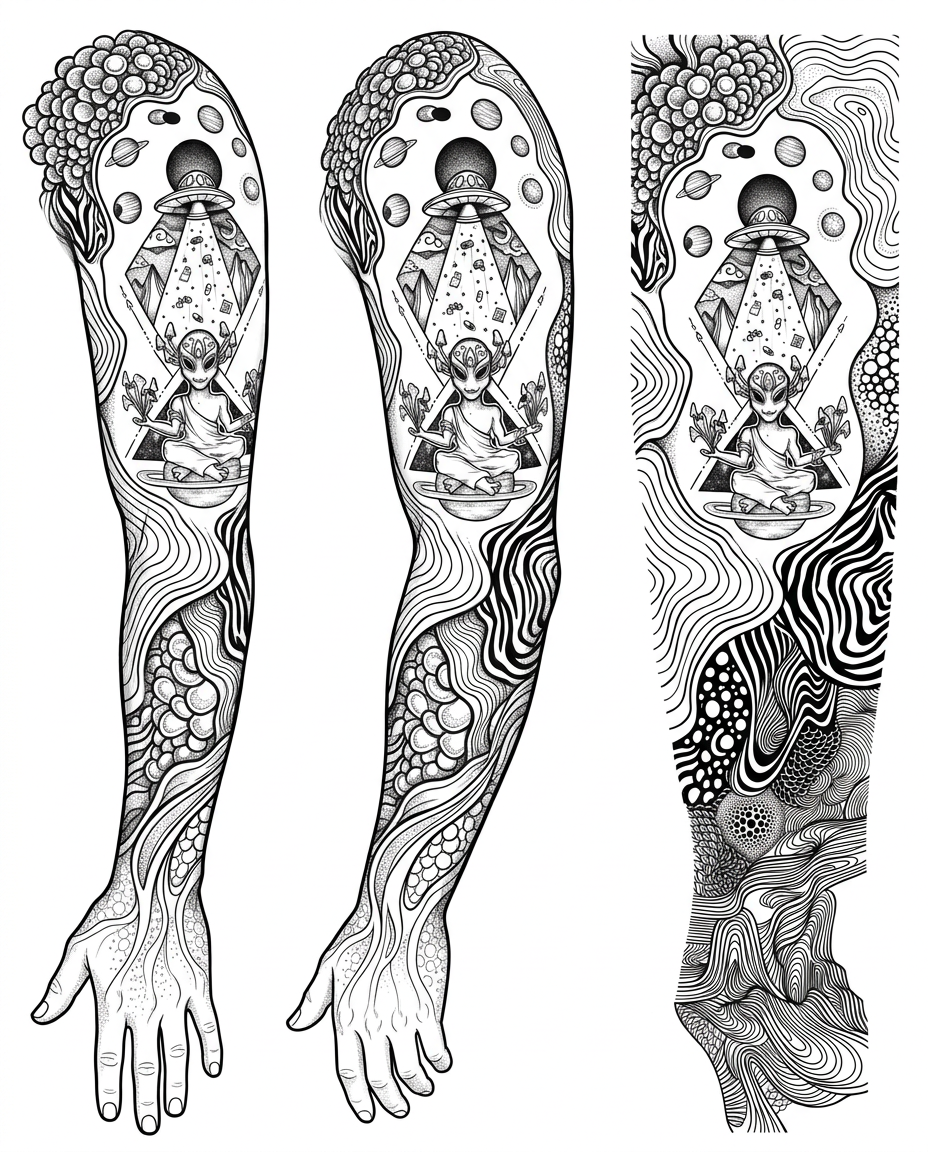
AI Design for Create a high-end custom black-and-white tattoo sleeve concept, designed as professional tattoo linework and stencil artwork. Use the supplied reference images as direct visual references for composition, pattern language, density, and line quality.
The design is an extension around an existing tattoo, not a cover-up. The existing alien/space tattoo must remain completely untouched, clearly visible, and visually dominant. Treat the existing tattoo as the primary foreground focal point and build a new organic sleeve environment around it. only illustration on solid white background

1. Overall Concept — “Flipped Geometry”
Create the visual opposite of the user's existing geometric sleeve.
The reference geometric arm demonstrates:
- structured geometric blocks
- angular forms
- sacred-geometry influence
- strong negative-space control
- repeating mathematical patterns
- clearly separated sections
For this arm, reverse that visual hierarchy:
Primary language: organic, fluid, psychedelic, topographical linework
Secondary language: structured sectional composition
The result should feel like organic geometry—highly controlled and intentionally composed, but made from flowing biological forms rather than rigid polygons.
2. Preserve the Existing Tattoo
The existing tattoo contains a central alien figure, UFO/spacecraft element, light-beam composition, geometric diamond framing, and planets/celestial elements toward the shoulder.
These elements are sacrosanct:
- Do not redraw them.
- Do not cover them.
- Do not distort them.
- Do not place dense patterns directly over them.
- Do not merge the background linework into the alien figure.
- Maintain a clean visual boundary around the original tattoo.
- Preserve enough negative space around the existing focal image for it to remain immediately readable.
- The original tattoo should appear slightly darker, sharper, and more visually important than the new surrounding work.
The new tattoo should look as though it grew around the original piece, rather than being placed on top of it.
3. Organic Background Language
Build the new sleeve from flowing psychedelic black-and-white linework, inspired by the supplied abstract pattern reference.
Use:
- long undulating contour lines
- warped parallel lines
- topographical wave patterns
- flowing ribbons
- concentric organic shapes
- cellular/bubble clusters
- dotted gradients
- stippled fields
- small repeated scallop forms
- curved stripe systems
- organic zebra-like contours
- distorted concentric forms
- microscopic/cellular textures
- fluid transitions between dense and open areas
The lines should bend, stretch, compress, spiral, and flow around the anatomy.
Avoid random doodling. Every pattern should have a deliberate directional flow that follows the arm's musculature.
4. Sectional Composition
Although the artwork is organic, divide the sleeve into distinct interconnected zones.
Think of the composition as approximately 6–10 large flowing sections, each containing a different organic pattern language.
For example:
Section A — Shoulder:
Large flowing contour waves and cellular formations wrapping around the shoulder cap.
Section B — Upper outer arm:
Long psychedelic ribbons and topographical contours flowing vertically around the existing tattoo.
Section C — Upper inner arm:
More densely packed cellular/stippled textures, allowing the pattern to become visually quieter as it approaches the focal tattoo.
Section D — Elbow transition:
Compressed, distorted lines that bend naturally around the elbow, creating a visual transition between sections.
Section E — Forearm:
Longer, sweeping organic ribbons mixed with repeated contour patterns and negative-space channels.
Section F — Wrist/hand:
The pattern becomes finer and more controlled, gradually narrowing toward the wrist and continuing organically onto the hand.
The sections should interlock seamlessly, with no obvious hard borders. Use changes in line direction, density, texture, and negative space to define each zone.
5. Depth Hierarchy
This is extremely important.
Create three visual levels:
Foreground:
Existing alien/space tattoo — strongest contrast, clearest forms, highest visual authority.
Middle ground:
Large organic sleeve structures — flowing contour ribbons and major pattern fields.
Background:
Fine stippling, cellular textures, thin repeated lines, subtle micro-patterns.
As the new pattern approaches the alien tattoo, reduce line density and visual weight so the focal tattoo naturally comes forward.
Use negative space strategically rather than filling every available area.
6. Anatomy-Aware Flow
Design the artwork specifically as a wraparound arm tattoo, not as a flat decorative illustration.
The organic lines should:
- follow the shoulder curvature
- wrap around the bicep and tricep
- flow through the elbow transition
- follow forearm muscle direction
- taper toward the wrist
- continue naturally onto the back/top of the hand
- accommodate joints and anatomical movement
- avoid awkward tangencies
- maintain readable negative-space channels
The pattern should look convincing when wrapped around a real human arm.
7. Hand Extension
Extend the design onto the hand, but keep it visually lighter and more refined than the main sleeve.
Use narrower flowing lines, small organic cellular patterns, and controlled contour bands.
The hand design should feel like the sleeve naturally continues into the hand, rather than appearing as a separate tattoo.
Keep major joints and knuckle areas relatively breathable so the design remains readable as the tattoo ages.
8. Black-and-White Tattoo Treatment
Pure black ink on white skin.
No color.
No grey watercolor effect.
No photorealism.
No decorative color gradients.
Use tattoo-appropriate:
- solid black
- clean linework
- varied line weights
- stippling
- dot gradients
- controlled blackwork
- negative space
- carefully balanced black-to-skin ratio
The linework should be extremely crisp, technically clean, tattooable, and stencil-friendly.
Avoid excessively microscopic details that would become muddy when tattooed.
9. Style Direction
The visual character should combine:
psychedelic organic linework + topographical mapping + cellular structures + fluid blackwork + contemporary ornamental tattoo design.
It should feel modern, minimalist, sophisticated, experimental, and highly intentional, rather than traditional tribal, generic mandala, or random psychedelic art.
The reference pattern should influence the line vocabulary, while the geometric sleeve reference should influence the organization and sectional discipline.
The final result should communicate:
organic chaos controlled by geometric composition.

10. Presentation / Output
Show the design as a professional tattoo artist concept sheet:
1. Full-arm tattoo placement view — showing the complete sleeve from shoulder to hand.
2. Three-quarter arm view — demonstrating how the patterns wrap around the anatomy.
3. Flat tattoo stencil/wrap layout — showing the pattern unfolded into a clean 2D arm template.
4. Clean black-and-white stencil version — isolated artwork on white.
5. Existing alien tattoo clearly preserved as the central focal element.
Use high-resolution professional tattoo-design presentation, clean white background, sharp black ink, precise contours, sophisticated negative-space management, no skin-rendering distractions in the stencil view.
The final design must look like something a highly experienced contemporary blackwork tattoo artist could actually stencil and tattoo—not an AI-generated decorative pattern.
Negative Prompt
Avoid: covering the existing tattoo, altering the alien figure, changing the original tattoo's proportions, geometric-only patterns, rigid mandalas, generic tribal tattoo, random doodles, excessive black fill, muddy shading, photorealism, color, watercolor, 3D effects, typography, symbols unrelated to the existing tattoo, disconnected pattern fragments, symmetrical full-arm mandala composition, overly dense micro-detail, illegible linework, flat clip-art appearance, ornamental wallpaper effect, or patterns that compete with the central alien tattoo

Create a high-end custom black-and-white tattoo sleeve concept, designed as professional tattoo linework and stencil artwork. Use the supplied reference images as direct visual references for composition, pattern language, density, and line quality. The design is an extension around an existing tattoo, not a cover-up. The existing alien/space tattoo must remain completely untouched, clearly visible, and visually dominant. Treat the existing tattoo as the primary foreground focal point and build a new organic sleeve environment around it. only illustration on solid white background 1. Overall Concept — “Flipped Geometry” Create the visual opposite of the user's existing geometric sleeve. The reference geometric arm demonstrates: - structured geometric blocks - angular forms - sacred-geometry influence - strong negative-space control - repeating mathematical patterns - clearly separated sections For this arm, reverse that visual hierarchy: Primary language: organic, fluid, psychedelic, topographical linework Secondary language: structured sectional composition The result should feel like organic geometry—highly controlled and intentionally composed, but made from flowing biological forms rather than rigid polygons. 2. Preserve the Existing Tattoo The existing tattoo contains a central alien figure, UFO/spacecraft element, light-beam composition, geometric diamond framing, and planets/celestial elements toward the shoulder. These elements are sacrosanct: - Do not redraw them. - Do not cover them. - Do not distort them. - Do not place dense patterns directly over them. - Do not merge the background linework into the alien figure. - Maintain a clean visual boundary around the original tattoo. - Preserve enough negative space around the existing focal image for it to remain immediately readable. - The original tattoo should appear slightly darker, sharper, and more visually important than the new surrounding work. The new tattoo should look as though it grew around the original piece, rather than being placed on top of it. 3. Organic Background Language Build the new sleeve from flowing psychedelic black-and-white linework, inspired by the supplied abstract pattern reference. Use: - long undulating contour lines - warped parallel lines - topographical wave patterns - flowing ribbons - concentric organic shapes - cellular/bubble clusters - dotted gradients - stippled fields - small repeated scallop forms - curved stripe systems - organic zebra-like contours - distorted concentric forms - microscopic/cellular textures - fluid transitions between dense and open areas The lines should bend, stretch, compress, spiral, and flow around the anatomy. Avoid random doodling. Every pattern should have a deliberate directional flow that follows the arm's musculature. 4. Sectional Composition Although the artwork is organic, divide the sleeve into distinct interconnected zones. Think of the composition as approximately 6–10 large flowing sections, each containing a different organic pattern language. For example: Section A — Shoulder: Large flowing contour waves and cellular formations wrapping around the shoulder cap. Section B — Upper outer arm: Long psychedelic ribbons and topographical contours flowing vertically around the existing tattoo. Section C — Upper inner arm: More densely packed cellular/stippled textures, allowing the pattern to become visually quieter as it approaches the focal tattoo. Section D — Elbow transition: Compressed, distorted lines that bend naturally around the elbow, creating a visual transition between sections. Section E — Forearm: Longer, sweeping organic ribbons mixed with repeated contour patterns and negative-space channels. Section F — Wrist/hand: The pattern becomes finer and more controlled, gradually narrowing toward the wrist and continuing organically onto the hand. The sections should interlock seamlessly, with no obvious hard borders. Use changes in line direction, density, texture, and negative space to define each zone. 5. Depth Hierarchy This is extremely important. Create three visual levels: Foreground: Existing alien/space tattoo — strongest contrast, clearest forms, highest visual authority. Middle ground: Large organic sleeve structures — flowing contour ribbons and major pattern fields. Background: Fine stippling, cellular textures, thin repeated lines, subtle micro-patterns. As the new pattern approaches the alien tattoo, reduce line density and visual weight so the focal tattoo naturally comes forward. Use negative space strategically rather than filling every available area. 6. Anatomy-Aware Flow Design the artwork specifically as a wraparound arm tattoo, not as a flat decorative illustration. The organic lines should: - follow the shoulder curvature - wrap around the bicep and tricep - flow through the elbow transition - follow forearm muscle direction - taper toward the wrist - continue naturally onto the back/top of the hand - accommodate joints and anatomical movement - avoid awkward tangencies - maintain readable negative-space channels The pattern should look convincing when wrapped around a real human arm. 7. Hand Extension Extend the design onto the hand, but keep it visually lighter and more refined than the main sleeve. Use narrower flowing lines, small organic cellular patterns, and controlled contour bands. The hand design should feel like the sleeve naturally continues into the hand, rather than appearing as a separate tattoo. Keep major joints and knuckle areas relatively breathable so the design remains readable as the tattoo ages. 8. Black-and-White Tattoo Treatment Pure black ink on white skin. No color. No grey watercolor effect. No photorealism. No decorative color gradients. Use tattoo-appropriate: - solid black - clean linework - varied line weights - stippling - dot gradients - controlled blackwork - negative space - carefully balanced black-to-skin ratio The linework should be extremely crisp, technically clean, tattooable, and stencil-friendly. Avoid excessively microscopic details that would become muddy when tattooed. 9. Style Direction The visual character should combine: psychedelic organic linework + topographical mapping + cellular structures + fluid blackwork + contemporary ornamental tattoo design. It should feel modern, minimalist, sophisticated, experimental, and highly intentional, rather than traditional tribal, generic mandala, or random psychedelic art. The reference pattern should influence the line vocabulary, while the geometric sleeve reference should influence the organization and sectional discipline. The final result should communicate: organic chaos controlled by geometric composition. 10. Presentation / Output Show the design as a professional tattoo artist concept sheet: 1. Full-arm tattoo placement view — showing the complete sleeve from shoulder to hand. 2. Three-quarter arm view — demonstrating how the patterns wrap around the anatomy. 3. Flat tattoo stencil/wrap layout — showing the pattern unfolded into a clean 2D arm template. 4. Clean black-and-white stencil version — isolated artwork on white. 5. Existing alien tattoo clearly preserved as the central focal element. Use high-resolution professional tattoo-design presentation, clean white background, sharp black ink, precise contours, sophisticated negative-space management, no skin-rendering distractions in the stencil view. The final design must look like something a highly experienced contemporary blackwork tattoo artist could actually stencil and tattoo—not an AI-generated decorative pattern. Negative Prompt Avoid: covering the existing tattoo, altering the alien figure, changing the original tattoo's proportions, geometric-only patterns, rigid mandalas, generic tribal tattoo, random doodles, excessive black fill, muddy shading, photorealism, color, watercolor, 3D effects, typography, symbols unrelated to the existing tattoo, disconnected pattern fragments, symmetrical full-arm mandala composition, overly dense micro-detail, illegible linework, flat clip-art appearance, ornamental wallpaper effect, or patterns that compete with the central alien tattoo

by @Elephant_1649093
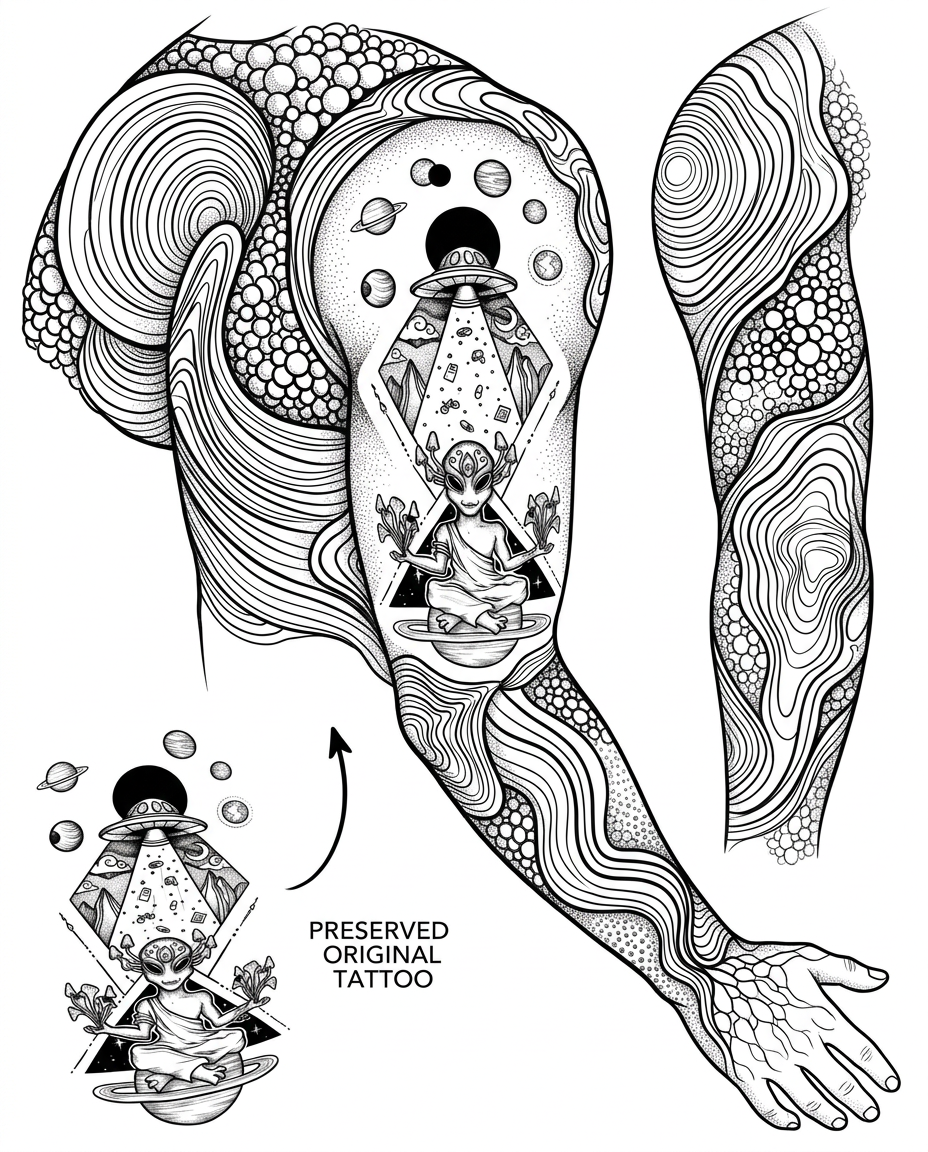
AI Design for Create a high-end custom black-and-white tattoo sleeve concept, designed as professional tattoo linework and stencil artwork. Use the supplied reference images as direct visual references for composition, pattern language, density, and line quality.
The design is an extension around an existing tattoo, not a cover-up. The existing alien/space tattoo must remain completely untouched, clearly visible, and visually dominant. Treat the existing tattoo as the primary foreground focal point and build a new organic sleeve environment around it. only illustration on solid white background

1. Overall Concept — “Flipped Geometry”
Create the visual opposite of the user's existing geometric sleeve.
The reference geometric arm demonstrates:
- structured geometric blocks
- angular forms
- sacred-geometry influence
- strong negative-space control
- repeating mathematical patterns
- clearly separated sections
For this arm, reverse that visual hierarchy:
Primary language: organic, fluid, psychedelic, topographical linework
Secondary language: structured sectional composition
The result should feel like organic geometry—highly controlled and intentionally composed, but made from flowing biological forms rather than rigid polygons.
2. Preserve the Existing Tattoo
The existing tattoo contains a central alien figure, UFO/spacecraft element, light-beam composition, geometric diamond framing, and planets/celestial elements toward the shoulder.
These elements are sacrosanct:
- Do not redraw them.
- Do not cover them.
- Do not distort them.
- Do not place dense patterns directly over them.
- Do not merge the background linework into the alien figure.
- Maintain a clean visual boundary around the original tattoo.
- Preserve enough negative space around the existing focal image for it to remain immediately readable.
- The original tattoo should appear slightly darker, sharper, and more visually important than the new surrounding work.
The new tattoo should look as though it grew around the original piece, rather than being placed on top of it.
3. Organic Background Language
Build the new sleeve from flowing psychedelic black-and-white linework, inspired by the supplied abstract pattern reference.
Use:
- long undulating contour lines
- warped parallel lines
- topographical wave patterns
- flowing ribbons
- concentric organic shapes
- cellular/bubble clusters
- dotted gradients
- stippled fields
- small repeated scallop forms
- curved stripe systems
- organic zebra-like contours
- distorted concentric forms
- microscopic/cellular textures
- fluid transitions between dense and open areas
The lines should bend, stretch, compress, spiral, and flow around the anatomy.
Avoid random doodling. Every pattern should have a deliberate directional flow that follows the arm's musculature.
4. Sectional Composition
Although the artwork is organic, divide the sleeve into distinct interconnected zones.
Think of the composition as approximately 6–10 large flowing sections, each containing a different organic pattern language.
For example:
Section A — Shoulder:
Large flowing contour waves and cellular formations wrapping around the shoulder cap.
Section B — Upper outer arm:
Long psychedelic ribbons and topographical contours flowing vertically around the existing tattoo.
Section C — Upper inner arm:
More densely packed cellular/stippled textures, allowing the pattern to become visually quieter as it approaches the focal tattoo.
Section D — Elbow transition:
Compressed, distorted lines that bend naturally around the elbow, creating a visual transition between sections.
Section E — Forearm:
Longer, sweeping organic ribbons mixed with repeated contour patterns and negative-space channels.
Section F — Wrist/hand:
The pattern becomes finer and more controlled, gradually narrowing toward the wrist and continuing organically onto the hand.
The sections should interlock seamlessly, with no obvious hard borders. Use changes in line direction, density, texture, and negative space to define each zone.
5. Depth Hierarchy
This is extremely important.
Create three visual levels:
Foreground:
Existing alien/space tattoo — strongest contrast, clearest forms, highest visual authority.
Middle ground:
Large organic sleeve structures — flowing contour ribbons and major pattern fields.
Background:
Fine stippling, cellular textures, thin repeated lines, subtle micro-patterns.
As the new pattern approaches the alien tattoo, reduce line density and visual weight so the focal tattoo naturally comes forward.
Use negative space strategically rather than filling every available area.
6. Anatomy-Aware Flow
Design the artwork specifically as a wraparound arm tattoo, not as a flat decorative illustration.
The organic lines should:
- follow the shoulder curvature
- wrap around the bicep and tricep
- flow through the elbow transition
- follow forearm muscle direction
- taper toward the wrist
- continue naturally onto the back/top of the hand
- accommodate joints and anatomical movement
- avoid awkward tangencies
- maintain readable negative-space channels
The pattern should look convincing when wrapped around a real human arm.
7. Hand Extension
Extend the design onto the hand, but keep it visually lighter and more refined than the main sleeve.
Use narrower flowing lines, small organic cellular patterns, and controlled contour bands.
The hand design should feel like the sleeve naturally continues into the hand, rather than appearing as a separate tattoo.
Keep major joints and knuckle areas relatively breathable so the design remains readable as the tattoo ages.
8. Black-and-White Tattoo Treatment
Pure black ink on white skin.
No color.
No grey watercolor effect.
No photorealism.
No decorative color gradients.
Use tattoo-appropriate:
- solid black
- clean linework
- varied line weights
- stippling
- dot gradients
- controlled blackwork
- negative space
- carefully balanced black-to-skin ratio
The linework should be extremely crisp, technically clean, tattooable, and stencil-friendly.
Avoid excessively microscopic details that would become muddy when tattooed.
9. Style Direction
The visual character should combine:
psychedelic organic linework + topographical mapping + cellular structures + fluid blackwork + contemporary ornamental tattoo design.
It should feel modern, minimalist, sophisticated, experimental, and highly intentional, rather than traditional tribal, generic mandala, or random psychedelic art.
The reference pattern should influence the line vocabulary, while the geometric sleeve reference should influence the organization and sectional discipline.
The final result should communicate:
organic chaos controlled by geometric composition.

10. Presentation / Output
Show the design as a professional tattoo artist concept sheet:
1. Full-arm tattoo placement view — showing the complete sleeve from shoulder to hand.
2. Three-quarter arm view — demonstrating how the patterns wrap around the anatomy.
3. Flat tattoo stencil/wrap layout — showing the pattern unfolded into a clean 2D arm template.
4. Clean black-and-white stencil version — isolated artwork on white.
5. Existing alien tattoo clearly preserved as the central focal element.
Use high-resolution professional tattoo-design presentation, clean white background, sharp black ink, precise contours, sophisticated negative-space management, no skin-rendering distractions in the stencil view.
The final design must look like something a highly experienced contemporary blackwork tattoo artist could actually stencil and tattoo—not an AI-generated decorative pattern.
Negative Prompt
Avoid: covering the existing tattoo, altering the alien figure, changing the original tattoo's proportions, geometric-only patterns, rigid mandalas, generic tribal tattoo, random doodles, excessive black fill, muddy shading, photorealism, color, watercolor, 3D effects, typography, symbols unrelated to the existing tattoo, disconnected pattern fragments, symmetrical full-arm mandala composition, overly dense micro-detail, illegible linework, flat clip-art appearance, ornamental wallpaper effect, or patterns that compete with the central alien tattoo

Create a high-end custom black-and-white tattoo sleeve concept, designed as professional tattoo linework and stencil artwork. Use the supplied reference images as direct visual references for composition, pattern language, density, and line quality. The design is an extension around an existing tattoo, not a cover-up. The existing alien/space tattoo must remain completely untouched, clearly visible, and visually dominant. Treat the existing tattoo as the primary foreground focal point and build a new organic sleeve environment around it. only illustration on solid white background 1. Overall Concept — “Flipped Geometry” Create the visual opposite of the user's existing geometric sleeve. The reference geometric arm demonstrates: - structured geometric blocks - angular forms - sacred-geometry influence - strong negative-space control - repeating mathematical patterns - clearly separated sections For this arm, reverse that visual hierarchy: Primary language: organic, fluid, psychedelic, topographical linework Secondary language: structured sectional composition The result should feel like organic geometry—highly controlled and intentionally composed, but made from flowing biological forms rather than rigid polygons. 2. Preserve the Existing Tattoo The existing tattoo contains a central alien figure, UFO/spacecraft element, light-beam composition, geometric diamond framing, and planets/celestial elements toward the shoulder. These elements are sacrosanct: - Do not redraw them. - Do not cover them. - Do not distort them. - Do not place dense patterns directly over them. - Do not merge the background linework into the alien figure. - Maintain a clean visual boundary around the original tattoo. - Preserve enough negative space around the existing focal image for it to remain immediately readable. - The original tattoo should appear slightly darker, sharper, and more visually important than the new surrounding work. The new tattoo should look as though it grew around the original piece, rather than being placed on top of it. 3. Organic Background Language Build the new sleeve from flowing psychedelic black-and-white linework, inspired by the supplied abstract pattern reference. Use: - long undulating contour lines - warped parallel lines - topographical wave patterns - flowing ribbons - concentric organic shapes - cellular/bubble clusters - dotted gradients - stippled fields - small repeated scallop forms - curved stripe systems - organic zebra-like contours - distorted concentric forms - microscopic/cellular textures - fluid transitions between dense and open areas The lines should bend, stretch, compress, spiral, and flow around the anatomy. Avoid random doodling. Every pattern should have a deliberate directional flow that follows the arm's musculature. 4. Sectional Composition Although the artwork is organic, divide the sleeve into distinct interconnected zones. Think of the composition as approximately 6–10 large flowing sections, each containing a different organic pattern language. For example: Section A — Shoulder: Large flowing contour waves and cellular formations wrapping around the shoulder cap. Section B — Upper outer arm: Long psychedelic ribbons and topographical contours flowing vertically around the existing tattoo. Section C — Upper inner arm: More densely packed cellular/stippled textures, allowing the pattern to become visually quieter as it approaches the focal tattoo. Section D — Elbow transition: Compressed, distorted lines that bend naturally around the elbow, creating a visual transition between sections. Section E — Forearm: Longer, sweeping organic ribbons mixed with repeated contour patterns and negative-space channels. Section F — Wrist/hand: The pattern becomes finer and more controlled, gradually narrowing toward the wrist and continuing organically onto the hand. The sections should interlock seamlessly, with no obvious hard borders. Use changes in line direction, density, texture, and negative space to define each zone. 5. Depth Hierarchy This is extremely important. Create three visual levels: Foreground: Existing alien/space tattoo — strongest contrast, clearest forms, highest visual authority. Middle ground: Large organic sleeve structures — flowing contour ribbons and major pattern fields. Background: Fine stippling, cellular textures, thin repeated lines, subtle micro-patterns. As the new pattern approaches the alien tattoo, reduce line density and visual weight so the focal tattoo naturally comes forward. Use negative space strategically rather than filling every available area. 6. Anatomy-Aware Flow Design the artwork specifically as a wraparound arm tattoo, not as a flat decorative illustration. The organic lines should: - follow the shoulder curvature - wrap around the bicep and tricep - flow through the elbow transition - follow forearm muscle direction - taper toward the wrist - continue naturally onto the back/top of the hand - accommodate joints and anatomical movement - avoid awkward tangencies - maintain readable negative-space channels The pattern should look convincing when wrapped around a real human arm. 7. Hand Extension Extend the design onto the hand, but keep it visually lighter and more refined than the main sleeve. Use narrower flowing lines, small organic cellular patterns, and controlled contour bands. The hand design should feel like the sleeve naturally continues into the hand, rather than appearing as a separate tattoo. Keep major joints and knuckle areas relatively breathable so the design remains readable as the tattoo ages. 8. Black-and-White Tattoo Treatment Pure black ink on white skin. No color. No grey watercolor effect. No photorealism. No decorative color gradients. Use tattoo-appropriate: - solid black - clean linework - varied line weights - stippling - dot gradients - controlled blackwork - negative space - carefully balanced black-to-skin ratio The linework should be extremely crisp, technically clean, tattooable, and stencil-friendly. Avoid excessively microscopic details that would become muddy when tattooed. 9. Style Direction The visual character should combine: psychedelic organic linework + topographical mapping + cellular structures + fluid blackwork + contemporary ornamental tattoo design. It should feel modern, minimalist, sophisticated, experimental, and highly intentional, rather than traditional tribal, generic mandala, or random psychedelic art. The reference pattern should influence the line vocabulary, while the geometric sleeve reference should influence the organization and sectional discipline. The final result should communicate: organic chaos controlled by geometric composition. 10. Presentation / Output Show the design as a professional tattoo artist concept sheet: 1. Full-arm tattoo placement view — showing the complete sleeve from shoulder to hand. 2. Three-quarter arm view — demonstrating how the patterns wrap around the anatomy. 3. Flat tattoo stencil/wrap layout — showing the pattern unfolded into a clean 2D arm template. 4. Clean black-and-white stencil version — isolated artwork on white. 5. Existing alien tattoo clearly preserved as the central focal element. Use high-resolution professional tattoo-design presentation, clean white background, sharp black ink, precise contours, sophisticated negative-space management, no skin-rendering distractions in the stencil view. The final design must look like something a highly experienced contemporary blackwork tattoo artist could actually stencil and tattoo—not an AI-generated decorative pattern. Negative Prompt Avoid: covering the existing tattoo, altering the alien figure, changing the original tattoo's proportions, geometric-only patterns, rigid mandalas, generic tribal tattoo, random doodles, excessive black fill, muddy shading, photorealism, color, watercolor, 3D effects, typography, symbols unrelated to the existing tattoo, disconnected pattern fragments, symmetrical full-arm mandala composition, overly dense micro-detail, illegible linework, flat clip-art appearance, ornamental wallpaper effect, or patterns that compete with the central alien tattoo

by @Elephant_1649093
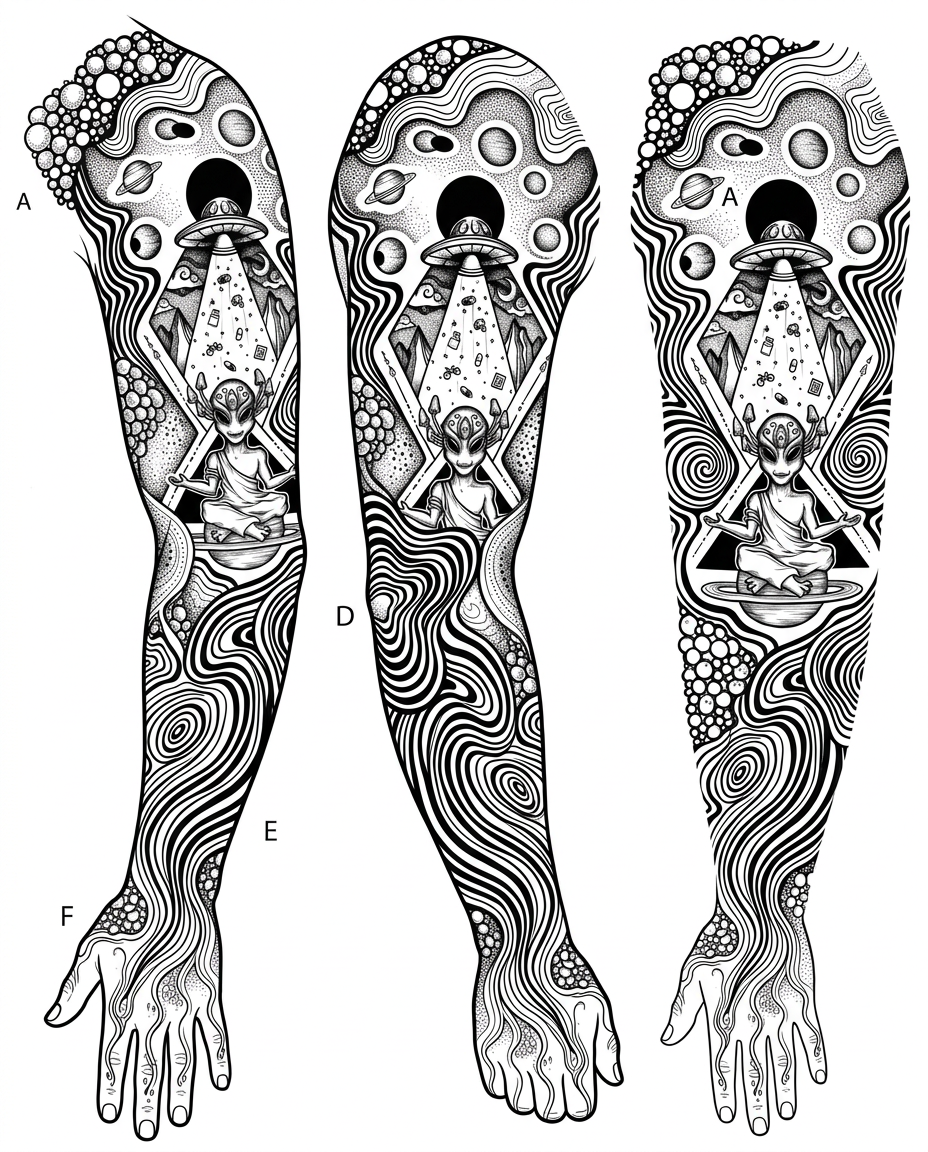
AI Design for Create a high-end custom black-and-white tattoo sleeve concept, designed as professional tattoo linework and stencil artwork. Use the supplied reference images as direct visual references for composition, pattern language, density, and line quality.
The design is an extension around an existing tattoo, not a cover-up. The existing alien/space tattoo must remain completely untouched, clearly visible, and visually dominant. Treat the existing tattoo as the primary foreground focal point and build a new organic sleeve environment around it. only illustration on solid white background

1. Overall Concept — “Flipped Geometry”
Create the visual opposite of the user's existing geometric sleeve.
The reference geometric arm demonstrates:
- structured geometric blocks
- angular forms
- sacred-geometry influence
- strong negative-space control
- repeating mathematical patterns
- clearly separated sections
For this arm, reverse that visual hierarchy:
Primary language: organic, fluid, psychedelic, topographical linework
Secondary language: structured sectional composition
The result should feel like organic geometry—highly controlled and intentionally composed, but made from flowing biological forms rather than rigid polygons.
2. Preserve the Existing Tattoo
The existing tattoo contains a central alien figure, UFO/spacecraft element, light-beam composition, geometric diamond framing, and planets/celestial elements toward the shoulder.
These elements are sacrosanct:
- Do not redraw them.
- Do not cover them.
- Do not distort them.
- Do not place dense patterns directly over them.
- Do not merge the background linework into the alien figure.
- Maintain a clean visual boundary around the original tattoo.
- Preserve enough negative space around the existing focal image for it to remain immediately readable.
- The original tattoo should appear slightly darker, sharper, and more visually important than the new surrounding work.
The new tattoo should look as though it grew around the original piece, rather than being placed on top of it.
3. Organic Background Language
Build the new sleeve from flowing psychedelic black-and-white linework, inspired by the supplied abstract pattern reference.
Use:
- long undulating contour lines
- warped parallel lines
- topographical wave patterns
- flowing ribbons
- concentric organic shapes
- cellular/bubble clusters
- dotted gradients
- stippled fields
- small repeated scallop forms
- curved stripe systems
- organic zebra-like contours
- distorted concentric forms
- microscopic/cellular textures
- fluid transitions between dense and open areas
The lines should bend, stretch, compress, spiral, and flow around the anatomy.
Avoid random doodling. Every pattern should have a deliberate directional flow that follows the arm's musculature.
4. Sectional Composition
Although the artwork is organic, divide the sleeve into distinct interconnected zones.
Think of the composition as approximately 6–10 large flowing sections, each containing a different organic pattern language.
For example:
Section A — Shoulder:
Large flowing contour waves and cellular formations wrapping around the shoulder cap.
Section B — Upper outer arm:
Long psychedelic ribbons and topographical contours flowing vertically around the existing tattoo.
Section C — Upper inner arm:
More densely packed cellular/stippled textures, allowing the pattern to become visually quieter as it approaches the focal tattoo.
Section D — Elbow transition:
Compressed, distorted lines that bend naturally around the elbow, creating a visual transition between sections.
Section E — Forearm:
Longer, sweeping organic ribbons mixed with repeated contour patterns and negative-space channels.
Section F — Wrist/hand:
The pattern becomes finer and more controlled, gradually narrowing toward the wrist and continuing organically onto the hand.
The sections should interlock seamlessly, with no obvious hard borders. Use changes in line direction, density, texture, and negative space to define each zone.
5. Depth Hierarchy
This is extremely important.
Create three visual levels:
Foreground:
Existing alien/space tattoo — strongest contrast, clearest forms, highest visual authority.
Middle ground:
Large organic sleeve structures — flowing contour ribbons and major pattern fields.
Background:
Fine stippling, cellular textures, thin repeated lines, subtle micro-patterns.
As the new pattern approaches the alien tattoo, reduce line density and visual weight so the focal tattoo naturally comes forward.
Use negative space strategically rather than filling every available area.
6. Anatomy-Aware Flow
Design the artwork specifically as a wraparound arm tattoo, not as a flat decorative illustration.
The organic lines should:
- follow the shoulder curvature
- wrap around the bicep and tricep
- flow through the elbow transition
- follow forearm muscle direction
- taper toward the wrist
- continue naturally onto the back/top of the hand
- accommodate joints and anatomical movement
- avoid awkward tangencies
- maintain readable negative-space channels
The pattern should look convincing when wrapped around a real human arm.
7. Hand Extension
Extend the design onto the hand, but keep it visually lighter and more refined than the main sleeve.
Use narrower flowing lines, small organic cellular patterns, and controlled contour bands.
The hand design should feel like the sleeve naturally continues into the hand, rather than appearing as a separate tattoo.
Keep major joints and knuckle areas relatively breathable so the design remains readable as the tattoo ages.
8. Black-and-White Tattoo Treatment
Pure black ink on white skin.
No color.
No grey watercolor effect.
No photorealism.
No decorative color gradients.
Use tattoo-appropriate:
- solid black
- clean linework
- varied line weights
- stippling
- dot gradients
- controlled blackwork
- negative space
- carefully balanced black-to-skin ratio
The linework should be extremely crisp, technically clean, tattooable, and stencil-friendly.
Avoid excessively microscopic details that would become muddy when tattooed.
9. Style Direction
The visual character should combine:
psychedelic organic linework + topographical mapping + cellular structures + fluid blackwork + contemporary ornamental tattoo design.
It should feel modern, minimalist, sophisticated, experimental, and highly intentional, rather than traditional tribal, generic mandala, or random psychedelic art.
The reference pattern should influence the line vocabulary, while the geometric sleeve reference should influence the organization and sectional discipline.
The final result should communicate:
organic chaos controlled by geometric composition.

10. Presentation / Output
Show the design as a professional tattoo artist concept sheet:
1. Full-arm tattoo placement view — showing the complete sleeve from shoulder to hand.
2. Three-quarter arm view — demonstrating how the patterns wrap around the anatomy.
3. Flat tattoo stencil/wrap layout — showing the pattern unfolded into a clean 2D arm template.
4. Clean black-and-white stencil version — isolated artwork on white.
5. Existing alien tattoo clearly preserved as the central focal element.
Use high-resolution professional tattoo-design presentation, clean white background, sharp black ink, precise contours, sophisticated negative-space management, no skin-rendering distractions in the stencil view.
The final design must look like something a highly experienced contemporary blackwork tattoo artist could actually stencil and tattoo—not an AI-generated decorative pattern.
Negative Prompt
Avoid: covering the existing tattoo, altering the alien figure, changing the original tattoo's proportions, geometric-only patterns, rigid mandalas, generic tribal tattoo, random doodles, excessive black fill, muddy shading, photorealism, color, watercolor, 3D effects, typography, symbols unrelated to the existing tattoo, disconnected pattern fragments, symmetrical full-arm mandala composition, overly dense micro-detail, illegible linework, flat clip-art appearance, ornamental wallpaper effect, or patterns that compete with the central alien tattoo

Create a high-end custom black-and-white tattoo sleeve concept, designed as professional tattoo linework and stencil artwork. Use the supplied reference images as direct visual references for composition, pattern language, density, and line quality. The design is an extension around an existing tattoo, not a cover-up. The existing alien/space tattoo must remain completely untouched, clearly visible, and visually dominant. Treat the existing tattoo as the primary foreground focal point and build a new organic sleeve environment around it. only illustration on solid white background 1. Overall Concept — “Flipped Geometry” Create the visual opposite of the user's existing geometric sleeve. The reference geometric arm demonstrates: - structured geometric blocks - angular forms - sacred-geometry influence - strong negative-space control - repeating mathematical patterns - clearly separated sections For this arm, reverse that visual hierarchy: Primary language: organic, fluid, psychedelic, topographical linework Secondary language: structured sectional composition The result should feel like organic geometry—highly controlled and intentionally composed, but made from flowing biological forms rather than rigid polygons. 2. Preserve the Existing Tattoo The existing tattoo contains a central alien figure, UFO/spacecraft element, light-beam composition, geometric diamond framing, and planets/celestial elements toward the shoulder. These elements are sacrosanct: - Do not redraw them. - Do not cover them. - Do not distort them. - Do not place dense patterns directly over them. - Do not merge the background linework into the alien figure. - Maintain a clean visual boundary around the original tattoo. - Preserve enough negative space around the existing focal image for it to remain immediately readable. - The original tattoo should appear slightly darker, sharper, and more visually important than the new surrounding work. The new tattoo should look as though it grew around the original piece, rather than being placed on top of it. 3. Organic Background Language Build the new sleeve from flowing psychedelic black-and-white linework, inspired by the supplied abstract pattern reference. Use: - long undulating contour lines - warped parallel lines - topographical wave patterns - flowing ribbons - concentric organic shapes - cellular/bubble clusters - dotted gradients - stippled fields - small repeated scallop forms - curved stripe systems - organic zebra-like contours - distorted concentric forms - microscopic/cellular textures - fluid transitions between dense and open areas The lines should bend, stretch, compress, spiral, and flow around the anatomy. Avoid random doodling. Every pattern should have a deliberate directional flow that follows the arm's musculature. 4. Sectional Composition Although the artwork is organic, divide the sleeve into distinct interconnected zones. Think of the composition as approximately 6–10 large flowing sections, each containing a different organic pattern language. For example: Section A — Shoulder: Large flowing contour waves and cellular formations wrapping around the shoulder cap. Section B — Upper outer arm: Long psychedelic ribbons and topographical contours flowing vertically around the existing tattoo. Section C — Upper inner arm: More densely packed cellular/stippled textures, allowing the pattern to become visually quieter as it approaches the focal tattoo. Section D — Elbow transition: Compressed, distorted lines that bend naturally around the elbow, creating a visual transition between sections. Section E — Forearm: Longer, sweeping organic ribbons mixed with repeated contour patterns and negative-space channels. Section F — Wrist/hand: The pattern becomes finer and more controlled, gradually narrowing toward the wrist and continuing organically onto the hand. The sections should interlock seamlessly, with no obvious hard borders. Use changes in line direction, density, texture, and negative space to define each zone. 5. Depth Hierarchy This is extremely important. Create three visual levels: Foreground: Existing alien/space tattoo — strongest contrast, clearest forms, highest visual authority. Middle ground: Large organic sleeve structures — flowing contour ribbons and major pattern fields. Background: Fine stippling, cellular textures, thin repeated lines, subtle micro-patterns. As the new pattern approaches the alien tattoo, reduce line density and visual weight so the focal tattoo naturally comes forward. Use negative space strategically rather than filling every available area. 6. Anatomy-Aware Flow Design the artwork specifically as a wraparound arm tattoo, not as a flat decorative illustration. The organic lines should: - follow the shoulder curvature - wrap around the bicep and tricep - flow through the elbow transition - follow forearm muscle direction - taper toward the wrist - continue naturally onto the back/top of the hand - accommodate joints and anatomical movement - avoid awkward tangencies - maintain readable negative-space channels The pattern should look convincing when wrapped around a real human arm. 7. Hand Extension Extend the design onto the hand, but keep it visually lighter and more refined than the main sleeve. Use narrower flowing lines, small organic cellular patterns, and controlled contour bands. The hand design should feel like the sleeve naturally continues into the hand, rather than appearing as a separate tattoo. Keep major joints and knuckle areas relatively breathable so the design remains readable as the tattoo ages. 8. Black-and-White Tattoo Treatment Pure black ink on white skin. No color. No grey watercolor effect. No photorealism. No decorative color gradients. Use tattoo-appropriate: - solid black - clean linework - varied line weights - stippling - dot gradients - controlled blackwork - negative space - carefully balanced black-to-skin ratio The linework should be extremely crisp, technically clean, tattooable, and stencil-friendly. Avoid excessively microscopic details that would become muddy when tattooed. 9. Style Direction The visual character should combine: psychedelic organic linework + topographical mapping + cellular structures + fluid blackwork + contemporary ornamental tattoo design. It should feel modern, minimalist, sophisticated, experimental, and highly intentional, rather than traditional tribal, generic mandala, or random psychedelic art. The reference pattern should influence the line vocabulary, while the geometric sleeve reference should influence the organization and sectional discipline. The final result should communicate: organic chaos controlled by geometric composition. 10. Presentation / Output Show the design as a professional tattoo artist concept sheet: 1. Full-arm tattoo placement view — showing the complete sleeve from shoulder to hand. 2. Three-quarter arm view — demonstrating how the patterns wrap around the anatomy. 3. Flat tattoo stencil/wrap layout — showing the pattern unfolded into a clean 2D arm template. 4. Clean black-and-white stencil version — isolated artwork on white. 5. Existing alien tattoo clearly preserved as the central focal element. Use high-resolution professional tattoo-design presentation, clean white background, sharp black ink, precise contours, sophisticated negative-space management, no skin-rendering distractions in the stencil view. The final design must look like something a highly experienced contemporary blackwork tattoo artist could actually stencil and tattoo—not an AI-generated decorative pattern. Negative Prompt Avoid: covering the existing tattoo, altering the alien figure, changing the original tattoo's proportions, geometric-only patterns, rigid mandalas, generic tribal tattoo, random doodles, excessive black fill, muddy shading, photorealism, color, watercolor, 3D effects, typography, symbols unrelated to the existing tattoo, disconnected pattern fragments, symmetrical full-arm mandala composition, overly dense micro-detail, illegible linework, flat clip-art appearance, ornamental wallpaper effect, or patterns that compete with the central alien tattoo

by @Elephant_1649093
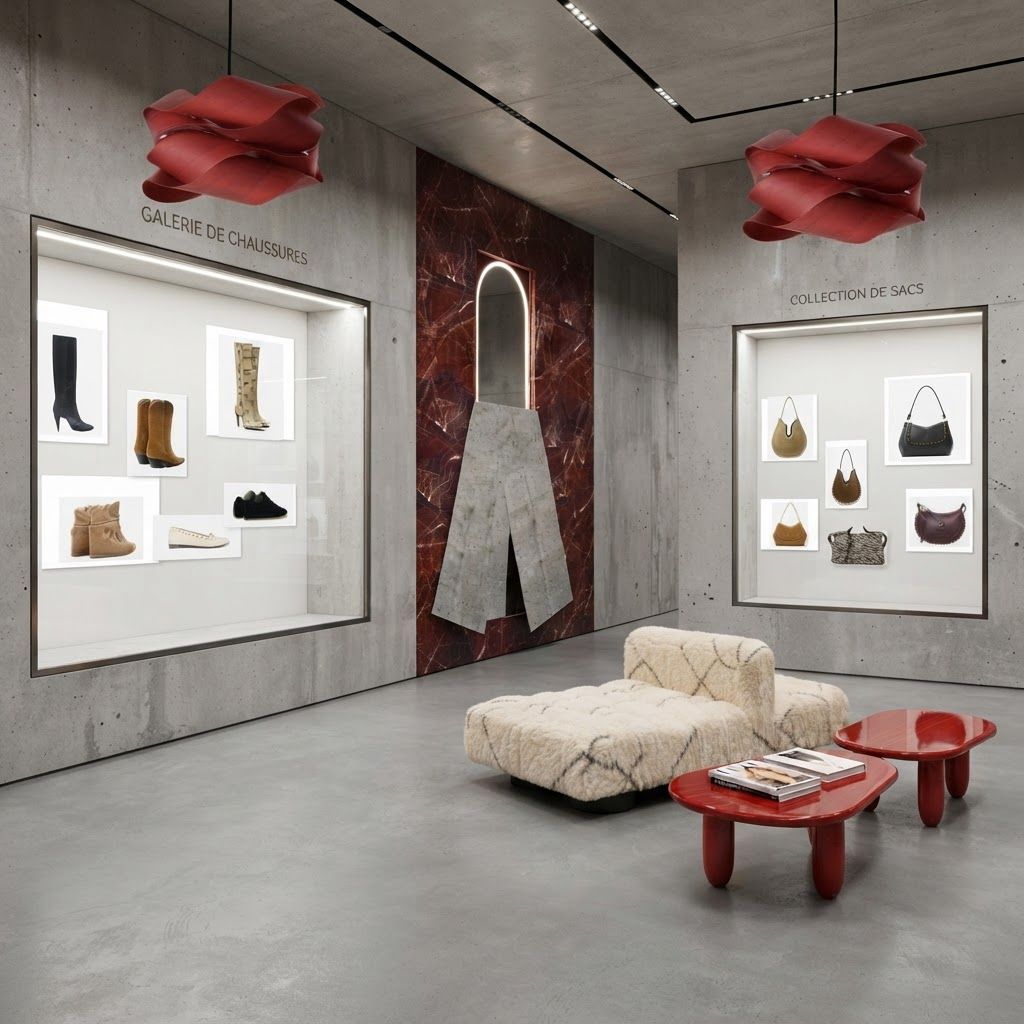
AI Design for make this look like a real store interior

make this look like a real store interior

by @Elephant_6618152

AI Design for make this look like a real store interior

make this look like a real store interior

by @Elephant_6618152

AI Design for Lifestyle product photograph of Retail Concept Mood Board being naturally used in a believable real-world setting. A retail mood board featuring images of designer boots and handbags, two glossy red pendant lights, a textured cream boucle sofa, red marble paneling, and a raw concrete wall background.

A retail mood board featuring images of designer boots and handbags, two glossy red pendant lights, a textured cream boucle sofa, red marble paneling, and a raw concrete wall background. Human-scale context, warm natural light, editorial composition, shallow depth of field, product clearly visible and undistorted.

Lifestyle product photograph of Retail Concept Mood Board being naturally used in a believable real-world setting. A retail mood board featuring images of designer boots and handbags, two glossy red pendant lights, a textured cream boucle sofa, red marble paneling, and a raw concrete wall background. A retail mood board featuring images of designer boots and handbags, two glossy red pendant lights, a textured cream boucle sofa, red marble paneling, and a raw concrete wall background. Human-scale context, warm natural light, editorial composition, shallow depth of field, product clearly visible and undistorted.

by @Elephant_6618152
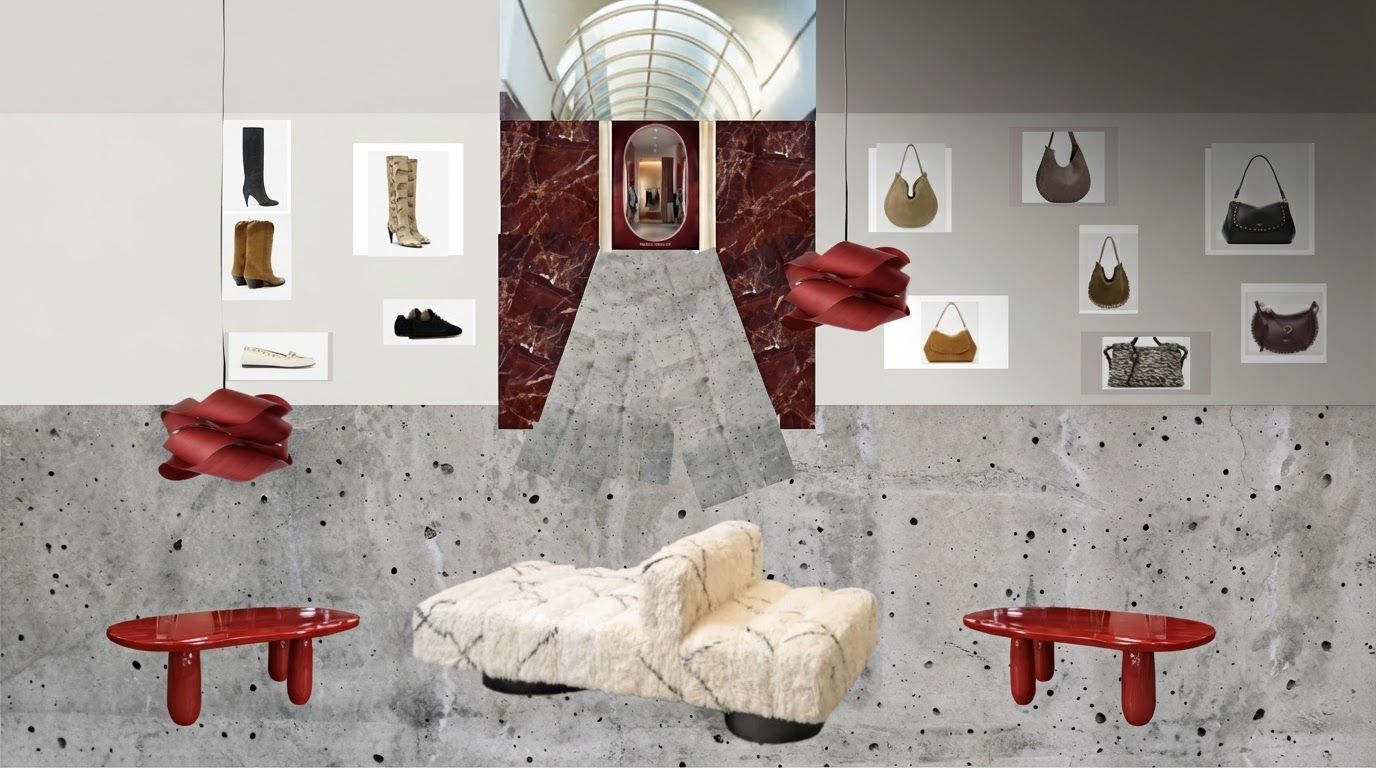
AI Design for Wide campaign hero photograph for Retail Concept Mood Board. A retail mood board featuring images of designer boots and handbags, two glossy red pendant lights, a textured cream boucle sofa, red marble paneling, and a raw concrete wall background.

A retail mood board featuring images of designer boots and handbags, two glossy red pendant lights, a textured cream boucle sofa, red marble paneling, and a raw concrete wall background. Premium advertising composition with the product as focal point, cinematic lighting, clean negative space on one side for copy to be added later, no rendered words or logos beyond the reference product.

Wide campaign hero photograph for Retail Concept Mood Board. A retail mood board featuring images of designer boots and handbags, two glossy red pendant lights, a textured cream boucle sofa, red marble paneling, and a raw concrete wall background. A retail mood board featuring images of designer boots and handbags, two glossy red pendant lights, a textured cream boucle sofa, red marble paneling, and a raw concrete wall background. Premium advertising composition with the product as focal point, cinematic lighting, clean negative space on one side for copy to be added later, no rendered words or logos beyond the reference product.

by @Elephant_6618152
AI Design for High-end studio product photograph of Retail Concept Mood Board. A retail mood board featuring images of designer boots and handbags, two glossy red pendant lights, a textured cream boucle sofa, red marble paneling, and a raw concrete wall background.

A retail mood board featuring images of designer boots and handbags, two glossy red pendant lights, a textured cream boucle sofa, red marble paneling, and a raw concrete wall background. Product centered as the clear hero, clean neutral background, controlled softbox lighting, realistic contact shadow, crisp edges, accurate material texture, no readable text added.

High-end studio product photograph of Retail Concept Mood Board. A retail mood board featuring images of designer boots and handbags, two glossy red pendant lights, a textured cream boucle sofa, red marble paneling, and a raw concrete wall background. A retail mood board featuring images of designer boots and handbags, two glossy red pendant lights, a textured cream boucle sofa, red marble paneling, and a raw concrete wall background. Product centered as the clear hero, clean neutral background, controlled softbox lighting, realistic contact shadow, crisp edges, accurate material texture, no readable text added.

by @Elephant_6618152
AI Design for یه فریم از ضربه به سمت چپ بالا با شمشیر بده با حفظ همه چیز و تعادل درختی     
با حذف بک گراند

یه فریم از ضربه به سمت چپ بالا با شمشیر بده با حفظ همه چیز و تعادل درختی با حذف بک گراند

by @Elephant_6022769

AI Design for یه فریم از ضربه به سمت چپ پایین با شمشیر بده با حفظ همه چیز و تعادل درختی    
با حذف بک گراند

یه فریم از ضربه به سمت چپ پایین با شمشیر بده با حفظ همه چیز و تعادل درختی با حذف بک گراند

by @Elephant_6022769

AI Design for Use the exact reference character and preserve her exact character design, face, hairstyle, armor, clothing, colors, proportions, ornaments, and anime/chibi art style.

Create ONE full-body sprite-sheet attack frame on a completely transparent background.

POSE CONSISTENCY IS CRITICAL:
Keep the exact same tree-balance stance from the reference.
The RIGHT FOOT must stay firmly planted on the ground.
The LEFT LEG must remain raised in the tree-balance position.
DO NOT swap the legs.
DO NOT mirror the character.
DO NOT reverse the stance.
DO NOT move, rotate, reposition, or change the planted foot.
DO NOT change the raised leg, knee, or lower-body position.
The entire lower body must remain identical.

ATTACK DIRECTION:
The character performs a powerful sword strike toward the UPPER LEFT.

The sword must point diagonally toward the upper left.
Both hands grip the sword naturally.
Rotate and twist ONLY the upper body, shoulders, arms, head, and sword toward the upper-left attack direction.
The character's face and eyes must clearly look toward the upper-left direction of the sword strike.

The legs and planted foot must remain completely unchanged while the upper body performs the attack.

Keep the character balanced and physically believable.
Full body visible.
Centered composition.
No cropping.
Transparent background.
No text.
No environment.
No extra characters.
No large effects.
Only a tiny, subtle motion effect at the sword tip.
Clean high-resolution PNG sprite style.

Use the exact reference character and preserve her exact character design, face, hairstyle, armor, clothing, colors, proportions, ornaments, and anime/chibi art style. Create ONE full-body sprite-sheet attack frame on a completely transparent background. POSE CONSISTENCY IS CRITICAL: Keep the exact same tree-balance stance from the reference. The RIGHT FOOT must stay firmly planted on the ground. The LEFT LEG must remain raised in the tree-balance position. DO NOT swap the legs. DO NOT mirror the character. DO NOT reverse the stance. DO NOT move, rotate, reposition, or change the planted foot. DO NOT change the raised leg, knee, or lower-body position. The entire lower body must remain identical. ATTACK DIRECTION: The character performs a powerful sword strike toward the UPPER LEFT. The sword must point diagonally toward the upper left. Both hands grip the sword naturally. Rotate and twist ONLY the upper body, shoulders, arms, head, and sword toward the upper-left attack direction. The character's face and eyes must clearly look toward the upper-left direction of the sword strike. The legs and planted foot must remain completely unchanged while the upper body performs the attack. Keep the character balanced and physically believable. Full body visible. Centered composition. No cropping. Transparent background. No text. No environment. No extra characters. No large effects. Only a tiny, subtle motion effect at the sword tip. Clean high-resolution PNG sprite style.

by @Elephant_6022769
AI Design for Use the exact reference character and preserve her exact character design, face, hairstyle, armor, clothing, colors, proportions, ornaments, and anime/chibi art style.

Create ONE full-body sprite-sheet attack frame on a completely transparent background.

POSE CONSISTENCY IS CRITICAL:
Keep the exact same tree-balance stance from the reference.
The RIGHT FOOT must stay firmly planted on the ground.
The LEFT LEG must remain raised in the tree-balance position.
DO NOT swap the legs.
DO NOT mirror the character.
DO NOT reverse the stance.
DO NOT move, rotate, reposition, or change the planted foot.
DO NOT change the raised leg, knee, or lower-body position.
The entire lower body must remain identical.

ATTACK DIRECTION:
The character performs a powerful sword strike toward the UPPER LEFT.

The sword must point diagonally toward the upper left.
Both hands grip the sword naturally.
Rotate and twist ONLY the upper body, shoulders, arms, head, and sword toward the upper-left attack direction.
The character's face and eyes must clearly look toward the upper-left direction of the sword strike.

The legs and planted foot must remain completely unchanged while the upper body performs the attack.

Keep the character balanced and physically believable.
Full body visible.
Centered composition.
No cropping.
Transparent background.
No text.
No environment.
No extra characters.
No large effects.
Only a tiny, subtle motion effect at the sword tip.
Clean high-resolution PNG sprite style.

Use the exact reference character and preserve her exact character design, face, hairstyle, armor, clothing, colors, proportions, ornaments, and anime/chibi art style. Create ONE full-body sprite-sheet attack frame on a completely transparent background. POSE CONSISTENCY IS CRITICAL: Keep the exact same tree-balance stance from the reference. The RIGHT FOOT must stay firmly planted on the ground. The LEFT LEG must remain raised in the tree-balance position. DO NOT swap the legs. DO NOT mirror the character. DO NOT reverse the stance. DO NOT move, rotate, reposition, or change the planted foot. DO NOT change the raised leg, knee, or lower-body position. The entire lower body must remain identical. ATTACK DIRECTION: The character performs a powerful sword strike toward the UPPER LEFT. The sword must point diagonally toward the upper left. Both hands grip the sword naturally. Rotate and twist ONLY the upper body, shoulders, arms, head, and sword toward the upper-left attack direction. The character's face and eyes must clearly look toward the upper-left direction of the sword strike. The legs and planted foot must remain completely unchanged while the upper body performs the attack. Keep the character balanced and physically believable. Full body visible. Centered composition. No cropping. Transparent background. No text. No environment. No extra characters. No large effects. Only a tiny, subtle motion effect at the sword tip. Clean high-resolution PNG sprite style.

by @Elephant_6022769
AI Design for Use the exact reference character and preserve her exact character design, face, hairstyle, armor, clothing, colors, proportions, ornaments, and anime/chibi art style.

Create ONE full-body sprite-sheet attack frame on a completely transparent background.

POSE CONSISTENCY IS CRITICAL:
Keep the exact same tree-balance stance from the reference.
The RIGHT FOOT must stay firmly planted on the ground.
The LEFT LEG must remain raised in the tree-balance position.
DO NOT swap the legs.
DO NOT mirror the character.
DO NOT reverse the stance.
DO NOT move, rotate, reposition, or change the planted foot.
DO NOT change the raised leg, knee, or lower-body position.
The entire lower body must remain identical.

ATTACK DIRECTION:
The character performs a powerful sword strike toward the UPPER LEFT.

The sword must point diagonally toward the upper left.
Both hands grip the sword naturally.
Rotate and twist ONLY the upper body, shoulders, arms, head, and sword toward the upper-left attack direction.
The character's face and eyes must clearly look toward the upper-left direction of the sword strike.

The legs and planted foot must remain completely unchanged while the upper body performs the attack.

Keep the character balanced and physically believable.
Full body visible.
Centered composition.
No cropping.
Transparent background.
No text.
No environment.
No extra characters.
No large effects.
Only a tiny, subtle motion effect at the sword tip.
Clean high-resolution PNG sprite style.

Use the exact reference character and preserve her exact character design, face, hairstyle, armor, clothing, colors, proportions, ornaments, and anime/chibi art style. Create ONE full-body sprite-sheet attack frame on a completely transparent background. POSE CONSISTENCY IS CRITICAL: Keep the exact same tree-balance stance from the reference. The RIGHT FOOT must stay firmly planted on the ground. The LEFT LEG must remain raised in the tree-balance position. DO NOT swap the legs. DO NOT mirror the character. DO NOT reverse the stance. DO NOT move, rotate, reposition, or change the planted foot. DO NOT change the raised leg, knee, or lower-body position. The entire lower body must remain identical. ATTACK DIRECTION: The character performs a powerful sword strike toward the UPPER LEFT. The sword must point diagonally toward the upper left. Both hands grip the sword naturally. Rotate and twist ONLY the upper body, shoulders, arms, head, and sword toward the upper-left attack direction. The character's face and eyes must clearly look toward the upper-left direction of the sword strike. The legs and planted foot must remain completely unchanged while the upper body performs the attack. Keep the character balanced and physically believable. Full body visible. Centered composition. No cropping. Transparent background. No text. No environment. No extra characters. No large effects. Only a tiny, subtle motion effect at the sword tip. Clean high-resolution PNG sprite style.

by @Elephant_6022769
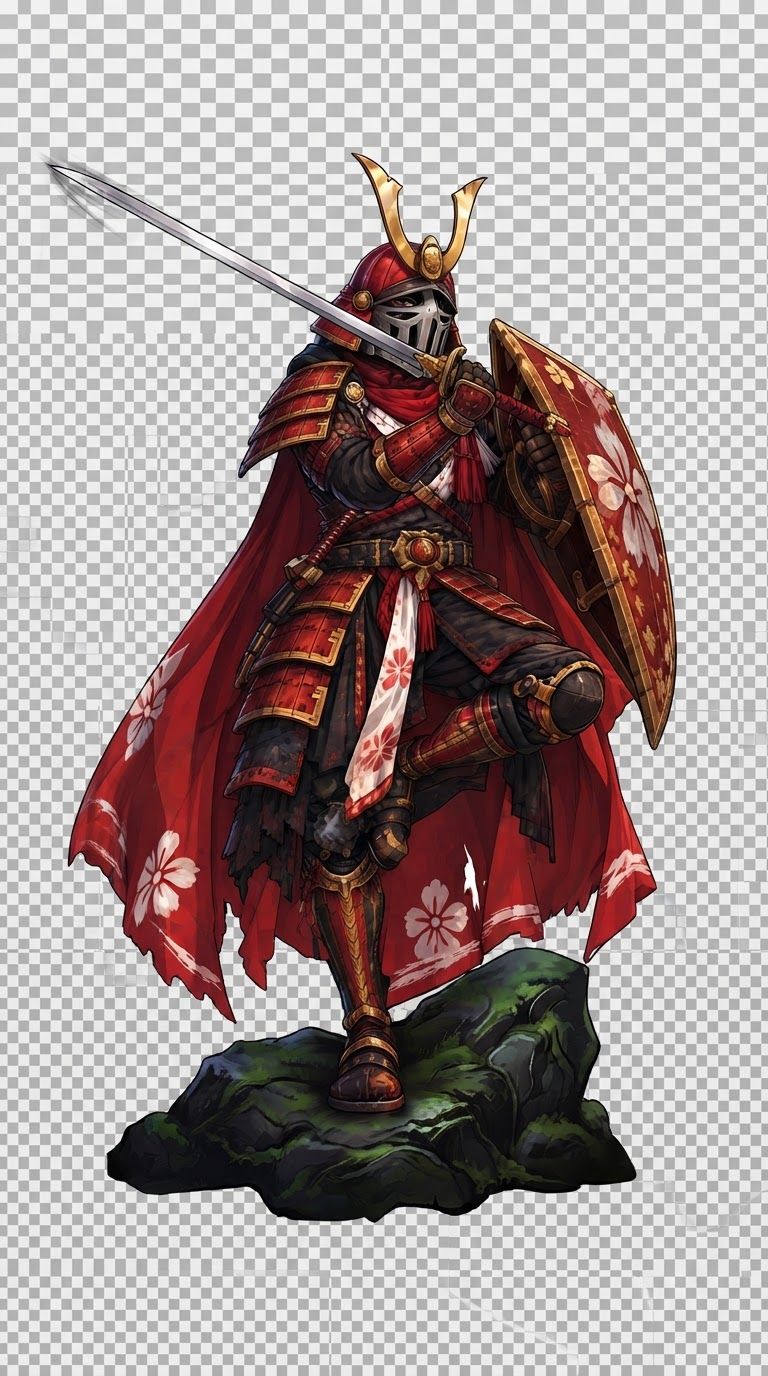
AI Design for Use the exact reference character and preserve her exact character design, face, hairstyle, armor, clothing, colors, proportions, ornaments, and anime/chibi art style.

Create ONE full-body sprite-sheet attack frame on a completely transparent background.

POSE CONSISTENCY IS CRITICAL:
Keep the exact same tree-balance stance from the reference.
The RIGHT FOOT must stay firmly planted on the ground.
The LEFT LEG must remain raised in the tree-balance position.
DO NOT swap the legs.
DO NOT mirror the character.
DO NOT reverse the stance.
DO NOT move, rotate, reposition, or change the planted foot.
DO NOT change the raised leg, knee, or lower-body position.
The entire lower body must remain identical.

ATTACK DIRECTION:
The character performs a powerful sword strike toward the UPPER LEFT.

The sword must point diagonally toward the upper left.
Both hands grip the sword naturally.
Rotate and twist ONLY the upper body, shoulders, arms, head, and sword toward the upper-left attack direction.
The character's face and eyes must clearly look toward the upper-left direction of the sword strike.

The legs and planted foot must remain completely unchanged while the upper body performs the attack.

Keep the character balanced and physically believable.
Full body visible.
Centered composition.
No cropping.
Transparent background.
No text.
No environment.
No extra characters.
No large effects.
Only a tiny, subtle motion effect at the sword tip.
Clean high-resolution PNG sprite style.

Use the exact reference character and preserve her exact character design, face, hairstyle, armor, clothing, colors, proportions, ornaments, and anime/chibi art style. Create ONE full-body sprite-sheet attack frame on a completely transparent background. POSE CONSISTENCY IS CRITICAL: Keep the exact same tree-balance stance from the reference. The RIGHT FOOT must stay firmly planted on the ground. The LEFT LEG must remain raised in the tree-balance position. DO NOT swap the legs. DO NOT mirror the character. DO NOT reverse the stance. DO NOT move, rotate, reposition, or change the planted foot. DO NOT change the raised leg, knee, or lower-body position. The entire lower body must remain identical. ATTACK DIRECTION: The character performs a powerful sword strike toward the UPPER LEFT. The sword must point diagonally toward the upper left. Both hands grip the sword naturally. Rotate and twist ONLY the upper body, shoulders, arms, head, and sword toward the upper-left attack direction. The character's face and eyes must clearly look toward the upper-left direction of the sword strike. The legs and planted foot must remain completely unchanged while the upper body performs the attack. Keep the character balanced and physically believable. Full body visible. Centered composition. No cropping. Transparent background. No text. No environment. No extra characters. No large effects. Only a tiny, subtle motion effect at the sword tip. Clean high-resolution PNG sprite style.

by @Elephant_6022769
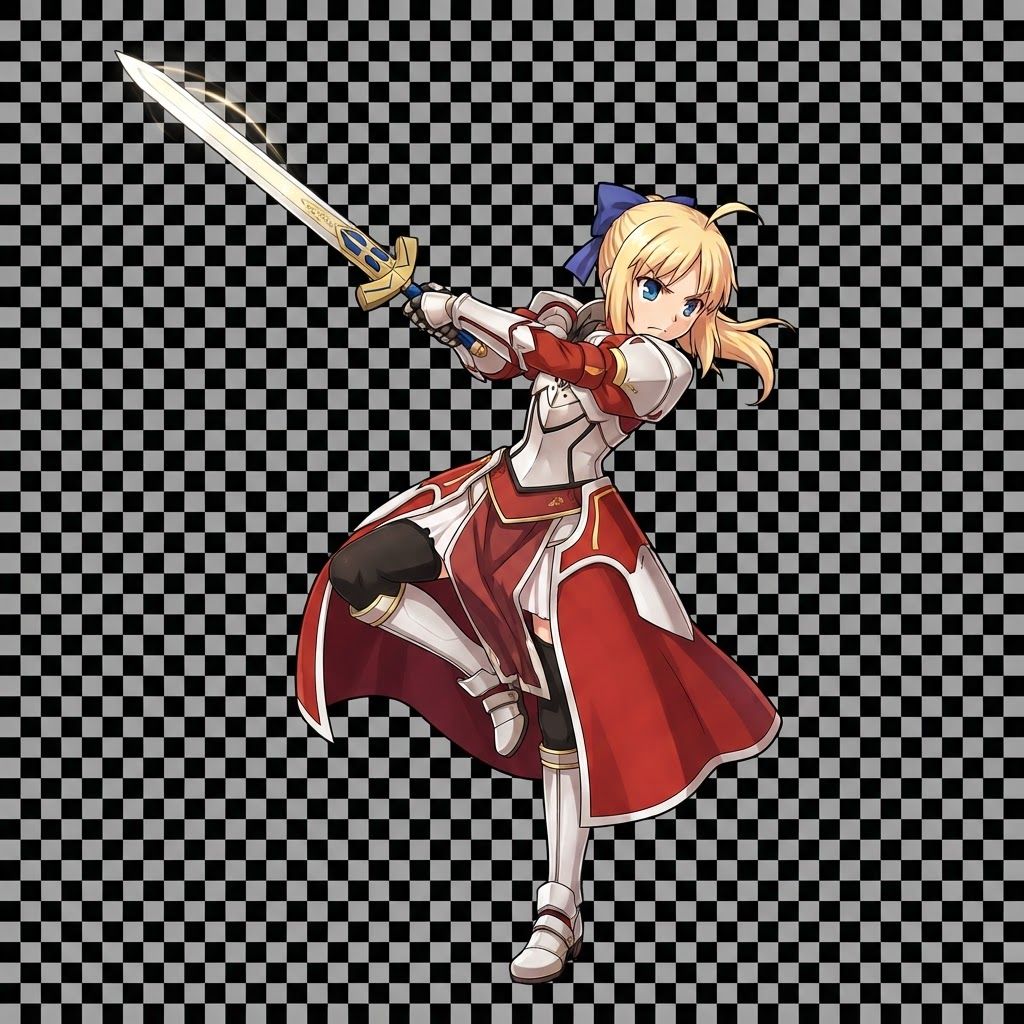
AI Design for Use the exact reference character and preserve her exact character design, face, hairstyle, armor, clothing, colors, proportions, ornaments, and anime/chibi art style.

Create ONE full-body sprite-sheet attack frame on a completely transparent background.

POSE CONSISTENCY IS CRITICAL:
Keep the exact same tree-balance stance from the reference.
The RIGHT FOOT must stay firmly planted on the ground.
The LEFT LEG must remain raised in the tree-balance position.
DO NOT swap the legs.
DO NOT mirror the character.
DO NOT reverse the stance.
DO NOT move, rotate, reposition, or change the planted foot.
DO NOT change the raised leg, knee, or lower-body position.
The entire lower body must remain identical.

ATTACK DIRECTION:
The character performs a powerful sword strike toward the UPPER LEFT.

The sword must point diagonally toward the upper left.
Both hands grip the sword naturally.
Rotate and twist ONLY the upper body, shoulders, arms, head, and sword toward the upper-left attack direction.
The character's face and eyes must clearly look toward the upper-left direction of the sword strike.

The legs and planted foot must remain completely unchanged while the upper body performs the attack.

Keep the character balanced and physically believable.
Full body visible.
Centered composition.
No cropping.
Transparent background.
No text.
No environment.
No extra characters.
No large effects.
Only a tiny, subtle motion effect at the sword tip.
Clean high-resolution PNG sprite style.

This is a square 1:1 image for posts. Fill the whole frame edge to edge and scale the subject large. Do not leave empty margin.

Use the exact reference character and preserve her exact character design, face, hairstyle, armor, clothing, colors, proportions, ornaments, and anime/chibi art style. Create ONE full-body sprite-sheet attack frame on a completely transparent background. POSE CONSISTENCY IS CRITICAL: Keep the exact same tree-balance stance from the reference. The RIGHT FOOT must stay firmly planted on the ground. The LEFT LEG must remain raised in the tree-balance position. DO NOT swap the legs. DO NOT mirror the character. DO NOT reverse the stance. DO NOT move, rotate, reposition, or change the planted foot. DO NOT change the raised leg, knee, or lower-body position. The entire lower body must remain identical. ATTACK DIRECTION: The character performs a powerful sword strike toward the UPPER LEFT. The sword must point diagonally toward the upper left. Both hands grip the sword naturally. Rotate and twist ONLY the upper body, shoulders, arms, head, and sword toward the upper-left attack direction. The character's face and eyes must clearly look toward the upper-left direction of the sword strike. The legs and planted foot must remain completely unchanged while the upper body performs the attack. Keep the character balanced and physically believable. Full body visible. Centered composition. No cropping. Transparent background. No text. No environment. No extra characters. No large effects. Only a tiny, subtle motion effect at the sword tip. Clean high-resolution PNG sprite style. This is a square 1:1 image for posts. Fill the whole frame edge to edge and scale the subject large. Do not leave empty margin.

by @Elephant_6022769
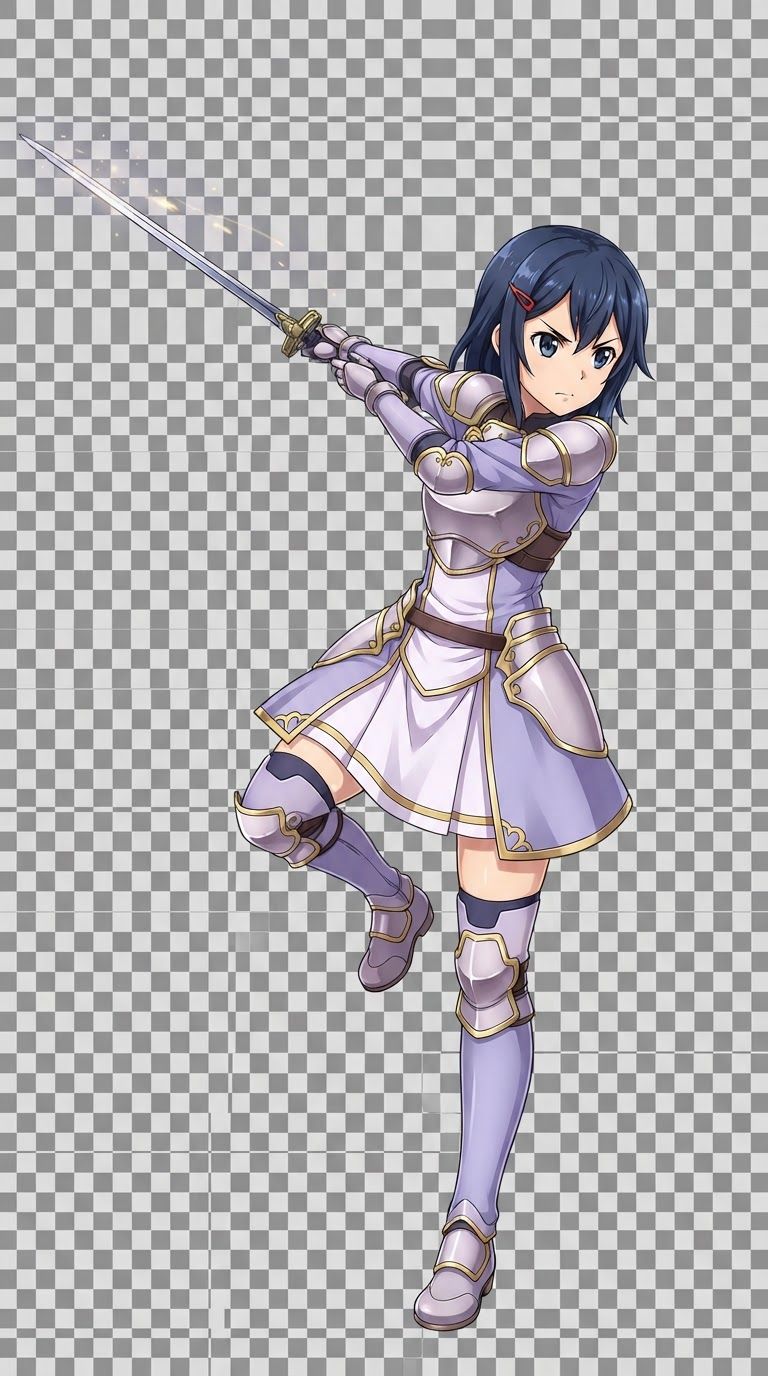
AI Design for Use the exact reference character and preserve her exact character design, face, hairstyle, armor, clothing, colors, proportions, ornaments, and anime/chibi art style.

Create ONE full-body sprite-sheet attack frame on a completely transparent background.

POSE CONSISTENCY IS CRITICAL:
Keep the exact same tree-balance stance from the reference.
The RIGHT FOOT must stay firmly planted on the ground.
The LEFT LEG must remain raised in the tree-balance position.
DO NOT swap the legs.
DO NOT mirror the character.
DO NOT reverse the stance.
DO NOT move, rotate, reposition, or change the planted foot.
DO NOT change the raised leg, knee, or lower-body position.
The entire lower body must remain identical.

ATTACK DIRECTION:
The character performs a powerful sword strike toward the UPPER LEFT.

The sword must point diagonally toward the upper left.
Both hands grip the sword naturally.
Rotate and twist ONLY the upper body, shoulders, arms, head, and sword toward the upper-left attack direction.
The character's face and eyes must clearly look toward the upper-left direction of the sword strike.

The legs and planted foot must remain completely unchanged while the upper body performs the attack.

Keep the character balanced and physically believable.
Full body visible.
Centered composition.
No cropping.
Transparent background.
No text.
No environment.
No extra characters.
No large effects.
Only a tiny, subtle motion effect at the sword tip.
Clean high-resolution PNG sprite style.

This is a tall 9:16 image for stories. Design the layout for that shape. Fill the whole frame edge to edge and scale the subject large. Do not leave empty margin.

Use the exact reference character and preserve her exact character design, face, hairstyle, armor, clothing, colors, proportions, ornaments, and anime/chibi art style. Create ONE full-body sprite-sheet attack frame on a completely transparent background. POSE CONSISTENCY IS CRITICAL: Keep the exact same tree-balance stance from the reference. The RIGHT FOOT must stay firmly planted on the ground. The LEFT LEG must remain raised in the tree-balance position. DO NOT swap the legs. DO NOT mirror the character. DO NOT reverse the stance. DO NOT move, rotate, reposition, or change the planted foot. DO NOT change the raised leg, knee, or lower-body position. The entire lower body must remain identical. ATTACK DIRECTION: The character performs a powerful sword strike toward the UPPER LEFT. The sword must point diagonally toward the upper left. Both hands grip the sword naturally. Rotate and twist ONLY the upper body, shoulders, arms, head, and sword toward the upper-left attack direction. The character's face and eyes must clearly look toward the upper-left direction of the sword strike. The legs and planted foot must remain completely unchanged while the upper body performs the attack. Keep the character balanced and physically believable. Full body visible. Centered composition. No cropping. Transparent background. No text. No environment. No extra characters. No large effects. Only a tiny, subtle motion effect at the sword tip. Clean high-resolution PNG sprite style. This is a tall 9:16 image for stories. Design the layout for that shape. Fill the whole frame edge to edge and scale the subject large. Do not leave empty margin.

by @Elephant_6022769
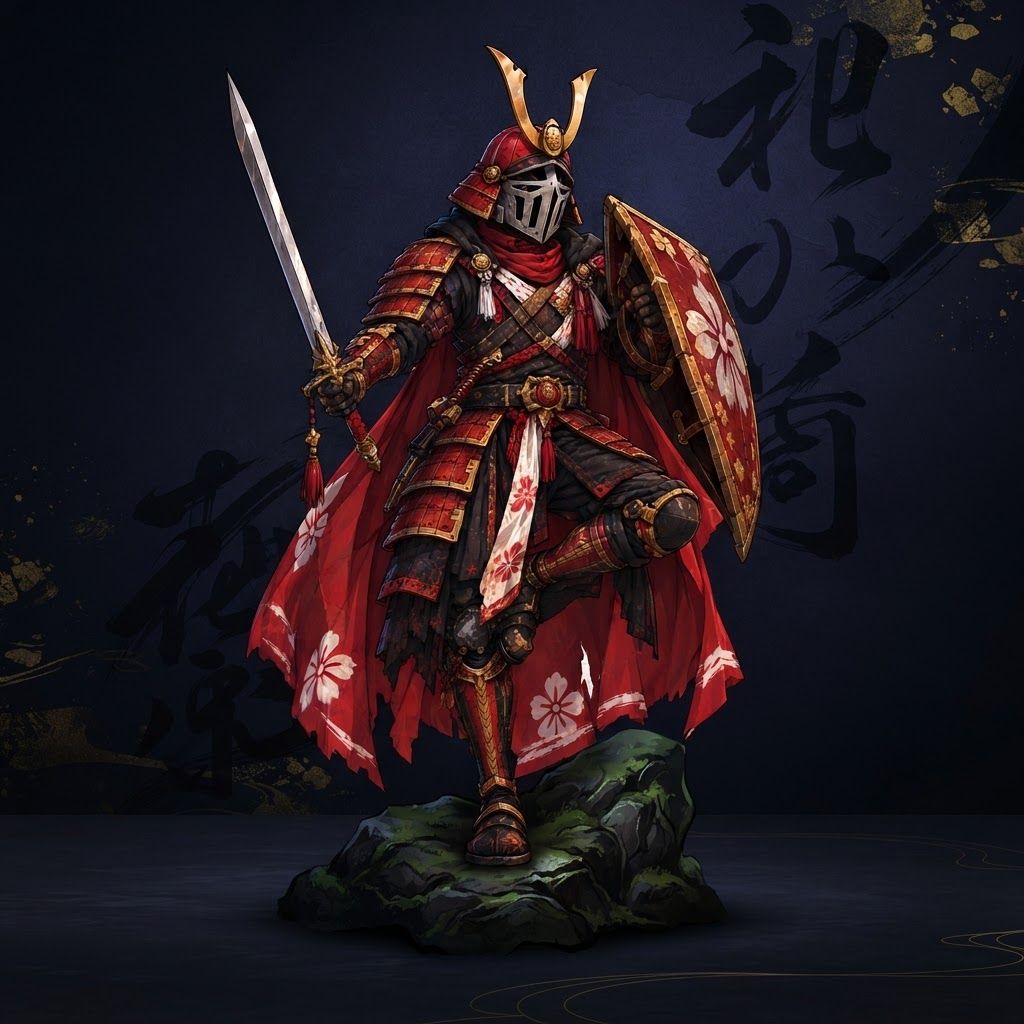
AI Design for Social campaign preview for  brand. Portrait campaign visual that feels ready for client approval, clear focal image, cohesive art direction, clean space for copy to be added later, no generated text.

Incorporate the attached brand element reference image (Reference A: brand element "Red Armored Samurai Warrior") into the composition where natural — preserve the depicted brand element's appearance.

Social campaign preview for brand. Portrait campaign visual that feels ready for client approval, clear focal image, cohesive art direction, clean space for copy to be added later, no generated text. Incorporate the attached brand element reference image (Reference A: brand element "Red Armored Samurai Warrior") into the composition where natural — preserve the depicted brand element's appearance.

by @Elephant_6022769
AI Design for Main campaign hero visual for  brand. Cinematic advertising image with a clear subject, memorable visual idea, strong depth and lighting, premium art direction, clean negative space for headline and CTA to be added later, no generated text.

Incorporate the attached brand element reference image (Reference A: brand element "Red Armored Samurai Warrior") into the composition where natural — preserve the depicted brand element's appearance.

Main campaign hero visual for brand. Cinematic advertising image with a clear subject, memorable visual idea, strong depth and lighting, premium art direction, clean negative space for headline and CTA to be added later, no generated text. Incorporate the attached brand element reference image (Reference A: brand element "Red Armored Samurai Warrior") into the composition where natural — preserve the depicted brand element's appearance.

by @Elephant_6022769
AI Design for Packaging design route for  brand. Client-presentation mockup with boxes, bags, labels, wraps, or product containers, realistic print finish, cohesive visual system, no fake readable text.

Incorporate the attached brand element reference image (Reference A: brand element "Red Armored Samurai Warrior") into the composition where natural — preserve the depicted brand element's appearance.

Packaging design route for brand. Client-presentation mockup with boxes, bags, labels, wraps, or product containers, realistic print finish, cohesive visual system, no fake readable text. Incorporate the attached brand element reference image (Reference A: brand element "Red Armored Samurai Warrior") into the composition where natural — preserve the depicted brand element's appearance.

by @Elephant_6022769
AI Design for Day 1: Grounding & Beginnings (Maa Shailaputri)
Prompt: A minimalist abstract 3D geometric mountain crest made of textured raw granite and dark marble, sliced cleanly through the center by a sharp glowing vertical metallic gold line. Matte terracotta orange studio background, luxury aesthetic, smooth shadows, divine grounding theme, high-end product design style.

Day 1: Grounding & Beginnings (Maa Shailaputri) Prompt: A minimalist abstract 3D geometric mountain crest made of textured raw granite and dark marble, sliced cleanly through the center by a sharp glowing vertical metallic gold line. Matte terracotta orange studio background, luxury aesthetic, smooth shadows, divine grounding theme, high-end product design style.

by @Elephant_4704913
AI Design for Day 1: Grounding & Beginnings (Maa Shailaputri)
Prompt: A minimalist abstract 3D geometric mountain crest made of textured raw granite and dark marble, sliced cleanly through the center by a sharp glowing vertical metallic gold line. Matte terracotta orange studio background, luxury aesthetic, smooth shadows, divine grounding theme, high-end product design style.

Day 1: Grounding & Beginnings (Maa Shailaputri) Prompt: A minimalist abstract 3D geometric mountain crest made of textured raw granite and dark marble, sliced cleanly through the center by a sharp glowing vertical metallic gold line. Matte terracotta orange studio background, luxury aesthetic, smooth shadows, divine grounding theme, high-end product design style.

by @Elephant_4704913
AI Design for Day 1: Grounding & Beginnings (Maa Shailaputri)
Prompt: A minimalist abstract 3D geometric mountain crest made of textured raw granite and dark marble, sliced cleanly through the center by a sharp glowing vertical metallic gold line. Matte terracotta orange studio background, luxury aesthetic, smooth shadows, divine grounding theme, high-end product design style.

Day 1: Grounding & Beginnings (Maa Shailaputri) Prompt: A minimalist abstract 3D geometric mountain crest made of textured raw granite and dark marble, sliced cleanly through the center by a sharp glowing vertical metallic gold line. Matte terracotta orange studio background, luxury aesthetic, smooth shadows, divine grounding theme, high-end product design style.

by @Elephant_4704913
AI Design for Create a cinematic historical illustration of the Russian Empire in 1894 under the Romanov dynasty, showing the enormous imperial world stretching from European Russia toward Siberia and the Pacific, grand Russian imperial architecture in the foreground, distant snow-covered landscapes, royal banners and military guards, an atmosphere of immense power and isolation, historically accurate late-19th-century Russian Imperial setting, Russian imperial uniforms and clothing from the 1890s, realistic human proportions, large-scale historical composition, fantasy realism, oil painting style, historical European realism, cinematic lighting, highly detailed architecture, rich but historically authentic colors, atmospheric winter fog and mist, full-bleed artwork, no frame, no border, no text, designed for a historical YouTube documentary visual.

Negative Prompt: modern clothing, modern buildings, modern weapons, modern vehicles, fantasy castles, medieval armor, Victorian England setting, futuristic objects, photographs, photorealistic humans, cartoon, anime, blurry, low quality, bad anatomy, extra fingers, missing fingers, distorted face, deformed hands, duplicate people, unrealistic clothing, incorrect historical period, text, watermark, logo, picture frame, border.

This is a wide 16:9 image for video. Design the layout for that shape. Fill the whole frame edge to edge and scale the subject large. Do not leave empty margin.

Create a cinematic historical illustration of the Russian Empire in 1894 under the Romanov dynasty, showing the enormous imperial world stretching from European Russia toward Siberia and the Pacific, grand Russian imperial architecture in the foreground, distant snow-covered landscapes, royal banners and military guards, an atmosphere of immense power and isolation, historically accurate late-19th-century Russian Imperial setting, Russian imperial uniforms and clothing from the 1890s, realistic human proportions, large-scale historical composition, fantasy realism, oil painting style, historical European realism, cinematic lighting, highly detailed architecture, rich but historically authentic colors, atmospheric winter fog and mist, full-bleed artwork, no frame, no border, no text, designed for a historical YouTube documentary visual. Negative Prompt: modern clothing, modern buildings, modern weapons, modern vehicles, fantasy castles, medieval armor, Victorian England setting, futuristic objects, photographs, photorealistic humans, cartoon, anime, blurry, low quality, bad anatomy, extra fingers, missing fingers, distorted face, deformed hands, duplicate people, unrealistic clothing, incorrect historical period, text, watermark, logo, picture frame, border. This is a wide 16:9 image for video. Design the layout for that shape. Fill the whole frame edge to edge and scale the subject large. Do not leave empty margin.

by @Elephant_2243201
AI Design for Main campaign hero visual concept for Campaign concepts for a client pitch. Cinematic advertising image with a clear subject, memorable visual idea, strong depth and lighting, premium art direction, clean negative space for headline and CTA to be added later, no generated text.

Main campaign hero visual concept for Campaign concepts for a client pitch. Cinematic advertising image with a clear subject, memorable visual idea, strong depth and lighting, premium art direction, clean negative space for headline and CTA to be added later, no generated text.

by @Elephant_2243201

AI Design for Packaging design route concept for Campaign concepts for a client pitch. Client-presentation mockup with boxes, bags, labels, wraps, or product containers, realistic print finish, cohesive visual system, no fake readable text.

Packaging design route concept for Campaign concepts for a client pitch. Client-presentation mockup with boxes, bags, labels, wraps, or product containers, realistic print finish, cohesive visual system, no fake readable text.

by @Elephant_2243201

AI Design for Social campaign preview concept for Campaign concepts for a client pitch. Portrait campaign visual that feels ready for client approval, clear focal image, cohesive art direction, clean space for copy to be added later, no generated text.

Social campaign preview concept for Campaign concepts for a client pitch. Portrait campaign visual that feels ready for client approval, clear focal image, cohesive art direction, clean space for copy to be added later, no generated text.

by @Elephant_2243201

AI Design for create this logo only icone

create this logo only icone

by @Elephant_1224575

AI Design for create this logo only icone

create this logo only icone

by @Elephant_1224575

AI Design for create this logo only icone

This is a square 1:1 image for posts. Fill the whole frame edge to edge and scale the subject large. Do not leave empty margin.

create this logo only icone This is a square 1:1 image for posts. Fill the whole frame edge to edge and scale the subject large. Do not leave empty margin.

by @Elephant_1224575

AI Design for create this logo only icone

create this logo only icone

by @Elephant_1224575

AI Design for create this logo only icone

create this logo only icone

by @Elephant_1224575

AI Design for give me z logo new uniqui design

give me z logo new uniqui design

by @Elephant_1224575

AI Design for give me z logo new uniqui design

give me z logo new uniqui design

by @Elephant_1224575

  • 1
  • 2
  • 3
  • ...
  • 13
  • 14
  • 15
  • 16
  • 17
  • ...
  • 6701
  • 6702
  • 6703

What's next?Explore more features
Hiding Elephant product features overview

Explore features

AI generation, vector tools, workflows, catalogs, and collaboration in one workspace.

How Hiding Elephant works

How it works

See how the AI canvas, automation, and teamwork fit together end to end.

Get started with Hiding Elephant

Try it free

Sign in and turn inspiration into projects you can edit, export, and share.

Go from browse to build

Explore what else the Elephant can do.You'll love it

AI image generation

AI Generation

Image tools

Image Tools

Workflow builder

Workflows

Brand and style templates

Brand Management

Product catalog

Product Catalog

Collaboration

Collaboration

Batch image generation

Batch generation

Explore community

Community workflows

The AI designworkspace forfast-moving ideas.

Product

  • Ellie
  • Apps
  • AI Generation
  • Vector Canvas
  • Image Tools
  • Workflows
  • Brand Management
  • Product Catalog
  • My Assets
  • Collaboration

Use Cases

  • E-commerce teams
  • Design agencies
  • Marketing teams
  • Content creators

Quick tools

  • All quick tools
  • Background Remover
  • Image Upscaler
  • Image Vectorizer
  • Image Optimizer
  • Image Reframer

Resources

  • About
  • Pricing
  • FAQ
  • Compare
  • Enterprise
  • Integrations
  • Explore
  • Blog
  • Case studies
  • Contact Us
  • Book a Demo
  • Affiliates

© 2026 Hiding Elephant. All rights reserved

Cookie PolicyPrivacy PolicyTerms of Service
Hiding Elephant