Product
Use Cases
How it Works
Pricing
Login

AI image design: Create a highly detailed, historically evocative digital oil painting depicting the 17th-century coffee trade, designed …
Back to community
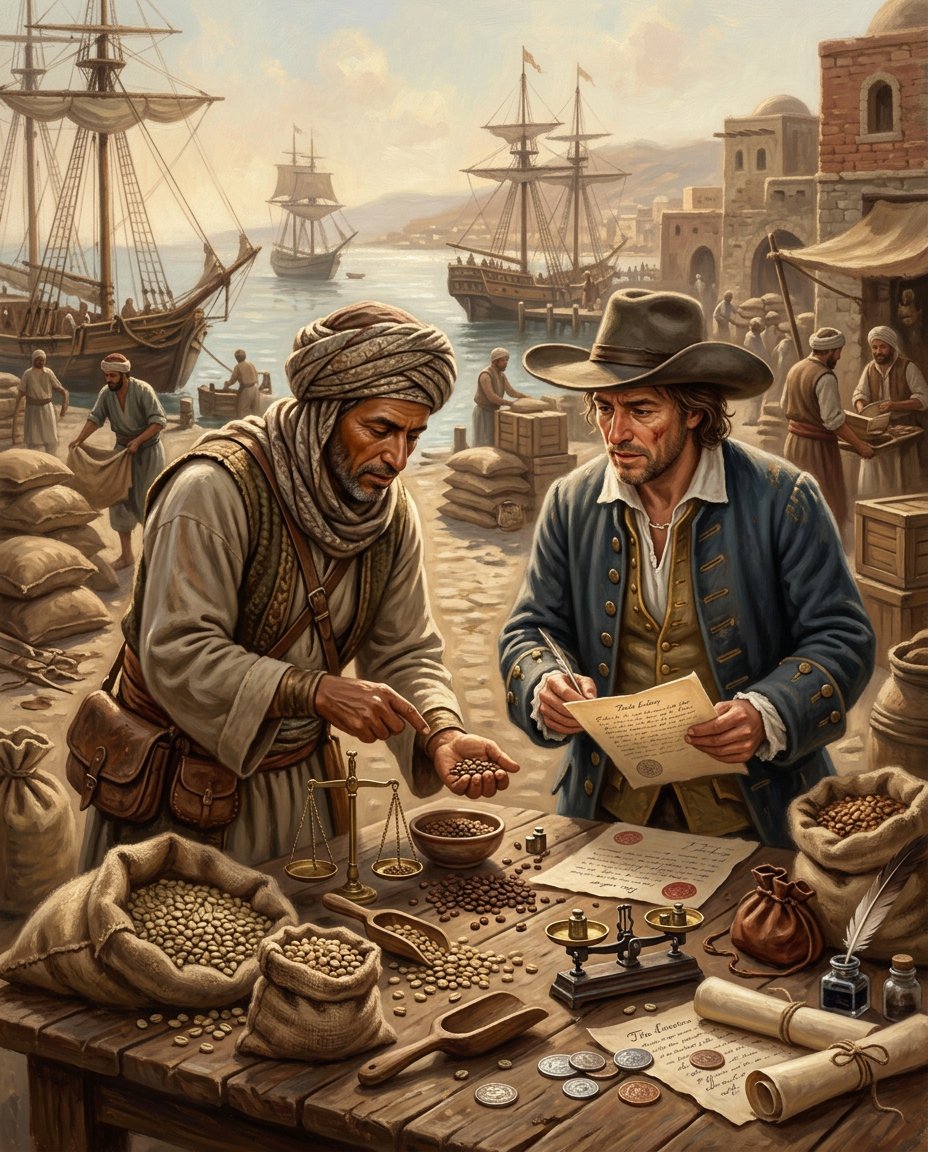
Create a highly detailed, historically evocative digital oil painting depicting the 17th-century coffee trade, designed as premium artwork for a sophisticated historical strategy board game. Use the attached reference image only as a visual and compositional inspiration, while creating a distinctly original scene.

The composition should be a vertical portrait-oriented historical illustration, centered on two 17th-century coffee merchants engaged in the trading and inspection of coffee. Place them at a weathered wooden trading table in a bustling 17th-century port associated with the coffee trade, inspired by Mocha, Yemen, during the height of maritime coffee commerce.

The two merchants should appear deeply engaged in examining, weighing, sorting, and negotiating over a valuable shipment of coffee. One merchant can be a Middle Eastern or Yemeni trader wearing historically appropriate layered robes, a wrapped turban, textured vest, and weathered leather accessories. The second can be a European maritime merchant or trader wearing historically appropriate 17th-century clothing such as a loose linen shirt, dark waistcoat, long coat, breeches, and a period-appropriate broad-brimmed hat. Their clothing should feel practical, worn, dusty, and authentic rather than theatrical or costume-like.

On the wooden table, show rich quantities of coffee beans, partially opened burlap or woven sacks, small brass weighing scales, wooden scoops, parchment trade records, leather pouches, scattered coins, and simple merchant tools. The coffee beans should be rendered with exceptional tactile detail, with variations in color, shape, texture, and natural imperfections. Include subtle evidence of the trading process, such as a merchant inspecting beans closely while another weighs a portion.

In the background, establish a historically convincing 17th-century maritime coffee port. Show wooden sailing ships with tall masts and canvas sails anchored beyond the harbor, cargo being transported, stacked burlap sacks and wooden crates, dock workers and distant merchants, wooden warehouses, simple Middle Eastern architectural forms, and a hazy coastal atmosphere. Keep the background slightly softer and less detailed than the foreground so the merchants remain the visual focus.

The scene should communicate commerce, exploration, maritime trade, cultural exchange, and the growing value of coffee as a global commodity. Introduce subtle narrative details that make the image feel like a moment captured from a larger historical story: merchants negotiating prices, coins changing hands, cargo awaiting shipment, and ships preparing to carry coffee across the sea.

Visual Style

Render the entire image as a museum-quality digital oil painting with the richness and tactile character of traditional historical oil painting. Use visible but refined painterly brushwork, layered translucent glazing, subtle impasto, natural pigment variation, softly blended atmospheric perspective, and carefully controlled edges.

Use a sophisticated historical palette of warm ochre, burnt umber, raw sienna, muted terracotta, deep brown, weathered cream, dusty blue, muted green, and subdued crimson, with restrained highlights of aged brass and warm gold. Avoid overly saturated modern colors.

Lighting should be warm late-afternoon sunlight filtered through coastal haze, creating soft highlights across faces, hands, coffee beans, fabrics, wooden surfaces, and brass objects. Use dramatic but natural chiaroscuro, with luminous faces and foreground objects emerging from a slightly darker environment.

Faces should be expressive and believable, showing concentration, calculation, curiosity, and fatigue. Hands should be anatomically accurate and carefully rendered, particularly where the merchants handle coffee beans, coins, scales, and documents.

The painting should have the atmosphere of a premium historical board-game illustration, combining archaeological authenticity with cinematic storytelling. The viewer should immediately understand that coffee is a valuable commodity being traded between cultures and transported through an international maritime network.

Composition
Vertical portrait composition, approximately 2:3 aspect ratio
Two primary merchants occupying the central and lower-middle portion
Trading table and coffee shipment forming a strong foreground anchor
Coffee beans and trading objects highly detailed
Sailing ships and harbor visible through the atmospheric background
Strong foreground-to-background depth
Natural diagonal composition created by arms, sacks, table, and ship masts
Faces positioned prominently enough to establish character and narrative
Background populated but visually subordinate
Generous atmospheric space toward the upper portion of the image
No modern objects or contemporary visual elements
No typography, labels, logos, borders, UI elements, or board-game text
Historical Authenticity

Maintain 17th-century material culture and clothing, with historically plausible textiles, architecture, ships, tools, containers, coins, trade documents, and merchant equipment. Avoid anachronistic clothing, modern coffee cups, modern sacks, modern machinery, contemporary buildings, or fantasy pirate stereotypes.

The overall image should feel like a lost historical painting depicting the early international coffee trade, but rendered with the clarity, richness, and cinematic detail expected from contemporary premium digital concept art.

Quality keywords:
ultra-detailed digital oil painting, historical realism, 17th-century maritime trade, coffee trade, Mocha port, Yemen, Ottoman-era atmosphere, European merchant, Middle Eastern merchant, period-authentic clothing, cinematic composition, museum-quality painting, tactile brushwork, realistic faces, expressive hands, detailed coffee beans, aged wood, burlap texture, brass weighing scale, sailing ships, atmospheric perspective, warm chiaroscuro, natural pigments, sophisticated color harmony, painterly realism, narrative historical illustration, premium board-game artwork, highly refined detail, cinematic depth, 8k quality.

Negative Prompt

Modern clothing, modern coffee cups, espresso machines, modern packaging, plastic, modern buildings, modern ships, steam engines, fantasy pirates, pirate clichés, treasure chests, exaggerated costumes, fantasy weapons, anachronistic architecture, cartoon style, anime, photorealistic photography, 3D render, glossy CGI, overly saturated colors, excessive sharpness, artificial faces, distorted anatomy, malformed hands, extra fingers, duplicated objects, repetitive faces, text, lettering, watermark, logo, border, frame, contemporary typography.

Community

Design detail

Elephant_1649093

Creator

@Elephant_1649093

Created October 7, 2026
Prompt

Create a highly detailed, historically evocative digital oil painting depicting the 17th-century coffee trade, designed as premium artwork for a sophisticated historical strategy board game. Use the attached reference image only as a visual and compositional inspiration, while creating a distinctly original scene. The composition should be a vertical portrait-oriented historical illustration, centered on two 17th-century coffee merchants engaged in the trading and inspection of coffee. Place them at a weathered wooden trading table in a bustling 17th-century port associated with the coffee trade, inspired by Mocha, Yemen, during the height of maritime coffee commerce. The two merchants should appear deeply engaged in examining, weighing, sorting, and negotiating over a valuable shipment of coffee. One merchant can be a Middle Eastern or Yemeni trader wearing historically appropriate layered robes, a wrapped turban, textured vest, and weathered leather accessories. The second can be a European maritime merchant or trader wearing historically appropriate 17th-century clothing such as a loose linen shirt, dark waistcoat, long coat, breeches, and a period-appropriate broad-brimmed hat. Their clothing should feel practical, worn, dusty, and authentic rather than theatrical or costume-like. On the wooden table, show rich quantities of coffee beans, partially opened burlap or woven sacks, small brass weighing scales, wooden scoops, parchment trade records, leather pouches, scattered coins, and simple merchant tools. The coffee beans should be rendered with exceptional tactile detail, with variations in color, shape, texture, and natural imperfections. Include subtle evidence of the trading process, such as a merchant inspecting beans closely while another weighs a portion. In the background, establish a historically convincing 17th-century maritime coffee port. Show wooden sailing ships with tall masts and canvas sails anchored beyond the harbor, cargo being transported, stacked burlap sacks and wooden crates, dock workers and distant merchants, wooden warehouses, simple Middle Eastern architectural forms, and a hazy coastal atmosphere. Keep the background slightly softer and less detailed than the foreground so the merchants remain the visual focus. The scene should communicate commerce, exploration, maritime trade, cultural exchange, and the growing value of coffee as a global commodity. Introduce subtle narrative details that make the image feel like a moment captured from a larger historical story: merchants negotiating prices, coins changing hands, cargo awaiting shipment, and ships preparing to carry coffee across the sea. Visual Style Render the entire image as a museum-quality digital oil painting with the richness and tactile character of traditional historical oil painting. Use visible but refined painterly brushwork, layered translucent glazing, subtle impasto, natural pigment variation, softly blended atmospheric perspective, and carefully controlled edges. Use a sophisticated historical palette of warm ochre, burnt umber, raw sienna, muted terracotta, deep brown, weathered cream, dusty blue, muted green, and subdued crimson, with restrained highlights of aged brass and warm gold. Avoid overly saturated modern colors. Lighting should be warm late-afternoon sunlight filtered through coastal haze, creating soft highlights across faces, hands, coffee beans, fabrics, wooden surfaces, and brass objects. Use dramatic but natural chiaroscuro, with luminous faces and foreground objects emerging from a slightly darker environment. Faces should be expressive and believable, showing concentration, calculation, curiosity, and fatigue. Hands should be anatomically accurate and carefully rendered, particularly where the merchants handle coffee beans, coins, scales, and documents. The painting should have the atmosphere of a premium historical board-game illustration, combining archaeological authenticity with cinematic storytelling. The viewer should immediately understand that coffee is a valuable commodity being traded between cultures and transported through an international maritime network. Composition Vertical portrait composition, approximately 2:3 aspect ratio Two primary merchants occupying the central and lower-middle portion Trading table and coffee shipment forming a strong foreground anchor Coffee beans and trading objects highly detailed Sailing ships and harbor visible through the atmospheric background Strong foreground-to-background depth Natural diagonal composition created by arms, sacks, table, and ship masts Faces positioned prominently enough to establish character and narrative Background populated but visually subordinate Generous atmospheric space toward the upper portion of the image No modern objects or contemporary visual elements No typography, labels, logos, borders, UI elements, or board-game text Historical Authenticity Maintain 17th-century material culture and clothing, with historically plausible textiles, architecture, ships, tools, containers, coins, trade documents, and merchant equipment. Avoid anachronistic clothing, modern coffee cups, modern sacks, modern machinery, contemporary buildings, or fantasy pirate stereotypes. The overall image should feel like a lost historical painting depicting the early international coffee trade, but rendered with the clarity, richness, and cinematic detail expected from contemporary premium digital concept art. Quality keywords: ultra-detailed digital oil painting, historical realism, 17th-century maritime trade, coffee trade, Mocha port, Yemen, Ottoman-era atmosphere, European merchant, Middle Eastern merchant, period-authentic clothing, cinematic composition, museum-quality painting, tactile brushwork, realistic faces, expressive hands, detailed coffee beans, aged wood, burlap texture, brass weighing scale, sailing ships, atmospheric perspective, warm chiaroscuro, natural pigments, sophisticated color harmony, painterly realism, narrative historical illustration, premium board-game artwork, highly refined detail, cinematic depth, 8k quality. Negative Prompt Modern clothing, modern coffee cups, espresso machines, modern packaging, plastic, modern buildings, modern ships, steam engines, fantasy pirates, pirate clichés, treasure chests, exaggerated costumes, fantasy weapons, anachronistic architecture, cartoon style, anime, photorealistic photography, 3D render, glossy CGI, overly saturated colors, excessive sharpness, artificial faces, distorted anatomy, malformed hands, extra fingers, duplicated objects, repetitive faces, text, lettering, watermark, logo, border, frame, contemporary typography.

Remix this design

Start for free with full control over models, settings, and canvas tools.

  • ·Generate with full control over models and settings
  • ·Save projects and share back to the community
  • ·No design experience required
Start free — use this prompt
Browse more community designs →
Start free — remix this

What's next?Explore more features

Hiding Elephant product features overview

Explore features

AI generation, vector tools, workflows, catalogs, and collaboration in one workspace.

How Hiding Elephant works

How it works

See how the AI canvas, automation, and teamwork fit together end to end.

Get started with Hiding Elephant

Try it free

Sign in and turn inspiration into projects you can edit, export, and share.

Go from browse to build

Explore what else the Elephant can do.You'll love it

AI image generation

AI Generation

Image tools

Image Tools

Workflow builder

Workflows

Brand and style templates

Brand Management

Product catalog

Product Catalog

Collaboration

Collaboration

Batch image generation

Batch generation

Explore community

Community workflows

The AI designworkspace forfast-moving ideas.

Product

  • Ellie
  • Apps
  • AI Generation
  • Vector Canvas
  • Image Tools
  • Workflows
  • Brand Management
  • Product Catalog
  • My Assets
  • Collaboration

Use Cases

  • E-commerce teams
  • Design agencies
  • Marketing teams
  • Content creators

Quick tools

  • All quick tools
  • Background Remover
  • Image Upscaler
  • Image Vectorizer
  • Image Optimizer
  • Image Reframer

Resources

  • About
  • Pricing
  • FAQ
  • Compare
  • Enterprise
  • Integrations
  • Explore
  • Blog
  • Case studies
  • Contact Us
  • Book a Demo
  • Affiliates

© 2026 Hiding Elephant. All rights reserved

Cookie PolicyPrivacy PolicyTerms of Service
Hiding Elephant