AI image design: Create a refined scientific botanical illustration for a premium book cover, using the uploaded reference image strictly…
Community
Design detail

Creator
@Elephant_1649093
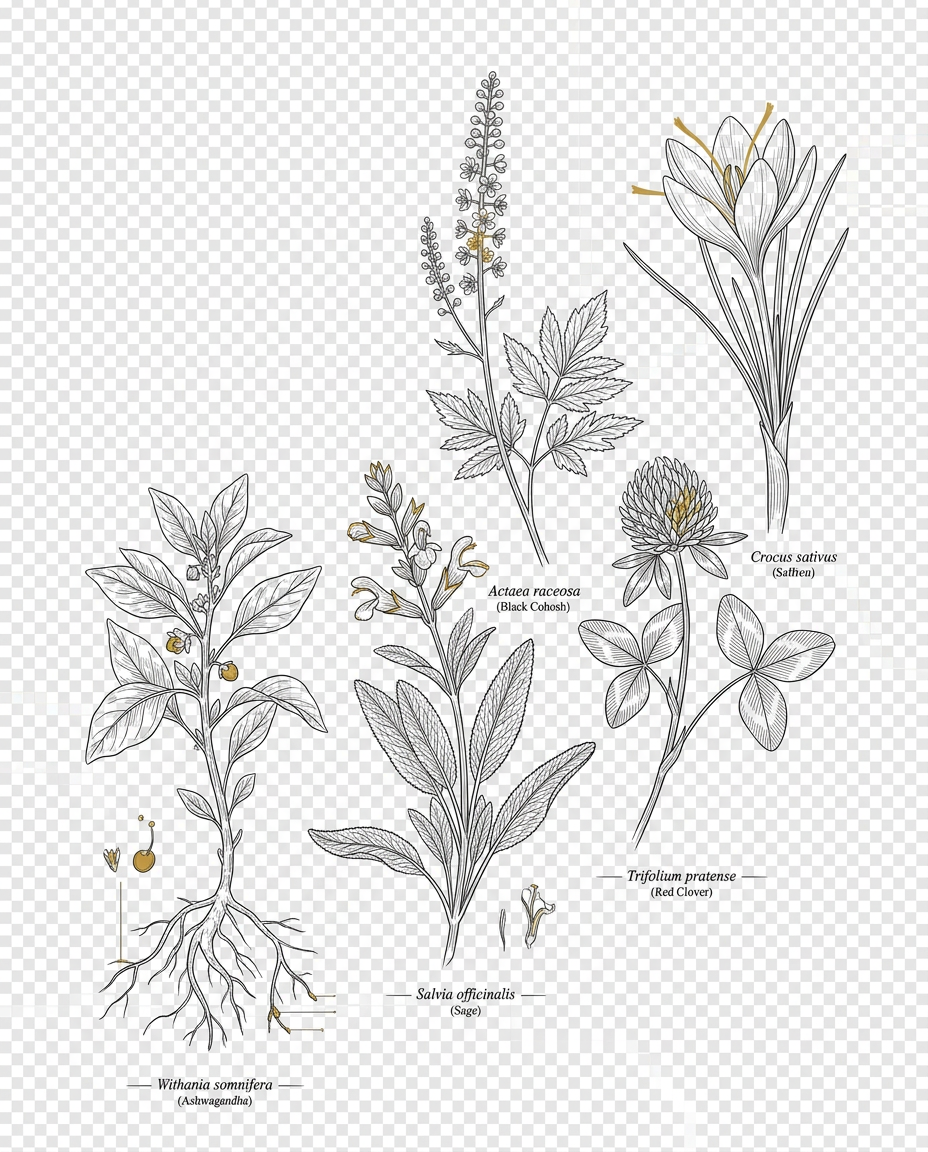
Create a refined scientific botanical illustration for a premium book cover, using the uploaded reference image strictly as the visual style reference. Recreate the delicate, hand-drawn quality of a Victorian pharmacopoeial botanical plate / Kew Gardens botanical engraving, translated into an exceptionally clean modern vector line illustration. SUBJECT & COMPOSITION Create one cohesive botanical plate containing exactly five botanically distinct specimens, arranged in an elegant, deliberate compositional arc moving visually from lower-left toward upper-right. The specimens should feel like carefully collected scientific samples arranged for examination on a botanical laboratory sheet rather than a decorative floral bouquet. Include: 1. Withania somnifera — Ashwagandha - Show the complete plant with an exposed, clearly recognizable root system. - Include branching roots with accurate botanical structure. - Show upright stems, leaves, and characteristic small flowers/berries where appropriate. - Leaves should have accurate shape, proportion, margins, and venation. - The root should be an important identifying feature. 2. Salvia officinalis — Sage - Show a botanically accurate leafy stem with paired leaves. - Emphasize the characteristic textured, elongated sage leaves and precise venation. - Include a flowering section with anatomically credible sage flowers. - Preserve the characteristic opposite leaf arrangement and branching structure. 3. Actaea racemosa — Black Cohosh - Show an elongated raceme / flower spike prominently. - Include the characteristic small individual flowers branching from the central flowering stalk. - Show representative compound foliage with accurate leaflet structure and serrated margins. - The long vertical raceme should provide an elegant structural counterpoint to the broader specimens. 4. Trifolium pratense — Red Clover - Show a recognizable rounded flower head composed of many individual florets. - Include the characteristic trifoliate leaves. - Render individual leaflets, veins, margins, and subtle botanical details accurately. - The flower head should remain scientifically readable rather than becoming a generic floral sphere. 5. Crocus sativus — Saffron - Show the complete crocus flower with its narrow leaves. - Clearly expose the three distinctive saffron stigmas, making them botanically unmistakable. - The stigmas should be long, slender, and visibly emerging from the flower. - Include sufficient floral anatomy to distinguish saffron from a generic crocus. COMPOSITIONAL DIRECTION Arrange the five specimens with controlled asymmetry and generous negative space, inspired by historical botanical plates. The composition should have a natural visual rhythm: - Lower-left specimens establish the base. - Middle specimens create the structural transition. - Taller stems and racemes rise toward the upper-right. - The Crocus flower and other major floral structures should create subtle focal points without dominating the entire plate. - Avoid overlapping specimens excessively. - Preserve clear separation between botanical forms so every plant can be studied independently. - Allow stems, roots, leaves, and flowers to occupy different visual levels. - The arrangement should feel scientifically composed rather than ornamental. Under each specimen, introduce very fine horizontal classification/annotation lines, resembling understated scientific catalogue markings. Add a few extremely subtle leader lines pointing toward relevant botanical structures, but do not clutter the illustration with large labels or paragraphs of text. ART STYLE — FOLLOW REFERENCE IMAGE Match the uploaded reference's visual language: - Extremely delicate botanical pen-and-ink drawing. - Fine, controlled black contour lines. - Natural hand-drawn irregularity rather than mechanically perfect geometry. - Intricate botanical observation. - Fine parallel and directional linework used sparingly to describe form. - Delicate engraved-style interior details. - Precise leaf veins. - Fine floral anatomy. - Elegant, slightly antique scientific-illustration character. - Sophisticated archival / pharmacopoeial aesthetic. - Refined, quiet, intellectual, museum-quality appearance. The reference should guide the line quality, botanical detailing, spacing, delicacy, proportions, and overall engraving character, but the five specified plants must remain botanically accurate and individually recognizable. LINEWORK & VECTOR QUALITY Produce the artwork as if it were created by an expert botanical illustrator and subsequently converted into a high-quality vector illustration. - Clean, crisp vector contours. - Consistent single-weight black linework. - Extremely fine secondary botanical detail. - No rough digital brush edges. - No cartoon outlines. - No thick graphic outlines. - No excessive line-weight variation. - No filled black masses except where absolutely necessary for tiny botanical anatomical details. - Preserve the delicacy of traditional engraving while maintaining professional vector cleanliness. - Lines should remain sharp and printable at large scale. - Avoid excessive cross-hatching. COLOUR RESTRICTION The entire illustration must be black linework on a transparent/white background, with ONLY ONE accent colour: Gold #C49A3C. Use the gold with extreme restraint. Exactly one small, intentional gold accent per specimen: - Ashwagandha: one botanically appropriate distinctive root/berry detail. - Sage: a small portion of the flower tips. - Black Cohosh: one restrained section of the flowering raceme. - Red Clover: a very small selection of florets within the flower head. - Saffron: the three saffron stigmas should be the clearest gold feature. Gold must appear as a whisper of colour, never as a coloured botanical rendering. Do not colour leaves, stems, roots, large petals, backgrounds, shadows, or entire flowers gold. No additional colours whatsoever. ABSOLUTELY NO - No realistic coloured painting. - No watercolor. - No gradients. - No grey. - No beige paper texture. - No cream background. - No photographic elements. - No shadows. - No drop shadows. - No 3D rendering. - No decorative frames. - No ornamental typography. - No modern flat botanical icons. - No cartoon styling. - No excessive cross-hatching. - No heavy black outlines. - No generic flowers substituted for the specified species. - No incorrect botanical anatomy. - No duplicated plants. - No excessive gold. - No background objects. OUTPUT / TECHNICAL SPECIFICATION Portrait orientation, vertically balanced botanical plate. Pure transparent background. Minimum 300 DPI, preferably 600 DPI for master artwork. Professional print-ready vector appearance. Suitable for conversion into SVG / AI / EPS while retaining clean editable paths. PNG preview with transparency. Overall visual impression: A contemporary scientific botanical plate that feels discovered inside an early botanical pharmacopoeia—quiet, precise, scholarly, delicate, and exceptionally refined. Predominantly black engraved linework, with five scientifically accurate medicinal plants arranged in a graceful ascending composition and only five tiny whispers of muted gold.
Remix this design
Start for free with full control over models, settings, and canvas tools.
- Generate with full control over models and settings
- Save projects and share back to the community
- No design experience required
What's next?Explore more features



Go from browse to build