Product
Use Cases
How it Works
Pricing
Login

AI image design: Create a high-end custom black-and-white tattoo sleeve concept, designed as professional tattoo linework and stencil art…
Back to community
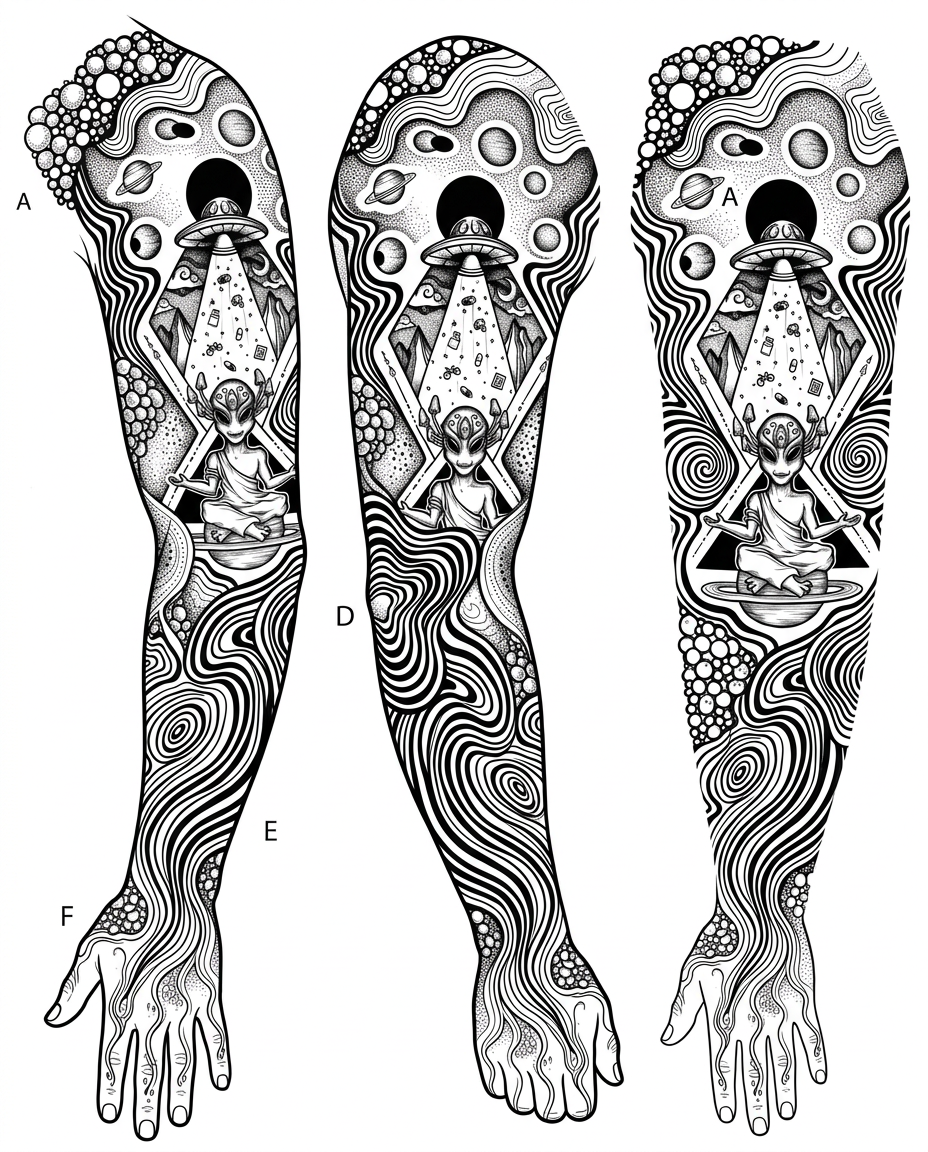
Create a high-end custom black-and-white tattoo sleeve concept, designed as professional tattoo linework and stencil artwork. Use the supplied reference images as direct visual references for composition, pattern language, density, and line quality.
The design is an extension around an existing tattoo, not a cover-up. The existing alien/space tattoo must remain completely untouched, clearly visible, and visually dominant. Treat the existing tattoo as the primary foreground focal point and build a new organic sleeve environment around it. only illustration on solid white background

1. Overall Concept — “Flipped Geometry”
Create the visual opposite of the user's existing geometric sleeve.
The reference geometric arm demonstrates:
- structured geometric blocks
- angular forms
- sacred-geometry influence
- strong negative-space control
- repeating mathematical patterns
- clearly separated sections
For this arm, reverse that visual hierarchy:
Primary language: organic, fluid, psychedelic, topographical linework
Secondary language: structured sectional composition
The result should feel like organic geometry—highly controlled and intentionally composed, but made from flowing biological forms rather than rigid polygons.
2. Preserve the Existing Tattoo
The existing tattoo contains a central alien figure, UFO/spacecraft element, light-beam composition, geometric diamond framing, and planets/celestial elements toward the shoulder.
These elements are sacrosanct:
- Do not redraw them.
- Do not cover them.
- Do not distort them.
- Do not place dense patterns directly over them.
- Do not merge the background linework into the alien figure.
- Maintain a clean visual boundary around the original tattoo.
- Preserve enough negative space around the existing focal image for it to remain immediately readable.
- The original tattoo should appear slightly darker, sharper, and more visually important than the new surrounding work.
The new tattoo should look as though it grew around the original piece, rather than being placed on top of it.
3. Organic Background Language
Build the new sleeve from flowing psychedelic black-and-white linework, inspired by the supplied abstract pattern reference.
Use:
- long undulating contour lines
- warped parallel lines
- topographical wave patterns
- flowing ribbons
- concentric organic shapes
- cellular/bubble clusters
- dotted gradients
- stippled fields
- small repeated scallop forms
- curved stripe systems
- organic zebra-like contours
- distorted concentric forms
- microscopic/cellular textures
- fluid transitions between dense and open areas
The lines should bend, stretch, compress, spiral, and flow around the anatomy.
Avoid random doodling. Every pattern should have a deliberate directional flow that follows the arm's musculature.
4. Sectional Composition
Although the artwork is organic, divide the sleeve into distinct interconnected zones.
Think of the composition as approximately 6–10 large flowing sections, each containing a different organic pattern language.
For example:
Section A — Shoulder:
Large flowing contour waves and cellular formations wrapping around the shoulder cap.
Section B — Upper outer arm:
Long psychedelic ribbons and topographical contours flowing vertically around the existing tattoo.
Section C — Upper inner arm:
More densely packed cellular/stippled textures, allowing the pattern to become visually quieter as it approaches the focal tattoo.
Section D — Elbow transition:
Compressed, distorted lines that bend naturally around the elbow, creating a visual transition between sections.
Section E — Forearm:
Longer, sweeping organic ribbons mixed with repeated contour patterns and negative-space channels.
Section F — Wrist/hand:
The pattern becomes finer and more controlled, gradually narrowing toward the wrist and continuing organically onto the hand.
The sections should interlock seamlessly, with no obvious hard borders. Use changes in line direction, density, texture, and negative space to define each zone.
5. Depth Hierarchy
This is extremely important.
Create three visual levels:
Foreground:
Existing alien/space tattoo — strongest contrast, clearest forms, highest visual authority.
Middle ground:
Large organic sleeve structures — flowing contour ribbons and major pattern fields.
Background:
Fine stippling, cellular textures, thin repeated lines, subtle micro-patterns.
As the new pattern approaches the alien tattoo, reduce line density and visual weight so the focal tattoo naturally comes forward.
Use negative space strategically rather than filling every available area.
6. Anatomy-Aware Flow
Design the artwork specifically as a wraparound arm tattoo, not as a flat decorative illustration.
The organic lines should:
- follow the shoulder curvature
- wrap around the bicep and tricep
- flow through the elbow transition
- follow forearm muscle direction
- taper toward the wrist
- continue naturally onto the back/top of the hand
- accommodate joints and anatomical movement
- avoid awkward tangencies
- maintain readable negative-space channels
The pattern should look convincing when wrapped around a real human arm.
7. Hand Extension
Extend the design onto the hand, but keep it visually lighter and more refined than the main sleeve.
Use narrower flowing lines, small organic cellular patterns, and controlled contour bands.
The hand design should feel like the sleeve naturally continues into the hand, rather than appearing as a separate tattoo.
Keep major joints and knuckle areas relatively breathable so the design remains readable as the tattoo ages.
8. Black-and-White Tattoo Treatment
Pure black ink on white skin.
No color.
No grey watercolor effect.
No photorealism.
No decorative color gradients.
Use tattoo-appropriate:
- solid black
- clean linework
- varied line weights
- stippling
- dot gradients
- controlled blackwork
- negative space
- carefully balanced black-to-skin ratio
The linework should be extremely crisp, technically clean, tattooable, and stencil-friendly.
Avoid excessively microscopic details that would become muddy when tattooed.
9. Style Direction
The visual character should combine:
psychedelic organic linework + topographical mapping + cellular structures + fluid blackwork + contemporary ornamental tattoo design.
It should feel modern, minimalist, sophisticated, experimental, and highly intentional, rather than traditional tribal, generic mandala, or random psychedelic art.
The reference pattern should influence the line vocabulary, while the geometric sleeve reference should influence the organization and sectional discipline.
The final result should communicate:
organic chaos controlled by geometric composition.

10. Presentation / Output
Show the design as a professional tattoo artist concept sheet:
1. Full-arm tattoo placement view — showing the complete sleeve from shoulder to hand.
2. Three-quarter arm view — demonstrating how the patterns wrap around the anatomy.
3. Flat tattoo stencil/wrap layout — showing the pattern unfolded into a clean 2D arm template.
4. Clean black-and-white stencil version — isolated artwork on white.
5. Existing alien tattoo clearly preserved as the central focal element.
Use high-resolution professional tattoo-design presentation, clean white background, sharp black ink, precise contours, sophisticated negative-space management, no skin-rendering distractions in the stencil view.
The final design must look like something a highly experienced contemporary blackwork tattoo artist could actually stencil and tattoo—not an AI-generated decorative pattern.
Negative Prompt
Avoid: covering the existing tattoo, altering the alien figure, changing the original tattoo's proportions, geometric-only patterns, rigid mandalas, generic tribal tattoo, random doodles, excessive black fill, muddy shading, photorealism, color, watercolor, 3D effects, typography, symbols unrelated to the existing tattoo, disconnected pattern fragments, symmetrical full-arm mandala composition, overly dense micro-detail, illegible linework, flat clip-art appearance, ornamental wallpaper effect, or patterns that compete with the central alien tattoo

Community

Design detail

Elephant_1649093

Creator

@Elephant_1649093

Created October 7, 2026
Prompt

Create a high-end custom black-and-white tattoo sleeve concept, designed as professional tattoo linework and stencil artwork. Use the supplied reference images as direct visual references for composition, pattern language, density, and line quality. The design is an extension around an existing tattoo, not a cover-up. The existing alien/space tattoo must remain completely untouched, clearly visible, and visually dominant. Treat the existing tattoo as the primary foreground focal point and build a new organic sleeve environment around it. only illustration on solid white background 1. Overall Concept — “Flipped Geometry” Create the visual opposite of the user's existing geometric sleeve. The reference geometric arm demonstrates: - structured geometric blocks - angular forms - sacred-geometry influence - strong negative-space control - repeating mathematical patterns - clearly separated sections For this arm, reverse that visual hierarchy: Primary language: organic, fluid, psychedelic, topographical linework Secondary language: structured sectional composition The result should feel like organic geometry—highly controlled and intentionally composed, but made from flowing biological forms rather than rigid polygons. 2. Preserve the Existing Tattoo The existing tattoo contains a central alien figure, UFO/spacecraft element, light-beam composition, geometric diamond framing, and planets/celestial elements toward the shoulder. These elements are sacrosanct: - Do not redraw them. - Do not cover them. - Do not distort them. - Do not place dense patterns directly over them. - Do not merge the background linework into the alien figure. - Maintain a clean visual boundary around the original tattoo. - Preserve enough negative space around the existing focal image for it to remain immediately readable. - The original tattoo should appear slightly darker, sharper, and more visually important than the new surrounding work. The new tattoo should look as though it grew around the original piece, rather than being placed on top of it. 3. Organic Background Language Build the new sleeve from flowing psychedelic black-and-white linework, inspired by the supplied abstract pattern reference. Use: - long undulating contour lines - warped parallel lines - topographical wave patterns - flowing ribbons - concentric organic shapes - cellular/bubble clusters - dotted gradients - stippled fields - small repeated scallop forms - curved stripe systems - organic zebra-like contours - distorted concentric forms - microscopic/cellular textures - fluid transitions between dense and open areas The lines should bend, stretch, compress, spiral, and flow around the anatomy. Avoid random doodling. Every pattern should have a deliberate directional flow that follows the arm's musculature. 4. Sectional Composition Although the artwork is organic, divide the sleeve into distinct interconnected zones. Think of the composition as approximately 6–10 large flowing sections, each containing a different organic pattern language. For example: Section A — Shoulder: Large flowing contour waves and cellular formations wrapping around the shoulder cap. Section B — Upper outer arm: Long psychedelic ribbons and topographical contours flowing vertically around the existing tattoo. Section C — Upper inner arm: More densely packed cellular/stippled textures, allowing the pattern to become visually quieter as it approaches the focal tattoo. Section D — Elbow transition: Compressed, distorted lines that bend naturally around the elbow, creating a visual transition between sections. Section E — Forearm: Longer, sweeping organic ribbons mixed with repeated contour patterns and negative-space channels. Section F — Wrist/hand: The pattern becomes finer and more controlled, gradually narrowing toward the wrist and continuing organically onto the hand. The sections should interlock seamlessly, with no obvious hard borders. Use changes in line direction, density, texture, and negative space to define each zone. 5. Depth Hierarchy This is extremely important. Create three visual levels: Foreground: Existing alien/space tattoo — strongest contrast, clearest forms, highest visual authority. Middle ground: Large organic sleeve structures — flowing contour ribbons and major pattern fields. Background: Fine stippling, cellular textures, thin repeated lines, subtle micro-patterns. As the new pattern approaches the alien tattoo, reduce line density and visual weight so the focal tattoo naturally comes forward. Use negative space strategically rather than filling every available area. 6. Anatomy-Aware Flow Design the artwork specifically as a wraparound arm tattoo, not as a flat decorative illustration. The organic lines should: - follow the shoulder curvature - wrap around the bicep and tricep - flow through the elbow transition - follow forearm muscle direction - taper toward the wrist - continue naturally onto the back/top of the hand - accommodate joints and anatomical movement - avoid awkward tangencies - maintain readable negative-space channels The pattern should look convincing when wrapped around a real human arm. 7. Hand Extension Extend the design onto the hand, but keep it visually lighter and more refined than the main sleeve. Use narrower flowing lines, small organic cellular patterns, and controlled contour bands. The hand design should feel like the sleeve naturally continues into the hand, rather than appearing as a separate tattoo. Keep major joints and knuckle areas relatively breathable so the design remains readable as the tattoo ages. 8. Black-and-White Tattoo Treatment Pure black ink on white skin. No color. No grey watercolor effect. No photorealism. No decorative color gradients. Use tattoo-appropriate: - solid black - clean linework - varied line weights - stippling - dot gradients - controlled blackwork - negative space - carefully balanced black-to-skin ratio The linework should be extremely crisp, technically clean, tattooable, and stencil-friendly. Avoid excessively microscopic details that would become muddy when tattooed. 9. Style Direction The visual character should combine: psychedelic organic linework + topographical mapping + cellular structures + fluid blackwork + contemporary ornamental tattoo design. It should feel modern, minimalist, sophisticated, experimental, and highly intentional, rather than traditional tribal, generic mandala, or random psychedelic art. The reference pattern should influence the line vocabulary, while the geometric sleeve reference should influence the organization and sectional discipline. The final result should communicate: organic chaos controlled by geometric composition. 10. Presentation / Output Show the design as a professional tattoo artist concept sheet: 1. Full-arm tattoo placement view — showing the complete sleeve from shoulder to hand. 2. Three-quarter arm view — demonstrating how the patterns wrap around the anatomy. 3. Flat tattoo stencil/wrap layout — showing the pattern unfolded into a clean 2D arm template. 4. Clean black-and-white stencil version — isolated artwork on white. 5. Existing alien tattoo clearly preserved as the central focal element. Use high-resolution professional tattoo-design presentation, clean white background, sharp black ink, precise contours, sophisticated negative-space management, no skin-rendering distractions in the stencil view. The final design must look like something a highly experienced contemporary blackwork tattoo artist could actually stencil and tattoo—not an AI-generated decorative pattern. Negative Prompt Avoid: covering the existing tattoo, altering the alien figure, changing the original tattoo's proportions, geometric-only patterns, rigid mandalas, generic tribal tattoo, random doodles, excessive black fill, muddy shading, photorealism, color, watercolor, 3D effects, typography, symbols unrelated to the existing tattoo, disconnected pattern fragments, symmetrical full-arm mandala composition, overly dense micro-detail, illegible linework, flat clip-art appearance, ornamental wallpaper effect, or patterns that compete with the central alien tattoo

Remix this design

Start for free with full control over models, settings, and canvas tools.

  • ·Generate with full control over models and settings
  • ·Save projects and share back to the community
  • ·No design experience required
Start free — use this prompt
Browse more community designs →
Start free — remix this

What's next?Explore more features

Hiding Elephant product features overview

Explore features

AI generation, vector tools, workflows, catalogs, and collaboration in one workspace.

How Hiding Elephant works

How it works

See how the AI canvas, automation, and teamwork fit together end to end.

Get started with Hiding Elephant

Try it free

Sign in and turn inspiration into projects you can edit, export, and share.

Go from browse to build

Explore what else the Elephant can do.You'll love it

AI image generation

AI Generation

Image tools

Image Tools

Workflow builder

Workflows

Brand and style templates

Brand Management

Product catalog

Product Catalog

Collaboration

Collaboration

Batch image generation

Batch generation

Explore community

Community workflows

The AI designworkspace forfast-moving ideas.

Product

  • Ellie
  • Apps
  • AI Generation
  • Vector Canvas
  • Image Tools
  • Workflows
  • Brand Management
  • Product Catalog
  • My Assets
  • Collaboration

Use Cases

  • E-commerce teams
  • Design agencies
  • Marketing teams
  • Content creators

Quick tools

  • All quick tools
  • Background Remover
  • Image Upscaler
  • Image Vectorizer
  • Image Optimizer
  • Image Reframer

Resources

  • About
  • Pricing
  • FAQ
  • Compare
  • Enterprise
  • Integrations
  • Explore
  • Blog
  • Case studies
  • Contact Us
  • Book a Demo
  • Affiliates

© 2026 Hiding Elephant. All rights reserved

Cookie PolicyPrivacy PolicyTerms of Service
Hiding Elephant