Product
Use Cases
How it Works
Pricing
Login

AI image design: # EXPRESSIVE FAMILY PORTRAIT — RAW FIGURATIVE MIXED-MEDIA EXPRESSIONISM first image is reference for art style second…
Back to community
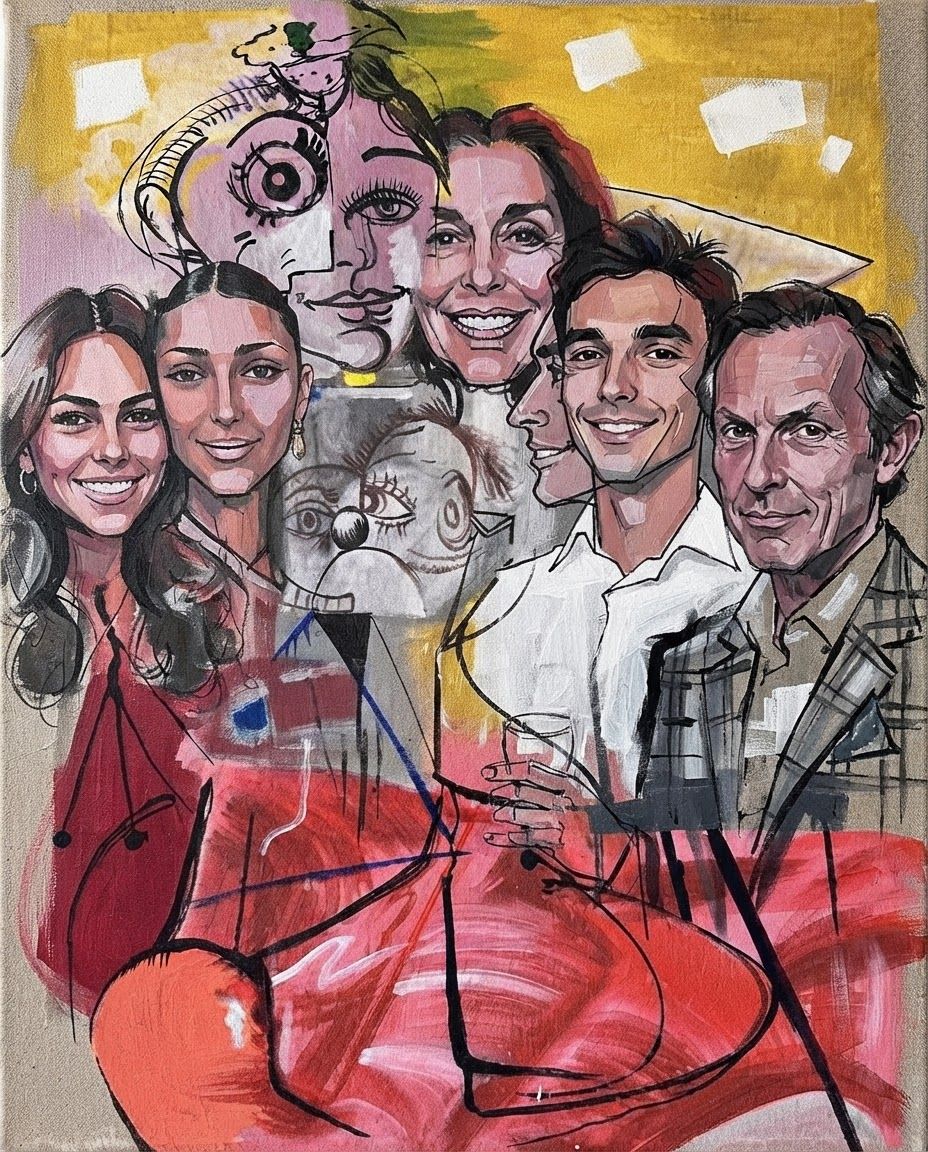
# EXPRESSIVE FAMILY PORTRAIT — RAW FIGURATIVE MIXED-MEDIA EXPRESSIONISM

first image is reference for art style second image is the family faces to use in the finakl art work## 1. Core Objective

Create an original, highly expressive family portrait painting that faithfully recreates the distinctive visual language, composition, colour relationships, line quality, and physical paint texture of the supplied reference artwork.

**The reference painting is the primary art-style and compositional reference. The supplied photographs of the family members are the primary identity and portrait references.** Combine these two sources without confusing their roles.

Incorporate every specified family member into one cohesive, densely layered figurative composition. Arrange their faces, partial bodies, overlapping profiles, and fragmented facial features in a manner reminiscent of the reference painting, creating an intimate, psychologically expressive family portrait that feels spontaneous, unconventional, imperfect, and genuinely hand-painted.

The result must look like an original physical painting made by an expressive contemporary artist, not a digital illustration with artificial paint effects.

## 2. Absolute Priority: Accurate Family Portraits

Faithful facial identity is essential. Every family member must remain recognisable as the specific person depicted in their supplied photograph.

Before applying the abstract painting style, carefully analyse each portrait reference for:

- Exact overall face shape, facial proportions, forehead height, cheekbone structure, jawline, chin shape, and natural asymmetries.
- Eye shape, eye spacing, eyelid structure, eyebrows, gaze direction, and distinctive expression.
- Nose length, bridge, width, tip shape, nostrils, and relationship to the other facial features.
- Lip shape, mouth width, cupid's bow, natural smile, and expression.
- Hairline, hairstyle, hair texture, facial hair where applicable, and distinctive identifying details.
- Age-appropriate facial characteristics, skin tone, and the individual's recognisable appearance.

**Preserve the identity of each person independently.** Do not merge one family member's facial features with another's. Do not average the faces, beautify them, idealise their proportions, or replace them with generic stylised faces.

Apply the expressive treatment through the placement of contours, angular linework, exaggerated painted marks, overlapping profiles, unusual colour patches, and fragmented perspective—not by randomly changing the underlying facial identity.

Each face should retain enough correctly positioned, anatomically coherent features to be immediately associated with its photographic reference, even when partially fragmented or interpreted through expressive brushwork.

Where a face is presented in profile, preserve that individual's actual nose profile, forehead-to-nose transition, chin, and facial silhouette. Where a face is frontal, retain the person's original eye spacing, nose-to-mouth relationship, and overall facial proportions.

Avoid excessive distortion across the eyes, nose, and mouth. The painting may be deliberately unconventional, but portrait recognition must take precedence over abstraction.

## 3. Exact Art-Style Direction

Reproduce the reference's distinctive combination of:

- Raw contemporary figurative expressionism.
- Picasso-inspired fractured portraiture and multiple-perspective facial construction.
- Naïve, almost childlike drawing spontaneity combined with sophisticated compositional instinct.
- Rough, gestural, semi-abstract line drawing.
- Loose, imperfect black contour work.
- Naïve surrealism and psychologically expressive figurative painting.
- Spontaneous mixed-media mark-making.
- Visibly physical, imperfect acrylic or gouache painting on textured canvas.

The painting should feel emotionally immediate, instinctive, unconventional, and slightly unruly. Preserve the tension between recognisable human faces and abstract visual experimentation.

Do not turn the work into polished Cubist geometry, a clean vector illustration, a conventional family portrait, a cartoon, or a photorealistic digital painting. The reference's charm lies in its collision of rough drawing, expressive colour, overlapping faces, and visible painterly accidents.

## 4. Composition and Arrangement

Create a vertically oriented, full-canvas family portrait with a dense, asymmetrical, overlapping composition inspired by the reference.

Arrange the family members as a collective constellation of faces rather than a conventional row of people posing for a photograph.

Use the following compositional principles:

- Place the most visually prominent family member in the upper-central or upper-left region, with a relatively large face.
- Distribute the remaining family members around and beneath the dominant portrait, using different scales, angles, and degrees of visibility.
- Allow selected faces to overlap, intersect, or partially emerge from behind other faces and painted forms.
- Mix frontal portraits, three-quarter views, and side profiles, adapting the arrangement to the number of family members and their reference photographs.
- Integrate partial shoulders, torsos, necks, arms, and simplified clothing shapes into the lower half of the painting.
- Let the figures merge visually into the surrounding paint instead of enclosing every person within a separate, neatly defined silhouette.
- Introduce a few secondary facial fragments, sketched eyes, profile outlines, and repeated contour marks to create the reference's layered, fragmented visual rhythm, without inadvertently inventing additional identifiable people.
- Use intersecting black lines, diagonal strokes, and loosely drawn geometric forms to connect separate figures.
- Allow selected contours to continue across colour fields or disappear beneath subsequent layers of paint.

The composition should feel crowded but intentional, with an organic balance between facial focal points, open areas of colour, expressive linework, and overlapping bodies.

Adapt the composition to accommodate every requested family member. Do not omit anyone, hide a principal face behind another figure, or crop a face so severely that it loses its recognisable features.

## 5. Facial Construction and Expressive Distortion

Build each portrait using a mixture of observational drawing and fragmented perspective.

A face may contain a subtly offset eye, an angular cheek contour, a simplified ear, a loosely outlined nose, or a second profile-like contour crossing the surrounding colour field. These devices should echo the reference's experimental visual language.

Use asymmetry selectively. One side of a face may be defined by a firm black outline while the other dissolves into pink, grey, yellow, or white paint. A frontal face may contain slightly different treatments of its two halves, creating a sense of simultaneous perspectives.

Introduce thick, imperfect strokes around selected eyes, eyebrows, nostrils, lips, and jawlines. Allow some lines to remain open, doubled, broken, or visibly redrawn.

Keep the essential facial landmarks structurally believable. Avoid misplaced pupils, duplicated mouths, excessive eyes, melted features, accidental facial fusion, and random distortions that destroy identity.

The faces should appear artistically reinterpreted, not carelessly malformed.

## 6. Colour Palette

Follow the reference's warm, high-contrast, deliberately imperfect colour palette.

Dominant colours:
- Saturated golden yellow and mustard yellow.
- Warm crimson, vermilion, and coral red.
- Dusty rose, muted pink, and pale mauve.
- Cool grey, smoky charcoal, and diluted black.
- Warm off-white and exposed canvas tones.

Secondary accents:
- Cobalt blue in small, irregular patches.
- Bright yellow highlights.
- Occasional orange-red transitions.
- Muted olive green and earthy neutral tones.

Use large, loosely painted fields of yellow across the upper background and red or crimson across the lower half. Introduce irregular pink and mauve passages around the faces, interrupted by grey, white, and darker brushstrokes.

Paint colour directly across facial planes in an expressive manner while preserving recognisable facial structure. Skin tones may be interrupted by pink, grey, yellow, or white, as in the reference, rather than rendered with conventional naturalistic shading.

Allow visible colour collisions, uneven coverage, and imperfect transitions between hues. Some areas should appear thinly painted, while others have denser, more saturated pigment.

Avoid a polished gradient-based finish, uniform skin rendering, pastel prettiness, or a carefully harmonised commercial illustration palette.

## 7. Signature Linework

Black linework is one of the most important visual characteristics of the reference.

Use expressive, dark charcoal-black or near-black outlines created with the appearance of a loaded brush, paint marker, or imperfect drawing tool.

Vary the line weight substantially:

- Thick, bold strokes for major silhouettes, selected facial contours, and structural divisions.
- Medium-weight lines for eyes, eyebrows, noses, mouths, clothing, and overlapping figure boundaries.
- Thin, scratchy lines for hair, secondary facial details, internal gestures, and loose construction marks.

Lines should be imperfect, occasionally doubled, unevenly pressured, abruptly terminated, or visibly retraced. Some contours should wander slightly beyond their intended boundaries.

Allow black strokes to cut across painted areas, connect separate figures, and occasionally continue into the background.

Use long, sweeping curves, sharp angular turns, loosely sketched arcs, diagonal marks, and irregular geometric divisions.

Do not use uniform vector outlines, perfectly smooth Bézier curves, mechanically consistent line weights, or polished digital inking.

## 8. Paint Texture and Mixed-Media Surface

The artwork must convincingly resemble a real painting on coarse, lightly textured canvas or primed fabric.

Include:

- Visible canvas weave beneath thinly painted areas.
- Broad, imperfect acrylic brushstrokes.
- Dry-brush scratches and broken pigment.
- Semi-transparent washes layered over earlier colours.
- Opaque paint patches with irregular edges.
- Small areas of exposed ground and incomplete coverage.
- White gestural marks crossing red, grey, and black sections.
- Visible revisions, overlapping strokes, and spontaneous corrections.
- Subtle pigment variation and natural irregularities in the painted surface.

The brushwork should remain apparent at close viewing distance. At a distance, the marks should resolve into a coherent, expressive family composition.

Preserve the slightly rough, handmade, imperfect quality of the reference. Avoid excessive grunge overlays, artificial canvas filters, simulated photographic distress, or uniformly distributed texture.

## 9. Background and Negative Space

Use an active, painterly background rather than a realistic setting.

The upper region should be dominated by warm yellow, with irregular white or pale cream patches. Introduce pink and mauve passages behind and between the faces.

The lower region should feature broad red and crimson brushwork with dark sweeping contours, fragments of clothing, and loosely suggested body shapes.

Allow the background to interact directly with the figures. Some faces should appear to emerge from the background, while other facial contours should dissolve into it.

Use occasional exposed canvas, pale grey patches, and small blue accents to create visual breathing spaces amid the dense composition.

No architectural interior, photographic environment, decorative frame, or realistic scenery is needed.

## 10. Clothing and Body Forms

Render clothing and bodies as simplified, expressive shapes rather than anatomically detailed figures.

Use loose angular blocks, gestural outlines, sweeping black curves, and irregular colour fields to suggest shoulders, torsos, sleeves, and seated or standing body positions.

Introduce red and pink garments, grey body shapes, small yellow accents, and occasional blue details where appropriate to the composition.

Clothing must not compete with the faces for attention. Avoid intricate fabric rendering, photorealistic folds, excessive anatomical detail, and perfectly symmetrical silhouettes.

## 11. Artistic Balance and Emotional Quality

The finished painting should communicate the complexity of family relationships through visual proximity, overlapping forms, contrasting expressions, and shared painterly space.

Preserve the reference's intriguing balance between humour, psychological intensity, tenderness, and expressive disorder.

Each person should retain an individual presence while participating in a unified visual structure.

The painting should feel like a spontaneous, intimate, emotionally observant work created by a skilled contemporary figurative artist who values imperfection, gesture, unconventional portraiture, and material authenticity.

## 12. Output Requirements

- One complete, original family portrait painting.
- Vertical portrait composition, approximately 3:4 aspect ratio.
- Full canvas visible, with no mockup, room scene, frame, or external border.
- All specified family members represented.
- High fidelity to the supplied facial identity references.
- Strong fidelity to the supplied painting's colour palette, composition, gestural linework, and mixed-media texture.
- Visible painterly surface and expressive black contours.
- High-resolution output suitable for large-format art printing.
- No text, lettering, logos, signatures, watermarks, or additional decorative typography.

## 13. Negative Prompt

Photorealistic family photography, conventional family portrait, generic AI faces, incorrect identities, blended identities, beautified faces, altered ages, idealised facial proportions, generic symmetrical faces, excessive facial distortion, unrecognisable portraits, malformed facial anatomy, randomly misplaced eyes, duplicated facial features, fused heads, unintended extra people, missing family members, obscured principal faces, smooth digital gradients, glossy 3D rendering, vector illustration, clean cartoon outlines, polished commercial character design, anime, children's book illustration, delicate pastel aesthetic, hyperrealistic skin, airbrushed surfaces, mechanically precise geometry, uniform outlines, sterile digital finish, excessive geometric abstraction, muddy colour mixing, overly dark composition, excessive decorative detail, realistic background scenery, typography, labels, watermark, signature, framed artwork, canvas mockup.

Community

Design detail

Elephant_3756952

Creator

@Elephant_3756952

Created October 24, 2026
Prompt

# EXPRESSIVE FAMILY PORTRAIT — RAW FIGURATIVE MIXED-MEDIA EXPRESSIONISM first image is reference for art style second image is the family faces to use in the finakl art work## 1. Core Objective Create an original, highly expressive family portrait painting that faithfully recreates the distinctive visual language, composition, colour relationships, line quality, and physical paint texture of the supplied reference artwork. **The reference painting is the primary art-style and compositional reference. The supplied photographs of the family members are the primary identity and portrait references.** Combine these two sources without confusing their roles. Incorporate every specified family member into one cohesive, densely layered figurative composition. Arrange their faces, partial bodies, overlapping profiles, and fragmented facial features in a manner reminiscent of the reference painting, creating an intimate, psychologically expressive family portrait that feels spontaneous, unconventional, imperfect, and genuinely hand-painted. The result must look like an original physical painting made by an expressive contemporary artist, not a digital illustration with artificial paint effects. ## 2. Absolute Priority: Accurate Family Portraits Faithful facial identity is essential. Every family member must remain recognisable as the specific person depicted in their supplied photograph. Before applying the abstract painting style, carefully analyse each portrait reference for: - Exact overall face shape, facial proportions, forehead height, cheekbone structure, jawline, chin shape, and natural asymmetries. - Eye shape, eye spacing, eyelid structure, eyebrows, gaze direction, and distinctive expression. - Nose length, bridge, width, tip shape, nostrils, and relationship to the other facial features. - Lip shape, mouth width, cupid's bow, natural smile, and expression. - Hairline, hairstyle, hair texture, facial hair where applicable, and distinctive identifying details. - Age-appropriate facial characteristics, skin tone, and the individual's recognisable appearance. **Preserve the identity of each person independently.** Do not merge one family member's facial features with another's. Do not average the faces, beautify them, idealise their proportions, or replace them with generic stylised faces. Apply the expressive treatment through the placement of contours, angular linework, exaggerated painted marks, overlapping profiles, unusual colour patches, and fragmented perspective—not by randomly changing the underlying facial identity. Each face should retain enough correctly positioned, anatomically coherent features to be immediately associated with its photographic reference, even when partially fragmented or interpreted through expressive brushwork. Where a face is presented in profile, preserve that individual's actual nose profile, forehead-to-nose transition, chin, and facial silhouette. Where a face is frontal, retain the person's original eye spacing, nose-to-mouth relationship, and overall facial proportions. Avoid excessive distortion across the eyes, nose, and mouth. The painting may be deliberately unconventional, but portrait recognition must take precedence over abstraction. ## 3. Exact Art-Style Direction Reproduce the reference's distinctive combination of: - Raw contemporary figurative expressionism. - Picasso-inspired fractured portraiture and multiple-perspective facial construction. - Naïve, almost childlike drawing spontaneity combined with sophisticated compositional instinct. - Rough, gestural, semi-abstract line drawing. - Loose, imperfect black contour work. - Naïve surrealism and psychologically expressive figurative painting. - Spontaneous mixed-media mark-making. - Visibly physical, imperfect acrylic or gouache painting on textured canvas. The painting should feel emotionally immediate, instinctive, unconventional, and slightly unruly. Preserve the tension between recognisable human faces and abstract visual experimentation. Do not turn the work into polished Cubist geometry, a clean vector illustration, a conventional family portrait, a cartoon, or a photorealistic digital painting. The reference's charm lies in its collision of rough drawing, expressive colour, overlapping faces, and visible painterly accidents. ## 4. Composition and Arrangement Create a vertically oriented, full-canvas family portrait with a dense, asymmetrical, overlapping composition inspired by the reference. Arrange the family members as a collective constellation of faces rather than a conventional row of people posing for a photograph. Use the following compositional principles: - Place the most visually prominent family member in the upper-central or upper-left region, with a relatively large face. - Distribute the remaining family members around and beneath the dominant portrait, using different scales, angles, and degrees of visibility. - Allow selected faces to overlap, intersect, or partially emerge from behind other faces and painted forms. - Mix frontal portraits, three-quarter views, and side profiles, adapting the arrangement to the number of family members and their reference photographs. - Integrate partial shoulders, torsos, necks, arms, and simplified clothing shapes into the lower half of the painting. - Let the figures merge visually into the surrounding paint instead of enclosing every person within a separate, neatly defined silhouette. - Introduce a few secondary facial fragments, sketched eyes, profile outlines, and repeated contour marks to create the reference's layered, fragmented visual rhythm, without inadvertently inventing additional identifiable people. - Use intersecting black lines, diagonal strokes, and loosely drawn geometric forms to connect separate figures. - Allow selected contours to continue across colour fields or disappear beneath subsequent layers of paint. The composition should feel crowded but intentional, with an organic balance between facial focal points, open areas of colour, expressive linework, and overlapping bodies. Adapt the composition to accommodate every requested family member. Do not omit anyone, hide a principal face behind another figure, or crop a face so severely that it loses its recognisable features. ## 5. Facial Construction and Expressive Distortion Build each portrait using a mixture of observational drawing and fragmented perspective. A face may contain a subtly offset eye, an angular cheek contour, a simplified ear, a loosely outlined nose, or a second profile-like contour crossing the surrounding colour field. These devices should echo the reference's experimental visual language. Use asymmetry selectively. One side of a face may be defined by a firm black outline while the other dissolves into pink, grey, yellow, or white paint. A frontal face may contain slightly different treatments of its two halves, creating a sense of simultaneous perspectives. Introduce thick, imperfect strokes around selected eyes, eyebrows, nostrils, lips, and jawlines. Allow some lines to remain open, doubled, broken, or visibly redrawn. Keep the essential facial landmarks structurally believable. Avoid misplaced pupils, duplicated mouths, excessive eyes, melted features, accidental facial fusion, and random distortions that destroy identity. The faces should appear artistically reinterpreted, not carelessly malformed. ## 6. Colour Palette Follow the reference's warm, high-contrast, deliberately imperfect colour palette. Dominant colours: - Saturated golden yellow and mustard yellow. - Warm crimson, vermilion, and coral red. - Dusty rose, muted pink, and pale mauve. - Cool grey, smoky charcoal, and diluted black. - Warm off-white and exposed canvas tones. Secondary accents: - Cobalt blue in small, irregular patches. - Bright yellow highlights. - Occasional orange-red transitions. - Muted olive green and earthy neutral tones. Use large, loosely painted fields of yellow across the upper background and red or crimson across the lower half. Introduce irregular pink and mauve passages around the faces, interrupted by grey, white, and darker brushstrokes. Paint colour directly across facial planes in an expressive manner while preserving recognisable facial structure. Skin tones may be interrupted by pink, grey, yellow, or white, as in the reference, rather than rendered with conventional naturalistic shading. Allow visible colour collisions, uneven coverage, and imperfect transitions between hues. Some areas should appear thinly painted, while others have denser, more saturated pigment. Avoid a polished gradient-based finish, uniform skin rendering, pastel prettiness, or a carefully harmonised commercial illustration palette. ## 7. Signature Linework Black linework is one of the most important visual characteristics of the reference. Use expressive, dark charcoal-black or near-black outlines created with the appearance of a loaded brush, paint marker, or imperfect drawing tool. Vary the line weight substantially: - Thick, bold strokes for major silhouettes, selected facial contours, and structural divisions. - Medium-weight lines for eyes, eyebrows, noses, mouths, clothing, and overlapping figure boundaries. - Thin, scratchy lines for hair, secondary facial details, internal gestures, and loose construction marks. Lines should be imperfect, occasionally doubled, unevenly pressured, abruptly terminated, or visibly retraced. Some contours should wander slightly beyond their intended boundaries. Allow black strokes to cut across painted areas, connect separate figures, and occasionally continue into the background. Use long, sweeping curves, sharp angular turns, loosely sketched arcs, diagonal marks, and irregular geometric divisions. Do not use uniform vector outlines, perfectly smooth Bézier curves, mechanically consistent line weights, or polished digital inking. ## 8. Paint Texture and Mixed-Media Surface The artwork must convincingly resemble a real painting on coarse, lightly textured canvas or primed fabric. Include: - Visible canvas weave beneath thinly painted areas. - Broad, imperfect acrylic brushstrokes. - Dry-brush scratches and broken pigment. - Semi-transparent washes layered over earlier colours. - Opaque paint patches with irregular edges. - Small areas of exposed ground and incomplete coverage. - White gestural marks crossing red, grey, and black sections. - Visible revisions, overlapping strokes, and spontaneous corrections. - Subtle pigment variation and natural irregularities in the painted surface. The brushwork should remain apparent at close viewing distance. At a distance, the marks should resolve into a coherent, expressive family composition. Preserve the slightly rough, handmade, imperfect quality of the reference. Avoid excessive grunge overlays, artificial canvas filters, simulated photographic distress, or uniformly distributed texture. ## 9. Background and Negative Space Use an active, painterly background rather than a realistic setting. The upper region should be dominated by warm yellow, with irregular white or pale cream patches. Introduce pink and mauve passages behind and between the faces. The lower region should feature broad red and crimson brushwork with dark sweeping contours, fragments of clothing, and loosely suggested body shapes. Allow the background to interact directly with the figures. Some faces should appear to emerge from the background, while other facial contours should dissolve into it. Use occasional exposed canvas, pale grey patches, and small blue accents to create visual breathing spaces amid the dense composition. No architectural interior, photographic environment, decorative frame, or realistic scenery is needed. ## 10. Clothing and Body Forms Render clothing and bodies as simplified, expressive shapes rather than anatomically detailed figures. Use loose angular blocks, gestural outlines, sweeping black curves, and irregular colour fields to suggest shoulders, torsos, sleeves, and seated or standing body positions. Introduce red and pink garments, grey body shapes, small yellow accents, and occasional blue details where appropriate to the composition. Clothing must not compete with the faces for attention. Avoid intricate fabric rendering, photorealistic folds, excessive anatomical detail, and perfectly symmetrical silhouettes. ## 11. Artistic Balance and Emotional Quality The finished painting should communicate the complexity of family relationships through visual proximity, overlapping forms, contrasting expressions, and shared painterly space. Preserve the reference's intriguing balance between humour, psychological intensity, tenderness, and expressive disorder. Each person should retain an individual presence while participating in a unified visual structure. The painting should feel like a spontaneous, intimate, emotionally observant work created by a skilled contemporary figurative artist who values imperfection, gesture, unconventional portraiture, and material authenticity. ## 12. Output Requirements - One complete, original family portrait painting. - Vertical portrait composition, approximately 3:4 aspect ratio. - Full canvas visible, with no mockup, room scene, frame, or external border. - All specified family members represented. - High fidelity to the supplied facial identity references. - Strong fidelity to the supplied painting's colour palette, composition, gestural linework, and mixed-media texture. - Visible painterly surface and expressive black contours. - High-resolution output suitable for large-format art printing. - No text, lettering, logos, signatures, watermarks, or additional decorative typography. ## 13. Negative Prompt Photorealistic family photography, conventional family portrait, generic AI faces, incorrect identities, blended identities, beautified faces, altered ages, idealised facial proportions, generic symmetrical faces, excessive facial distortion, unrecognisable portraits, malformed facial anatomy, randomly misplaced eyes, duplicated facial features, fused heads, unintended extra people, missing family members, obscured principal faces, smooth digital gradients, glossy 3D rendering, vector illustration, clean cartoon outlines, polished commercial character design, anime, children's book illustration, delicate pastel aesthetic, hyperrealistic skin, airbrushed surfaces, mechanically precise geometry, uniform outlines, sterile digital finish, excessive geometric abstraction, muddy colour mixing, overly dark composition, excessive decorative detail, realistic background scenery, typography, labels, watermark, signature, framed artwork, canvas mockup.

Remix this design

Start for free with full control over models, settings, and canvas tools.

  • ·Generate with full control over models and settings
  • ·Save projects and share back to the community
  • ·No design experience required
Start free — use this prompt
Browse more community designs →
Start free — remix this

What's next?Explore more features

Hiding Elephant product features overview

Explore features

AI generation, vector tools, workflows, catalogs, and collaboration in one workspace.

How Hiding Elephant works

How it works

See how the AI canvas, automation, and teamwork fit together end to end.

Get started with Hiding Elephant

Try it free

Sign in and turn inspiration into projects you can edit, export, and share.

Go from browse to build

Explore what else the Elephant can do.You'll love it

AI image generation

AI Generation

Image tools

Image Tools

Workflow builder

Workflows

Brand and style templates

Brand Management

Product catalog

Product Catalog

Collaboration

Collaboration

Batch image generation

Batch generation

Explore community

Community workflows

The AI designworkspace forfast-moving ideas.

Product

  • Ellie
  • Apps
  • AI Generation
  • Vector Canvas
  • Image Tools
  • Workflows
  • Brand Management
  • Product Catalog
  • My Assets
  • Collaboration

Use Cases

  • E-commerce teams
  • Design agencies
  • Marketing teams
  • Content creators

Quick tools

  • All quick tools
  • Background Remover
  • Image Upscaler
  • Image Vectorizer
  • Image Optimizer
  • Image Reframer

Resources

  • About
  • Pricing
  • FAQ
  • Compare
  • Enterprise
  • Integrations
  • Explore
  • Blog
  • Case studies
  • Contact Us
  • Book a Demo
  • Affiliates

© 2026 Hiding Elephant. All rights reserved

Cookie PolicyPrivacy PolicyTerms of Service
Hiding Elephant