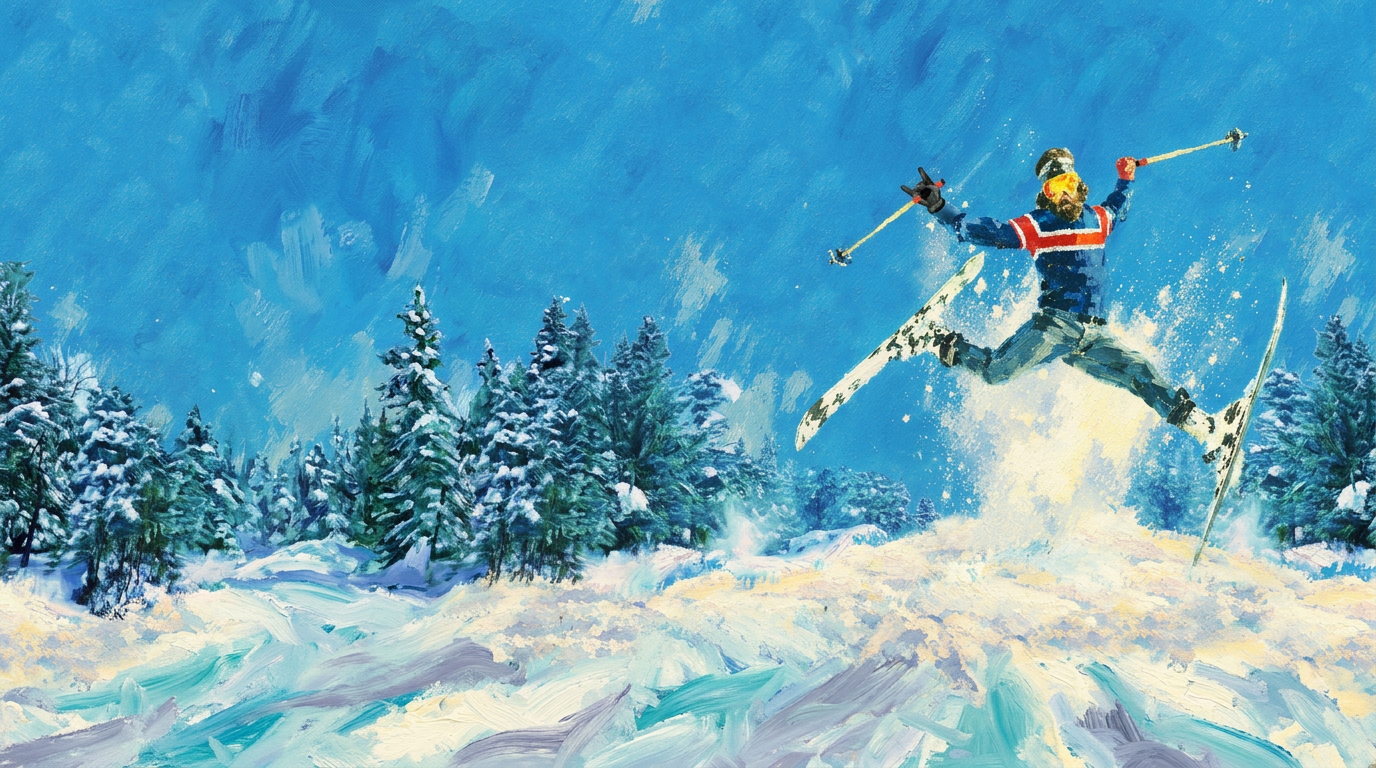
AI image design: Recreate the complete illustrated landscape from Reference Image 1 as a professional, entirely hand-painted landscape pa…
Community
Design detail

Creator
@Elephant_1649093
Recreate the complete illustrated landscape from Reference Image 1 as a professional, entirely hand-painted landscape painting, using Reference Image 2 exclusively as the guide for painting technique, brushwork, colour blending, lighting, atmospheric depth, and painterly realism. The final artwork must look like an original painting created by a skilled landscape artist using traditional oil paints on canvas. Preserve the distinctive scene, action, composition, and visual energy of the first reference, but completely remove its commercial graphic-design treatment. Transform the graphic beer-can label artwork into a seamless, full-bleed fine-art painting. The landscape, trees, snow, sky, airborne skier, and snow spray must all belong to the same painted world. No section should look like a pasted illustration, digital collage, photograph, or vector graphic. 1. SCENE AND COMPOSITION — FOLLOW REFERENCE IMAGE 1 Reconstruct the complete winter skiing scene shown in Reference Image 1. Central subject: an airborne freestyle skier Position a single skier prominently in the upper-middle to right portion of the composition, performing an energetic airborne ski jump above a snowy mountain slope. Preserve the dramatic, wide-legged airborne pose, with both skis extending outward in opposing diagonal directions. The skier's arms are raised and spread apart, holding ski poles that extend diagonally through the air. Dress the skier in a vivid blue winter jacket with strong red-and-white horizontal detailing across the chest, dark ski trousers, gloves, a helmet, and ski goggles. Use expressive but believable anatomical proportions, with the figure convincingly suspended in midair. Paint the skier using confident, economical brushstrokes. Build the clothing from interlocking patches of blue, navy, white, red, and subtle highlights, allowing the underpainting and directional strokes to contribute to the form. Suggest the helmet, goggles, and facial area through painterly colour and simplified shapes rather than photographic detail. Render both skis as long, narrow, curved forms with convincing perspective, clear separation from the snow, and crisp enough edges to remain legible against the bright sky and snow. Retain the sense of speed, exhilaration, freedom, and playful après-ski culture. Mountain landscape and snowy foreground Create a sweeping winter mountain environment beneath the skier. Fill the lower third of the composition with a broad, undulating snow-covered ski slope. Paint the snow as a richly textured surface with sweeping directional strokes, broken patches of pale blue, icy cyan, cool grey, warm cream, and brilliant white. Build a dynamic plume of snow beneath and behind the airborne skier, with irregular flecks, splashes, and expressive brush marks suggesting the momentum of the jump. Include dense clusters of snow-covered evergreen trees along the lower left and right edges, framing the central action without obscuring the skier. Give the pine trees varied heights, silhouettes, and densities. Paint their branches using layered dark blue-green, forest green, ultramarine, muted teal, and snowy white. Allow the trees to recede naturally into the landscape, with more defined brushwork and contrast in the foreground and softer, less distinct forms farther away. Keep the snowy terrain open and luminous around the airborne figure, creating a strong contrast between the skier, the sky, and the landscape. Sky and atmosphere The upper half of the scene should feature a vast, brilliant alpine blue sky. Use rich cerulean, cobalt, turquoise, and ultramarine blue, interspersed with lighter cyan and pale blue. Apply broad, directional brushstrokes that suggest movement in the atmosphere without becoming abstract. Introduce subtle variations in temperature and value, with lighter passages around the airborne figure and slightly deeper blues toward the upper edges. Integrate delicate, broken strokes of pale blue and white into the sky, echoing the loose, expressive treatment of the snow. Maintain a bright, cold, sunlit winter atmosphere, with the clarity and vibrancy of a beautiful ski day. 2. PAINTING STYLE — FOLLOW REFERENCE IMAGE 2 Reference Image 2 is the primary reference for the painting technique. Study its balance between realistic landscape representation and clearly visible traditional brushwork. The essential quality: painterly realism, not photorealism and not loose impressionism. The image must appear convincing and realistic when viewed from a distance, while revealing rich, tactile brushstrokes when viewed closely. Apply the following characteristics throughout the painting: Visible oil-paint brushwork: Use varied, directional strokes to construct the landscape, foliage, snow, clothing, sky, and atmospheric effects. Naturalistic colour blending: Blend adjacent colours through layered brushwork and optical colour mixing rather than smooth digital gradients. Painterly edges: Combine soft, atmospheric transitions with selectively sharp edges around important forms. Avoid uniformly crisp outlines. Layered paint application: Build convincing depth through overlapping strokes, varied paint thickness, subtle impasto, and occasional palette-knife-like marks. Rich colour relationships: Create depth through shifts in hue, temperature, saturation, and value rather than artificial sharpening or excessive contrast. Realistic light and shadow: Establish coherent daylight illuminating the snow, reflecting blue light into shaded areas and creating warmer highlights on sunlit surfaces. Organic mark-making: Allow individual strokes to remain visible, varied, and slightly irregular. Avoid repetitive textures or mechanically generated patterns. Traditional canvas character: Suggest a subtle, natural oil-paint surface with tactile pigment and restrained canvas texture. The painting should feel professionally finished, not rough or unfinished. The mountain landscape, sky, snow, trees, and skier must all share this same painting language. The figure must not look photorealistic while the background looks painted, and the background must not appear like a digital texture applied over an illustration. 3. COLOUR PALETTE Use the bold winter colours of Reference Image 1, interpreted through the sophisticated pigment handling of Reference Image 2. Sky: Cerulean blue, cobalt blue, ultramarine, turquoise, pale cyan. Snow: Titanium white, cool ivory, icy blue, muted lavender-grey, pale turquoise, warm cream, restrained hints of golden sunlight. Evergreen trees: Deep forest green, blue-green, muted teal, dark olive, ultramarine shadows, broken white snow highlights. Skier: Saturated cobalt and navy blue, vivid red, warm white, charcoal, and restrained yellow-orange reflections. Snow spray: Bright white, pale cyan, cool blue-grey, with occasional sharp, high-value highlights. Maintain a rich but harmonious palette. Allow colours to mix and interact through brushwork. Avoid flat, uniform colour fills, excessive digital saturation, neon effects, or artificial colour grading. 4. LIGHTING, DEPTH, AND REALISM Use clear, natural alpine daylight. The snow should feel luminous, substantial, and three-dimensional, with visible undulations, shadows, reflected sky colour, and broken highlights. Create convincing atmospheric perspective through progressively softer detail and lower contrast in distant landscape elements. Use overlapping tree silhouettes, changes in snow texture, and carefully controlled edges to establish foreground, middle ground, and background. The skier must remain the principal focal point through contrast, placement, silhouette, and colour—not through an artificial glow, outline, or photographic cutout effect. The overall result should feel like a masterfully executed landscape painting that captures a fleeting moment of athletic movement within an expansive winter environment. 5. COMPOSITIONAL BALANCE Preserve the energetic, panoramic composition of Reference Image 1. Maintain the expansive blue sky as a major compositional element. Keep the skier large enough to read clearly, with the full body, both skis, both arms, and ski poles visible. Preserve the dramatic diagonal movement of the skis and poles. Use the snow-covered evergreen trees to frame the scene along the lower edges. Balance the bright, open snowfield against the darker tree masses. Keep the snow spray visually dynamic without overwhelming the skier. Extend the painted landscape naturally to all four edges of the canvas. The scene should feel expansive, spontaneous, and alive, rather than tightly cropped or artificially centred. 6. COMPLETE REMOVAL OF GRAPHIC DESIGN ELEMENTS The final output must contain painting only. Remove every element associated with the original beer-can label design, including: All text, typography, lettering, slogans, and logos. The “Brewskis” title and all brand-related graphics. The turquoise information panel on the left. All beer-can label borders, dividing lines, symbols, illustrations, and regulatory text. All graphic overlays, vector shapes, badges, icons, and layout elements. Any visible can, packaging mockup, label template, or presentation background. Do not leave blank rectangles, flat-colour panels, faded text remnants, or unnatural gaps where the original graphics were located. Instead, paint a continuous, uninterrupted winter landscape across the entire image. Extend the sky, snowy trees, terrain, and atmospheric details naturally through every area previously occupied by text and graphics. Do not reserve an empty panel or create dedicated spaces for future lettering. The painting must stand alone as a complete fine-art landscape. Typography and brand elements will be added separately during the packaging-design stage. 7. OUTPUT AND FINISH Format: Wide horizontal panoramic landscape. Aspect ratio: Approximately 2:1, suitable for a wraparound beer-can label. Resolution: Highest available, with sufficient detail for professional packaging reproduction. Finish: Complete, polished, full-bleed traditional oil painting. Surface: Subtle tactile canvas and pigment texture. Style: Realistic landscape painting with expressive, clearly visible brushwork. Detail: Rich close-up texture while maintaining convincing overall realism at a distance. Edges: Painting extends fully to all four canvas edges. Presentation: Artwork only, with no frame, mockup, border, lettering, or surrounding objects. NEGATIVE PROMPT Photograph, photorealistic digital composite, 3D render, CGI, vector illustration, flat graphic design, cartoon, comic-book style, cel shading, anime, airbrushed gradients, excessively smooth digital painting, plastic-looking surfaces, generic AI landscape, repetitive tree patterns, uniform brushstroke texture, excessive palette-knife abstraction, unfinished sketch, muddy colours, excessive blur, oversharpening, artificial HDR, neon colours, glowing outlines, cutout skier, inconsistent lighting, incorrect anatomy, extra limbs, missing ski poles, malformed skis, cropped skier, cropped ski tips, text, typography, logos, labels, brand marks, beer cans, packaging mockups, graphic panels, decorative borders, watermarks, signatures, or empty colour blocks. FINAL ART DIRECTION Create an authentic, professional oil painting of the exact winter-sports scene in Reference Image 1, painted with the naturalistic depth, sophisticated colour handling, and expressive visible brushstrokes of Reference Image 2. Preserve the airborne skier and the distinctive alpine composition while transforming the entire image into one cohesive, continuous, richly textured landscape painting. The defining test: viewed from across a room, the image should read as a believable, beautifully composed winter landscape. Viewed up close, the individual brushstrokes, layered pigments, and tactile qualities of traditional oil paint should become clearly visible. It must look genuinely painted by hand, not like a digital illustration with a painterly filter.
Remix this design
Start for free with full control over models, settings, and canvas tools.
- Generate with full control over models and settings
- Save projects and share back to the community
- No design experience required
What's next?Explore more features



Go from browse to build