Product
Use Cases
How it Works
Pricing
Login

AI image design: create another, have the dog and cat sitting on the street 1. Main composition and visual hierarchy Design a portrait-…
Back to community
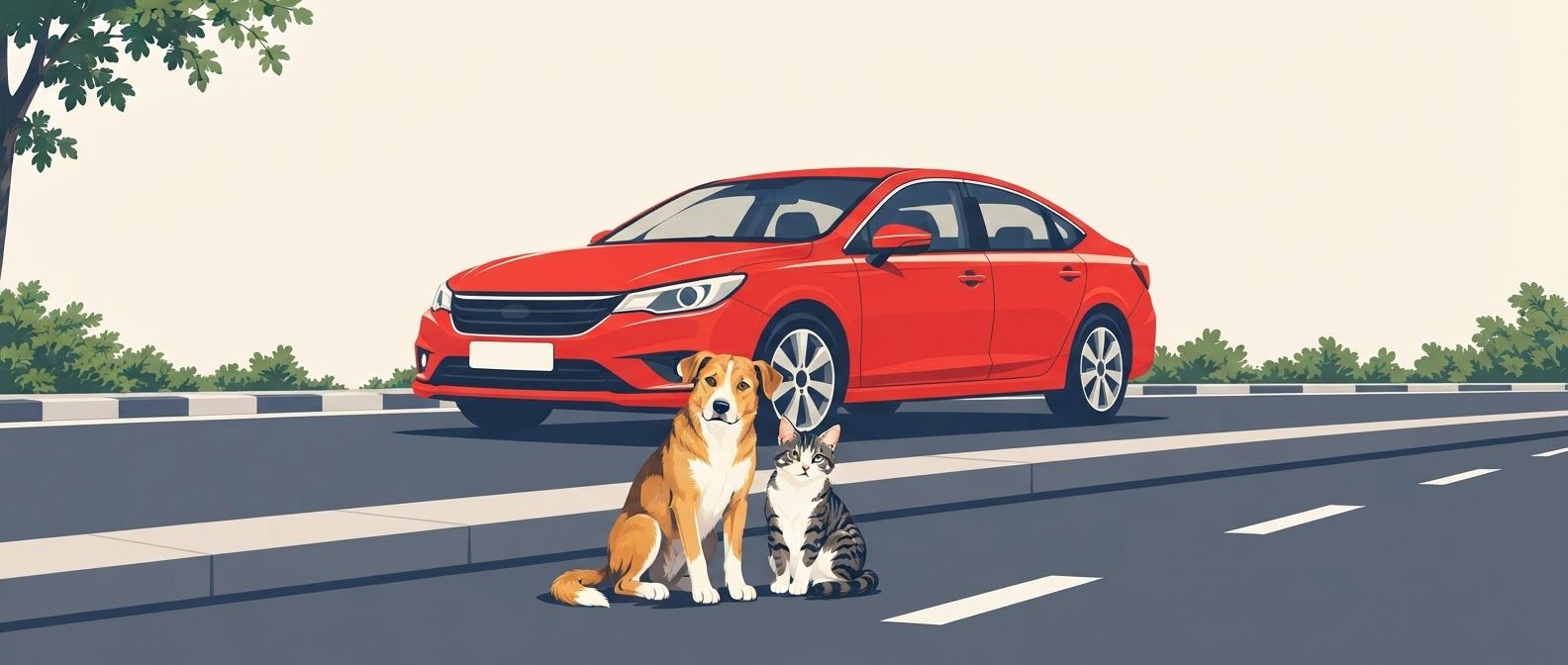
create another, have the dog and cat sitting on the street
1. Main composition and visual hierarchy
Design a portrait-oriented poster with a balanced, carefully structured composition and an immediate visual focal point.
- Primary subject: the car. Illustrate a clearly recognizable modern passenger car occupying the central or upper-middle portion of the composition. Show the vehicle in a readable three-quarter front-side view, with distinct wheels, windows, headlights, bumper, windshield, and body panels. Keep the proportions believable while simplifying the details into bold vector shapes.
- Secondary subjects: the dog and cat. Place a dog and a cat resting peacefully beside the same street, clearly separated from the car's wheels and path. Both animals must be fully visible, identifiable at first glance, and large enough to remain readable when the poster is viewed from a distance.
- Street environment. Depict the road using a few strong geometric elements, such as a broad roadway, curb, pavement, and simplified lane markings. The road must be unmistakable without requiring a detailed cityscape.
- Visual relationship. Establish a clear spatial relationship between the car, roadway, curb, and animals. The car should appear to be travelling along the street or slowing down near the animals, while the dog and cat occupy a safe resting area beside the road. Their placement should communicate that drivers must remain alert and give animals space.
- Negative space. Preserve generous uncluttered space, particularly in the upper section and around the main illustration, so campaign organizers can add a protest slogan, event information, or supporting text later in a design application.
2. Character design: dog and cat
Illustrate the animals using expressive yet simplified vector forms.
Dog: A friendly, medium-sized street dog with recognizable canine proportions, upright or relaxed ears, a clear muzzle, four distinguishable legs, and a naturally curved tail. Show the dog lying comfortably on the pavement beside the curb, with its body resting on the ground and its head slightly raised. Its posture should communicate calmness, vulnerability, and the right to occupy public space safely.
Cat: A recognizable domestic street cat resting beside the dog. Give it pointed ears, a rounded body, a distinct tail, and clearly defined paws. Show the cat sitting in a relaxed position or curled up comfortably near the curb. Ensure its silhouette remains visually distinct from the dog's silhouette.
The dog and cat should have a gentle, peaceful presence rather than exaggerated cartoon expressions. Avoid anthropomorphic poses, clothing, human facial expressions, or overly cute mascot styling. Their visual appeal should come from clean silhouettes, thoughtful proportions, and simple, expressive shapes.
3. Car design and road safety storytelling
The car must be immediately recognizable as a road vehicle, not a generic abstract shape.
- Use a conventional passenger-car silhouette with accurate wheel placement and a clearly defined front and rear.
- Ensure both wheels are visible where the chosen perspective permits, with circular tires and simple hub details.
- Keep the vehicle's perspective consistent with the road and surrounding objects.
- Position the vehicle so it does not obscure the animals or overlap their silhouettes.
- Show a clear margin between the car's wheels and the resting animals.
- Use a grounded perspective, with the road, curb, and pavement aligned logically.
- If appropriate, incorporate a simple road-edge marking or curb boundary to reinforce the separation between the vehicle lane and the animals' resting area.
The intended narrative should be immediately understood: vehicles share streets with animals, and responsible driving helps keep them safe. Convey urgency through graphic contrast and purposeful composition, not through depictions of accidents, injured animals, or graphic violence.
4. Color palette
Use a limited, high-contrast palette suitable for a protest poster that needs to attract attention in public spaces.

Use warm ivory or pale cream as the main background, charcoal for strong outlines and road details, and protest red or safety yellow for selected high-impact areas. Muted green may be used sparingly for small environmental accents.
Maintain clear contrast between the car, animals, pavement, and background. Give the dog and cat distinct coat colors so their silhouettes do not merge with the roadway. Avoid using too many colors or gradients, and ensure that the artwork remains effective when reproduced using inexpensive poster printing.
5. Graphic language and finish
- Strictly flat, two-dimensional vector artwork.
- Solid color fills with clean, precise edges.
- Bold, simplified geometric construction.
- Consistent line weight and deliberate silhouette design.
- Strong figure-ground separation.
- Minimal environmental details.
- Contemporary editorial illustration with the visual impact of a protest graphic.
- Carefully controlled asymmetry to create movement without making the layout feel unstable.
- Crisp, polished shapes that resemble professionally produced vector artwork.
- High legibility at both close range and from across a street.
- Print-friendly colors and clean outer contours.
The artwork should feel serious enough for a public protest, compassionate toward street animals, and visually powerful without becoming aggressive or overly decorative.
6. Poster layout and print specifications
- Format: Portrait poster, preferably 2:3 aspect ratio, adaptable to A3 or A2 printing.
- Composition: One unified illustration with a clear central focal point.
- Visual hierarchy: Car first, dog and cat second, simplified street environment third.
- Margins: Keep all essential illustrated elements within a comfortable print-safe area.
- Text: Absolutely no text, letters, numbers, captions, slogans, signage, watermarks, or logos.
- Background: Simple, uncluttered, and integrated with the vector scene.
- Output quality: High-resolution, sharp-edged artwork suitable for large-format printing and subsequent graphic design editing.
7. Negative prompt
Photorealism, hyperrealistic rendering, 3D models, CGI, glossy surfaces, painterly brushwork, watercolor, oil painting, pencil sketches, photographic textures, complex gradients, excessive shadows, dramatic cinematic lighting, overly detailed buildings, crowded traffic, multiple distracting vehicles, distorted car proportions, incorrect wheel placement, floating objects, inconsistent perspective, anatomically confusing animals, extra legs, missing paws, fused animal silhouettes, obscured dog, obscured cat, animals positioned directly under wheels, animals blocking the car's wheels, injured animals, blood, accident scenes, aggressive animals, anthropomorphic characters, excessive decorative elements, busy patterns, complicated backgrounds, illegible details, text, typography, letters, numbers, logos, watermarks, borders that crowd the artwork.
Final creative direction: The finished poster should resemble a bold, professionally art-directed animal welfare protest graphic. At first glance, viewers should recognize a car on a street and a dog and cat resting safely beside it. The illustration should be emotionally engaging, compositionally balanced, visually direct, and completely free of text, leaving the campaign message open for later customization.

Community

Design detail

Elephant_3756952

Creator

@Elephant_3756952

Created October 11, 2026
Prompt

create another, have the dog and cat sitting on the street 1. Main composition and visual hierarchy Design a portrait-oriented poster with a balanced, carefully structured composition and an immediate visual focal point. - Primary subject: the car. Illustrate a clearly recognizable modern passenger car occupying the central or upper-middle portion of the composition. Show the vehicle in a readable three-quarter front-side view, with distinct wheels, windows, headlights, bumper, windshield, and body panels. Keep the proportions believable while simplifying the details into bold vector shapes. - Secondary subjects: the dog and cat. Place a dog and a cat resting peacefully beside the same street, clearly separated from the car's wheels and path. Both animals must be fully visible, identifiable at first glance, and large enough to remain readable when the poster is viewed from a distance. - Street environment. Depict the road using a few strong geometric elements, such as a broad roadway, curb, pavement, and simplified lane markings. The road must be unmistakable without requiring a detailed cityscape. - Visual relationship. Establish a clear spatial relationship between the car, roadway, curb, and animals. The car should appear to be travelling along the street or slowing down near the animals, while the dog and cat occupy a safe resting area beside the road. Their placement should communicate that drivers must remain alert and give animals space. - Negative space. Preserve generous uncluttered space, particularly in the upper section and around the main illustration, so campaign organizers can add a protest slogan, event information, or supporting text later in a design application. 2. Character design: dog and cat Illustrate the animals using expressive yet simplified vector forms. Dog: A friendly, medium-sized street dog with recognizable canine proportions, upright or relaxed ears, a clear muzzle, four distinguishable legs, and a naturally curved tail. Show the dog lying comfortably on the pavement beside the curb, with its body resting on the ground and its head slightly raised. Its posture should communicate calmness, vulnerability, and the right to occupy public space safely. Cat: A recognizable domestic street cat resting beside the dog. Give it pointed ears, a rounded body, a distinct tail, and clearly defined paws. Show the cat sitting in a relaxed position or curled up comfortably near the curb. Ensure its silhouette remains visually distinct from the dog's silhouette. The dog and cat should have a gentle, peaceful presence rather than exaggerated cartoon expressions. Avoid anthropomorphic poses, clothing, human facial expressions, or overly cute mascot styling. Their visual appeal should come from clean silhouettes, thoughtful proportions, and simple, expressive shapes. 3. Car design and road safety storytelling The car must be immediately recognizable as a road vehicle, not a generic abstract shape. - Use a conventional passenger-car silhouette with accurate wheel placement and a clearly defined front and rear. - Ensure both wheels are visible where the chosen perspective permits, with circular tires and simple hub details. - Keep the vehicle's perspective consistent with the road and surrounding objects. - Position the vehicle so it does not obscure the animals or overlap their silhouettes. - Show a clear margin between the car's wheels and the resting animals. - Use a grounded perspective, with the road, curb, and pavement aligned logically. - If appropriate, incorporate a simple road-edge marking or curb boundary to reinforce the separation between the vehicle lane and the animals' resting area. The intended narrative should be immediately understood: vehicles share streets with animals, and responsible driving helps keep them safe. Convey urgency through graphic contrast and purposeful composition, not through depictions of accidents, injured animals, or graphic violence. 4. Color palette Use a limited, high-contrast palette suitable for a protest poster that needs to attract attention in public spaces. Use warm ivory or pale cream as the main background, charcoal for strong outlines and road details, and protest red or safety yellow for selected high-impact areas. Muted green may be used sparingly for small environmental accents. Maintain clear contrast between the car, animals, pavement, and background. Give the dog and cat distinct coat colors so their silhouettes do not merge with the roadway. Avoid using too many colors or gradients, and ensure that the artwork remains effective when reproduced using inexpensive poster printing. 5. Graphic language and finish - Strictly flat, two-dimensional vector artwork. - Solid color fills with clean, precise edges. - Bold, simplified geometric construction. - Consistent line weight and deliberate silhouette design. - Strong figure-ground separation. - Minimal environmental details. - Contemporary editorial illustration with the visual impact of a protest graphic. - Carefully controlled asymmetry to create movement without making the layout feel unstable. - Crisp, polished shapes that resemble professionally produced vector artwork. - High legibility at both close range and from across a street. - Print-friendly colors and clean outer contours. The artwork should feel serious enough for a public protest, compassionate toward street animals, and visually powerful without becoming aggressive or overly decorative. 6. Poster layout and print specifications - Format: Portrait poster, preferably 2:3 aspect ratio, adaptable to A3 or A2 printing. - Composition: One unified illustration with a clear central focal point. - Visual hierarchy: Car first, dog and cat second, simplified street environment third. - Margins: Keep all essential illustrated elements within a comfortable print-safe area. - Text: Absolutely no text, letters, numbers, captions, slogans, signage, watermarks, or logos. - Background: Simple, uncluttered, and integrated with the vector scene. - Output quality: High-resolution, sharp-edged artwork suitable for large-format printing and subsequent graphic design editing. 7. Negative prompt Photorealism, hyperrealistic rendering, 3D models, CGI, glossy surfaces, painterly brushwork, watercolor, oil painting, pencil sketches, photographic textures, complex gradients, excessive shadows, dramatic cinematic lighting, overly detailed buildings, crowded traffic, multiple distracting vehicles, distorted car proportions, incorrect wheel placement, floating objects, inconsistent perspective, anatomically confusing animals, extra legs, missing paws, fused animal silhouettes, obscured dog, obscured cat, animals positioned directly under wheels, animals blocking the car's wheels, injured animals, blood, accident scenes, aggressive animals, anthropomorphic characters, excessive decorative elements, busy patterns, complicated backgrounds, illegible details, text, typography, letters, numbers, logos, watermarks, borders that crowd the artwork. Final creative direction: The finished poster should resemble a bold, professionally art-directed animal welfare protest graphic. At first glance, viewers should recognize a car on a street and a dog and cat resting safely beside it. The illustration should be emotionally engaging, compositionally balanced, visually direct, and completely free of text, leaving the campaign message open for later customization.

Remix this design

Start for free with full control over models, settings, and canvas tools.

  • ·Generate with full control over models and settings
  • ·Save projects and share back to the community
  • ·No design experience required
Start free — use this prompt
Browse more community designs →
Start free — remix this

What's next?Explore more features

Hiding Elephant product features overview

Explore features

AI generation, vector tools, workflows, catalogs, and collaboration in one workspace.

How Hiding Elephant works

How it works

See how the AI canvas, automation, and teamwork fit together end to end.

Get started with Hiding Elephant

Try it free

Sign in and turn inspiration into projects you can edit, export, and share.

Go from browse to build

Explore what else the Elephant can do.You'll love it

AI image generation

AI Generation

Image tools

Image Tools

Workflow builder

Workflows

Brand and style templates

Brand Management

Product catalog

Product Catalog

Collaboration

Collaboration

Batch image generation

Batch generation

Explore community

Community workflows

The AI designworkspace forfast-moving ideas.

Product

  • Ellie
  • Apps
  • AI Generation
  • Vector Canvas
  • Image Tools
  • Workflows
  • Brand Management
  • Product Catalog
  • My Assets
  • Collaboration

Use Cases

  • E-commerce teams
  • Design agencies
  • Marketing teams
  • Content creators

Quick tools

  • All quick tools
  • Background Remover
  • Image Upscaler
  • Image Vectorizer
  • Image Optimizer
  • Image Reframer

Resources

  • About
  • Pricing
  • FAQ
  • Compare
  • Enterprise
  • Integrations
  • Explore
  • Blog
  • Contact Us
  • Book a Demo
  • Affiliates

© 2026 Hiding Elephant. All rights reserved

Cookie PolicyPrivacy PolicyTerms of Service
Hiding Elephant