Product
Use Cases
How it Works
Pricing
Login

AI image design: Create a highly detailed professional AAA game character concept sheet exploring a single cohesive robot design based on…
Back to community
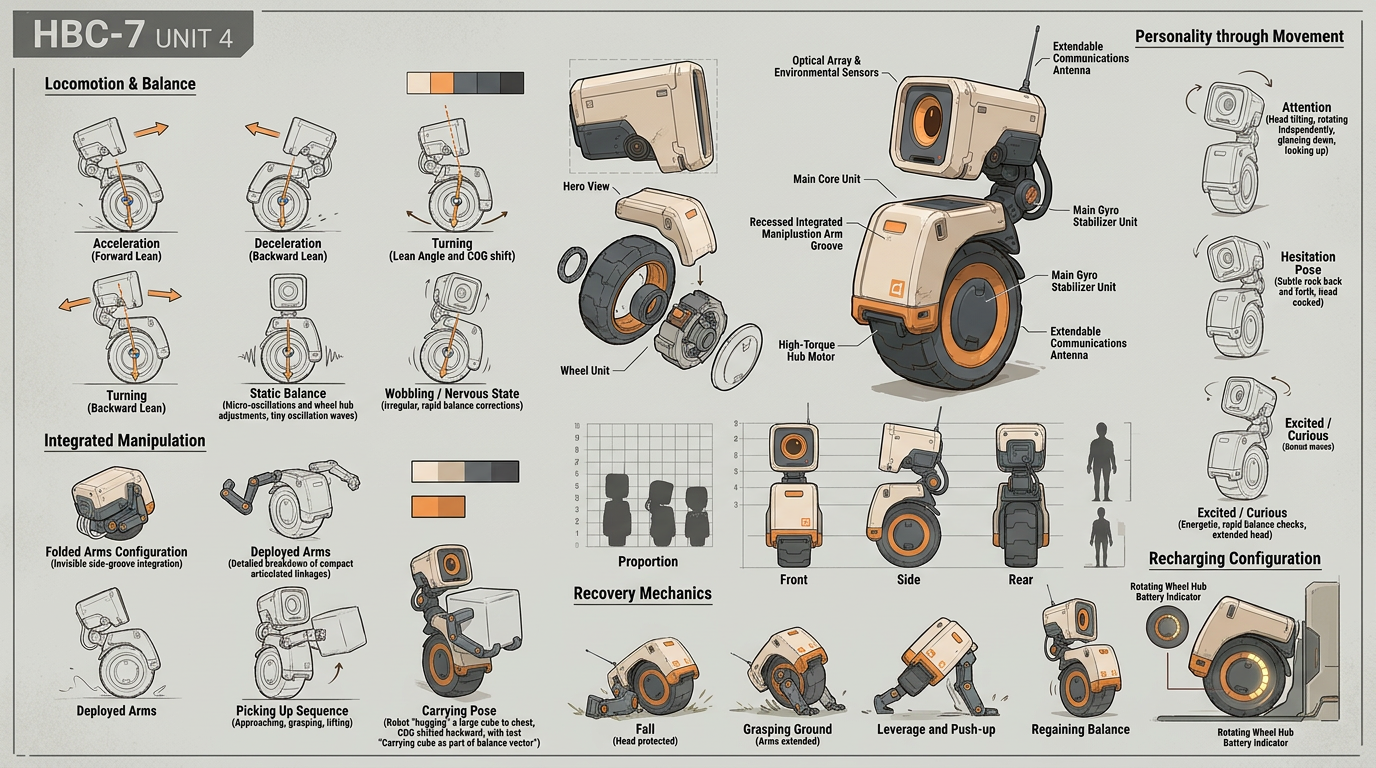
Create a highly detailed professional AAA game character concept sheet exploring a single cohesive robot design based on a self-balancing unicycle. This is not a polished final illustration but an industrial design exploration intended to solve locomotion, manipulation, balance, personality, and interaction as one unified mechanical system.

The goal is to design a small autonomous AI companion whose physical behavior naturally emerges from its body mechanics, rather than attaching expressive features onto an existing robot.

The robot should feel like a believable machine that gradually develops individuality through movement and learning. Every visible component should have a clear functional purpose.

Central Design Philosophy

The robot's entire existence revolves around maintaining dynamic balance.

Its movement, posture, object manipulation, hesitation, emotional expression, failures, recovery, and interaction with the environment should all emerge from this single mechanical principle.

Instead of asking:
"What should this robot look like?"

Ask:
"What body would naturally evolve if balancing itself was its greatest challenge?"

Overall Appearance

A compact self-balancing robot roughly knee height.

Simple, memorable silhouette composed primarily of:

independent optical sensor head
articulated neck
compact central body
single large drive wheel
two integrated manipulation arms
minimal exposed mechanics
small antenna
a few visible flexible cables

The silhouette should remain instantly recognizable from every angle.

Avoid unnecessary panels, decorations, armor plating or excessive greebles.

Everything should feel engineered rather than ornamental.

Readable Attention

The head must be completely independent from the body.

Large single optical sensor.

The head should rotate, tilt, lean, glance downward, look upward and inspect objects.

The player should immediately understand exactly what the robot is observing without requiring facial expressions.

The head should contribute significantly to personality.

Small antenna and soft cable movement should reinforce curiosity and fragility.

Unified Mechanical System

Every action should originate from the balancing mechanism.

When accelerating:

body leans forward

When braking:

body rocks backward

When inspecting:

wheel makes tiny balance corrections

When thinking:

subtle oscillations and micro-adjustments

When carrying:

center of gravity visibly shifts

When nervous:

slight unstable wobble

When uncertain:

hesitant forward-and-back balancing motions

When excited:

energetic balancing corrections

Its "emotions" emerge through physics rather than animation alone.

Manipulation System

The arms should not feel attached afterwards.

Instead they are fully integrated into the body.

Both arms retract into recessed side grooves running vertically along the sides of the torso.

When inactive they remain almost invisible.

When deployed they unfold through compact articulated linkages.

The arms should be designed for:

picking up cubes
carrying cubes tightly against the torso
stabilizing loads
pushing against the floor
assisting recovery after falling
bracing while climbing over obstacles

The manipulation mechanism must clearly explain:

how the robot approaches a cube
how it grasps it
how it lifts it
how it carries it
how it places it down

Avoid unexplained floating poses.

Carrying Principle

The cube is intentionally large relative to the robot.

Rather than holding it away from the body,

the robot hugs it tightly against its chest.

The carried cube becomes part of its balance.

Its entire body leans backward like a hand truck carrying heavy cargo.

Visible physical effort should be apparent.

Recovery Mechanics

One major design challenge.

Show clearly how the robot:

falls

protects its head

uses its arms

pushes itself upright

finds balance again

Recovery should emerge naturally from the existing mechanics rather than hidden devices.

Turning

The single wheel remains the only drive wheel.

Turning should be achieved through controlled leaning combined with steering dynamics.

Demonstrate believable balance during turns.

No hidden wheels.

No stabilizers deployed during normal movement.

Recharging

Show a charging configuration that is obviously the same machine.

The robot should remain balanced while connected.

No separate resting form.

The charging pose should naturally emerge from its body mechanics.

Perhaps:

slightly leaned against a charging dock

wheel locked

arms lightly supporting

or body resting against a docking structure.

Battery Indicator

Integrate the battery indicator directly into the robot.

No floating HUD.

Possible implementations:

illuminated inner wheel ring
circular energy band
segmented rotating wheel hub

The indicator remains visible in every configuration:

standing

moving

carrying

fallen

charging

The battery visualization should naturally decrease as energy is consumed.

Physical Simplicity

Keep the design physically economical.

The robot should plausibly translate into a simplified physics rig consisting primarily of:

head
neck
torso
wheel
two articulated arms

Avoid unnecessary moving components.

Prioritize mechanical clarity.

Concept Sheet Layout

Professional industrial character development page.

Include:

hero 3/4 view
front
side
rear
orthographic views
exploded mechanical diagram
articulation points
folded arm configuration
deployed arm configuration
carrying pose
picking up cube sequence
placing cube sequence
balancing sketches
turning sketches
hesitation poses
wobbling poses
fallen pose
recovery sequence
charging pose
silhouette studies
proportion diagrams
wheel and arm mechanism breakdowns
center-of-gravity arrows
balance vectors
motion path sketches

Everything should feel like an industrial design proposal ready for 3D production.

Art Direction

Retro industrial science fiction.

Stylized but mechanically believable.

Warm off-white composite panels.

Dark graphite structural frame.

Soft orange functional lighting.

Clean industrial forms.

Minimal panel lines.

Readable geometry.

Inspired by high-end game concept art from Naughty Dog, Valve, Campo Santo, Pixar robotics research, Simon Stålenhag mechanical sensibilities, and modern industrial product design—without copying any existing character.

Negative Prompt

Humanoid robot, android, human anatomy, oversized expressive eyes, military robot, battle mech, transformer, anime robot, excessive armor, floating parts, unexplained mechanisms, decorative greebles, multiple wheels, tank treads, generic service robot, overcomplicated engineering, inconsistent proportions, inconsistent articulation, magical movement, impossible physics, disconnected limbs, unrealistic grasping, ornamental sci-fi details.

This revised prompt shifts the focus away from generating "cute robot variations" and instead asks the model to solve the character as a coherent mechanical design problem, ensuring the robot's locomotion, manipulation, balance, recovery, and personality all emerge from the same underlying principle.

Community

Design detail

Elephant_5639848

Creator

@Elephant_5639848

Created July 30, 2026
Prompt

Create a highly detailed professional AAA game character concept sheet exploring a single cohesive robot design based on a self-balancing unicycle. This is not a polished final illustration but an industrial design exploration intended to solve locomotion, manipulation, balance, personality, and interaction as one unified mechanical system. The goal is to design a small autonomous AI companion whose physical behavior naturally emerges from its body mechanics, rather than attaching expressive features onto an existing robot. The robot should feel like a believable machine that gradually develops individuality through movement and learning. Every visible component should have a clear functional purpose. Central Design Philosophy The robot's entire existence revolves around maintaining dynamic balance. Its movement, posture, object manipulation, hesitation, emotional expression, failures, recovery, and interaction with the environment should all emerge from this single mechanical principle. Instead of asking: "What should this robot look like?" Ask: "What body would naturally evolve if balancing itself was its greatest challenge?" Overall Appearance A compact self-balancing robot roughly knee height. Simple, memorable silhouette composed primarily of: independent optical sensor head articulated neck compact central body single large drive wheel two integrated manipulation arms minimal exposed mechanics small antenna a few visible flexible cables The silhouette should remain instantly recognizable from every angle. Avoid unnecessary panels, decorations, armor plating or excessive greebles. Everything should feel engineered rather than ornamental. Readable Attention The head must be completely independent from the body. Large single optical sensor. The head should rotate, tilt, lean, glance downward, look upward and inspect objects. The player should immediately understand exactly what the robot is observing without requiring facial expressions. The head should contribute significantly to personality. Small antenna and soft cable movement should reinforce curiosity and fragility. Unified Mechanical System Every action should originate from the balancing mechanism. When accelerating: body leans forward When braking: body rocks backward When inspecting: wheel makes tiny balance corrections When thinking: subtle oscillations and micro-adjustments When carrying: center of gravity visibly shifts When nervous: slight unstable wobble When uncertain: hesitant forward-and-back balancing motions When excited: energetic balancing corrections Its "emotions" emerge through physics rather than animation alone. Manipulation System The arms should not feel attached afterwards. Instead they are fully integrated into the body. Both arms retract into recessed side grooves running vertically along the sides of the torso. When inactive they remain almost invisible. When deployed they unfold through compact articulated linkages. The arms should be designed for: picking up cubes carrying cubes tightly against the torso stabilizing loads pushing against the floor assisting recovery after falling bracing while climbing over obstacles The manipulation mechanism must clearly explain: how the robot approaches a cube how it grasps it how it lifts it how it carries it how it places it down Avoid unexplained floating poses. Carrying Principle The cube is intentionally large relative to the robot. Rather than holding it away from the body, the robot hugs it tightly against its chest. The carried cube becomes part of its balance. Its entire body leans backward like a hand truck carrying heavy cargo. Visible physical effort should be apparent. Recovery Mechanics One major design challenge. Show clearly how the robot: falls protects its head uses its arms pushes itself upright finds balance again Recovery should emerge naturally from the existing mechanics rather than hidden devices. Turning The single wheel remains the only drive wheel. Turning should be achieved through controlled leaning combined with steering dynamics. Demonstrate believable balance during turns. No hidden wheels. No stabilizers deployed during normal movement. Recharging Show a charging configuration that is obviously the same machine. The robot should remain balanced while connected. No separate resting form. The charging pose should naturally emerge from its body mechanics. Perhaps: slightly leaned against a charging dock wheel locked arms lightly supporting or body resting against a docking structure. Battery Indicator Integrate the battery indicator directly into the robot. No floating HUD. Possible implementations: illuminated inner wheel ring circular energy band segmented rotating wheel hub The indicator remains visible in every configuration: standing moving carrying fallen charging The battery visualization should naturally decrease as energy is consumed. Physical Simplicity Keep the design physically economical. The robot should plausibly translate into a simplified physics rig consisting primarily of: head neck torso wheel two articulated arms Avoid unnecessary moving components. Prioritize mechanical clarity. Concept Sheet Layout Professional industrial character development page. Include: hero 3/4 view front side rear orthographic views exploded mechanical diagram articulation points folded arm configuration deployed arm configuration carrying pose picking up cube sequence placing cube sequence balancing sketches turning sketches hesitation poses wobbling poses fallen pose recovery sequence charging pose silhouette studies proportion diagrams wheel and arm mechanism breakdowns center-of-gravity arrows balance vectors motion path sketches Everything should feel like an industrial design proposal ready for 3D production. Art Direction Retro industrial science fiction. Stylized but mechanically believable. Warm off-white composite panels. Dark graphite structural frame. Soft orange functional lighting. Clean industrial forms. Minimal panel lines. Readable geometry. Inspired by high-end game concept art from Naughty Dog, Valve, Campo Santo, Pixar robotics research, Simon Stålenhag mechanical sensibilities, and modern industrial product design—without copying any existing character. Negative Prompt Humanoid robot, android, human anatomy, oversized expressive eyes, military robot, battle mech, transformer, anime robot, excessive armor, floating parts, unexplained mechanisms, decorative greebles, multiple wheels, tank treads, generic service robot, overcomplicated engineering, inconsistent proportions, inconsistent articulation, magical movement, impossible physics, disconnected limbs, unrealistic grasping, ornamental sci-fi details. This revised prompt shifts the focus away from generating "cute robot variations" and instead asks the model to solve the character as a coherent mechanical design problem, ensuring the robot's locomotion, manipulation, balance, recovery, and personality all emerge from the same underlying principle.

Remix this design

Start for free with full control over models, settings, and canvas tools.

  • ·Generate with full control over models and settings
  • ·Save projects and share back to the community
  • ·No design experience required
Start free — use this prompt
Browse more community designs →
Start free — remix this

What's next?Explore more features

Hiding Elephant product features overview

Explore features

AI generation, vector tools, workflows, catalogs, and collaboration in one workspace.

How Hiding Elephant works

How it works

See how the AI canvas, automation, and teamwork fit together end to end.

Get started with Hiding Elephant

Try it free

Sign in and turn inspiration into projects you can edit, export, and share.

Go from browse to build

Explore what else the Elephant can do.You'll love it

AI image generation

AI Generation

Image tools

Image Tools

Workflow builder

Workflows

Brand and style templates

Brand Management

Product catalog

Product Catalog

Collaboration

Collaboration

Batch image generation

Batch generation

Explore community

Community workflows

The AI designworkspace forfast-moving ideas.

Product

  • AI Generation
  • Vector Canvas
  • Image Tools
  • Workflows
  • Brand Management
  • Product Catalog
  • My Assets
  • Collaboration

Use Cases

  • E-commerce teams
  • Design agencies
  • Marketing teams
  • Content creators

Quick tools

  • All quick tools
  • Background Remover
  • Image Upscaler
  • Image Vectorizer
  • Image Optimizer
  • Image Reframer

Resources

  • About
  • Pricing
  • FAQ
  • Compare
  • Enterprise
  • Explore
  • Blog
  • Contact Us
  • Book a Demo
  • Affiliates

© 2026 Hiding Elephant. All rights reserved

Cookie PolicyPrivacy PolicyTerms of Service
Hiding Elephant