Product
Use Cases
How it Works
Pricing
Login

AI image design: The Mobile Recharge System is a Python-based console application that simulates the process of recharging a mobile phone…
Back to community
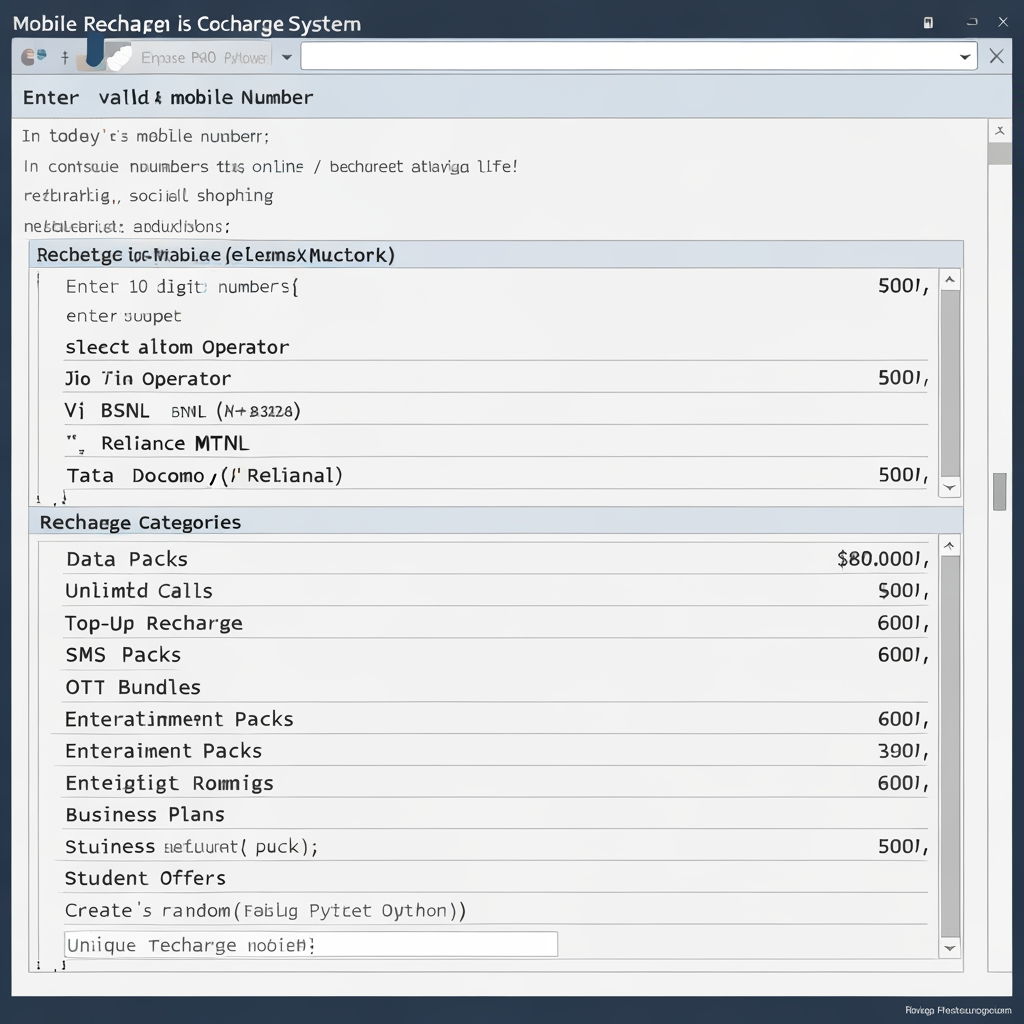
The Mobile Recharge System is a Python-based console application that simulates the process of recharging a mobile phone. In today's world, mobile phones have become an essential part of daily life. People use them for voice calls, internet access, online education, banking, shopping, social media, entertainment, and business communication. To continue using these services without interruption, users need to recharge their mobile numbers regularly. This project is designed to provide a simple and efficient way to perform a mobile recharge while helping students understand the practical use of Python programming.
The main aim of this project is to develop a menu-driven application that allows users to recharge their mobile numbers in an easy and organized manner. The user first enters a valid 10-digit mobile number. The program checks whether the entered number is valid. If the number is incorrect, the application displays an error message and stops the process. This validation ensures that only correct mobile numbers are accepted, improving the reliability and accuracy of the system.
After entering a valid mobile number, the user selects the telecom operator from the list of available networks. The application supports several popular telecom operators such as Jio, Airtel, Vi, BSNL, and MTNL. It also includes Tata Docomo and Reliance CDMA as demonstration networks for educational purposes. The selected network is stored by the system and is displayed later in the recharge receipt.
The application provides multiple recharge categories so that users can choose a plan according to their requirements. These categories include Data Packs, Unlimited Calls, Top-Up Recharge, SMS Packs, International Roaming, OTT Bundles, Entertainment Packs, Gaming Packs, Business Plans, and Student Offers. Each category contains different recharge plans with different prices and benefits. For example, users can choose data packs for internet usage, unlimited calling plans for voice communication, OTT bundles for streaming services, or student offers designed for educational needs.
Once the category is selected, the application displays all the available recharge plans under that category. The user selects one plan from the list, and the corresponding recharge amount is automatically identified by the system. After the plan selection, the recharge process begins. The application creates a unique transaction ID using Python's random module and records the current date and time using the datetime module. Finally, the application displays a detailed recharge receipt containing the mobile number, network name, recharge category, selected plan, recharge amount, transaction ID, date and time, and recharge status. This makes the application similar to a real mobile recharge system.
This project is developed using the Python programming language and demonstrates many important programming concepts. It uses variables to store user information, dictionaries to organize telecom operators, recharge categories, and plans, lists and tuples to store recharge details, loops to display menu options, and conditional statements to validate user input and control program execution. The application also uses Python's built-in random and datetime modules to generate transaction IDs and display the current date and time. These programming concepts help students understand how different Python features work together to build a complete application.
One of the major advantages of this project is its simplicity. Since it is a console-based application, it does not require a graphical user interface or an external database. The program is easy to understand, execute, and modify. Beginners can easily study the source code and learn how menu-driven applications are developed. The modular structure of the program also makes it easy to add new features without changing the entire code.
This project has many practical applications and can be further improved in the future. Additional features such as customer login, online payment gateway integration, recharge history, database connectivity using MySQL or SQLite, SMS and email notifications, QR code payments, digital wallet support, and graphical user interfaces using Tkinter or PyQt can be added. These enhancements would make the system more realistic and suitable for commercial use.
The Mobile Recharge System is an excellent educational project for students who are learning Python programming. It combines theoretical knowledge with practical implementation by solving a real-world problem. The project improves logical thinking, programming skills, input validation techniques, and problem-solving abilities. Overall, it provides a strong foundation for developing advanced telecom and online payment applications while helping students gain confidence in software development using Python.
create a logo

Community

Design detail

Elephant_1105456

Creator

@Elephant_1105456

Created July 27, 2026
Prompt

The Mobile Recharge System is a Python-based console application that simulates the process of recharging a mobile phone. In today's world, mobile phones have become an essential part of daily life. People use them for voice calls, internet access, online education, banking, shopping, social media, entertainment, and business communication. To continue using these services without interruption, users need to recharge their mobile numbers regularly. This project is designed to provide a simple and efficient way to perform a mobile recharge while helping students understand the practical use of Python programming. The main aim of this project is to develop a menu-driven application that allows users to recharge their mobile numbers in an easy and organized manner. The user first enters a valid 10-digit mobile number. The program checks whether the entered number is valid. If the number is incorrect, the application displays an error message and stops the process. This validation ensures that only correct mobile numbers are accepted, improving the reliability and accuracy of the system. After entering a valid mobile number, the user selects the telecom operator from the list of available networks. The application supports several popular telecom operators such as Jio, Airtel, Vi, BSNL, and MTNL. It also includes Tata Docomo and Reliance CDMA as demonstration networks for educational purposes. The selected network is stored by the system and is displayed later in the recharge receipt. The application provides multiple recharge categories so that users can choose a plan according to their requirements. These categories include Data Packs, Unlimited Calls, Top-Up Recharge, SMS Packs, International Roaming, OTT Bundles, Entertainment Packs, Gaming Packs, Business Plans, and Student Offers. Each category contains different recharge plans with different prices and benefits. For example, users can choose data packs for internet usage, unlimited calling plans for voice communication, OTT bundles for streaming services, or student offers designed for educational needs. Once the category is selected, the application displays all the available recharge plans under that category. The user selects one plan from the list, and the corresponding recharge amount is automatically identified by the system. After the plan selection, the recharge process begins. The application creates a unique transaction ID using Python's random module and records the current date and time using the datetime module. Finally, the application displays a detailed recharge receipt containing the mobile number, network name, recharge category, selected plan, recharge amount, transaction ID, date and time, and recharge status. This makes the application similar to a real mobile recharge system. This project is developed using the Python programming language and demonstrates many important programming concepts. It uses variables to store user information, dictionaries to organize telecom operators, recharge categories, and plans, lists and tuples to store recharge details, loops to display menu options, and conditional statements to validate user input and control program execution. The application also uses Python's built-in random and datetime modules to generate transaction IDs and display the current date and time. These programming concepts help students understand how different Python features work together to build a complete application. One of the major advantages of this project is its simplicity. Since it is a console-based application, it does not require a graphical user interface or an external database. The program is easy to understand, execute, and modify. Beginners can easily study the source code and learn how menu-driven applications are developed. The modular structure of the program also makes it easy to add new features without changing the entire code. This project has many practical applications and can be further improved in the future. Additional features such as customer login, online payment gateway integration, recharge history, database connectivity using MySQL or SQLite, SMS and email notifications, QR code payments, digital wallet support, and graphical user interfaces using Tkinter or PyQt can be added. These enhancements would make the system more realistic and suitable for commercial use. The Mobile Recharge System is an excellent educational project for students who are learning Python programming. It combines theoretical knowledge with practical implementation by solving a real-world problem. The project improves logical thinking, programming skills, input validation techniques, and problem-solving abilities. Overall, it provides a strong foundation for developing advanced telecom and online payment applications while helping students gain confidence in software development using Python. create a logo

Remix this design

Start for free with full control over models, settings, and canvas tools.

  • ·Generate with full control over models and settings
  • ·Save projects and share back to the community
  • ·No design experience required
Start free — use this prompt
Browse more community designs →
Start free — remix this

What's next?Explore more features

Hiding Elephant product features overview

Explore features

AI generation, vector tools, workflows, catalogs, and collaboration in one workspace.

How Hiding Elephant works

How it works

See how the AI canvas, automation, and teamwork fit together end to end.

Get started with Hiding Elephant

Try it free

Sign in and turn inspiration into projects you can edit, export, and share.

Go from browse to build

Explore what else the Elephant can do.You'll love it

AI image generation

AI Generation

Image tools

Image Tools

Workflow builder

Workflows

Brand and style templates

Brand Management

Product catalog

Product Catalog

Collaboration

Collaboration

Batch image generation

Batch generation

Explore community

Community workflows

The AI designworkspace forfast-moving ideas.

Product

  • AI Generation
  • Vector Canvas
  • Image Tools
  • Workflows
  • Brand Management
  • Product Catalog
  • My Assets
  • Collaboration

Use Cases

  • E-commerce teams
  • Design agencies
  • Marketing teams
  • Content creators

Quick tools

  • All quick tools
  • Background Remover
  • Image Upscaler
  • Image Vectorizer
  • Image Optimizer
  • Image Reframer

Resources

  • About
  • Pricing
  • FAQ
  • Compare
  • Enterprise
  • Explore
  • Blog
  • Contact Us
  • Book a Demo
  • Affiliates

© 2026 Hiding Elephant. All rights reserved

Cookie PolicyPrivacy PolicyTerms of Service
Hiding Elephant