Product
Use Cases
How it Works
Pricing
Login

AI image design: DIGITAL RIGHTS UNDER PECA 2016: A Simple Analysis of Freedom of Speech and Privacy in Pakistan Author: Tanveer Shahid…
Back to community
DIGITAL RIGHTS UNDER PECA 2016: A Simple Analysis of Freedom of Speech and Privacy in Pakistan
Author: 
Tanveer Shahid & Syed Tahir Naveed
Supervisor: 
Prof. Dr. Zaheer Ahmed
Department
LLM, School Of Law and Policy , University of Management and Technology, Lahore, Pakistan.


1. INTRODUCTION & BACKGROUND
BRIEF CONTEXT: 
Internet use is growing very fast in Pakistan. Because of this, cybercrime has also increased. So the government made a law to control it.
Problem/Gap: 
PECA 2016 was made to stop cybercrime. But people are worried that it hurts basic rights like freedom of speech, privacy, and fair court process.
Purpose: 
This study checks if PECA 2016 matches the Constitution and international human rights rules. It also gives ideas to better protect digital rights in Pakistan.

2. RESEARCH QUESTIONS
•	Does PECA 2016 follow the Constitution’s rules about freedom of speech and privacy?  
•	How has PECA affected people’s freedom of speech and privacy in real life?  
•	What are the legal problems in PECA, and what changes are needed to protect digital rights?
3. METHODOLOGY 
•	Research Design: 
Qualitative research + Doctrinal legal analysis + Comparative legal analysis + Policy analysis
•	Sample/Population:
 PECA 2016, court judgments, constitutional provisions, international laws, comparative frameworks
•	Content Analyzed: 
Laws, court cases, government rules, policy documents, international legal instruments
•	Data Technique: 
Legal content analysis + comparative analysis + rights-based constitutional analysis
4. FINDINGS 
KEY FINDINGS (ALIGNED WITH RESEARCH QUESTIONS)
1.	PECA contains several provisions that are inconsistent with constitutional protections of freedom of expression and privacy, particularly Sections 20 and 37.
2.	Broad content-blocking powers, criminal defamation provisions, and surveillance mechanisms create significant risks for digital rights and due process.
3.	Judicial oversight remains limited, while enforcement practices may encourage self-censorship among journalists, activists, and online users.
4.	Comparative models from the EU and UK demonstrate more transparent and rights-compatible approaches to digital governance.
________________________________________
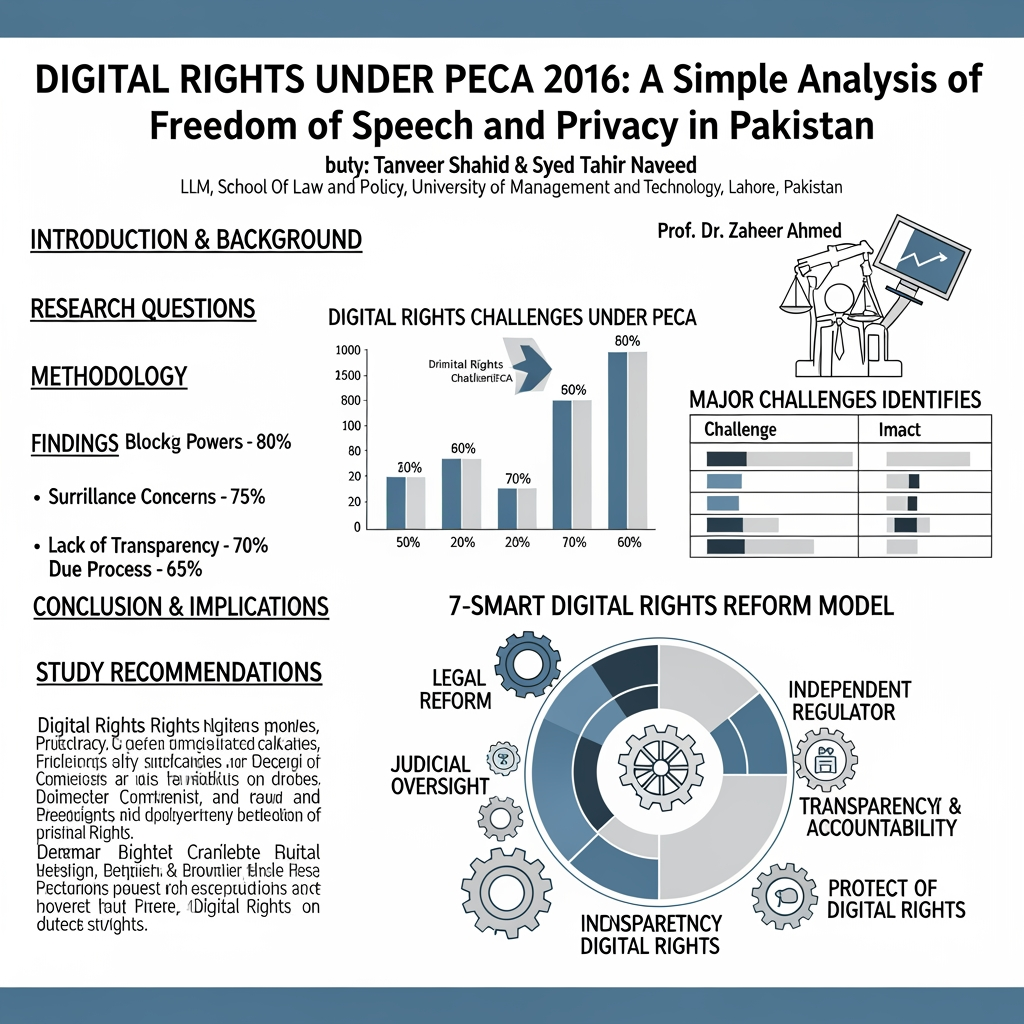
DIGITAL RIGHTS CHALLENGES UNDER PECA
•	Criminal Defamation — 85% 
•	Content Blocking Powers — 80% 
•	Surveillance Concerns — 75% 
•	Lack of Transparency — 70% 
•	Due Process Issues — 65% 
Impact Level (%)
________________________________________
MAJOR CHALLENGES IDENTIFIED
Challenge	Impact
Criminal Defamation	                Chilling Effect on Speech
Content Blocking	                 Reduced Online Freedom
Surveillance Powers	                   Privacy Risks
Weak Oversight	                  Due Process Concerns
Lack of Transparency	                  Accountability Deficit

5. CONCLUSION & IMPLICATIONS
KEY CONCLUSIONS
•	PECA plays an important role in addressing cybercrime but contains several provisions that adversely affect freedom of expression and privacy. 
•	Current enforcement mechanisms grant extensive powers to regulatory authorities without sufficient safeguards. 
•	Meaningful reform is required to align PECA with constitutional guarantees and international human rights standards. 
PRACTICAL IMPLICATIONS
•	Better protection of digital rights 
•	Improved transparency and accountability 
•	Enhanced public trust in digital governance 
•	Stronger constitutional compliance 
•	More effective cybercrime regulation 
________________________________________
6. STUDY RECOMMENDATIONS
TOP 5 RECOMMENDATIONS
1.	Treat ordinary online defamation as a civil matter instead of a criminal offense. 
2.	Require court warrants before surveillance or access to personal data. 
3.	Create an independent digital rights authority. 
4.	Make content-blocking decisions more transparent. 
5.	Introduce a strong data protection law to safeguard personal information.
7-SMART DIGITAL RIGHTS REFORM MODEL
1. LEGAL REFORM
2. JUDICIAL OVERSIGHT
3. INDEPENDENT REGULATOR
4. TRANSPARENCY & ACCOUNTABILITY
5. PROTECTION OF DIGITAL RIGHTS

Community

Design detail

Elephant_1745215

Creator

@Elephant_1745215

Created June 13, 2026
Prompt

DIGITAL RIGHTS UNDER PECA 2016: A Simple Analysis of Freedom of Speech and Privacy in Pakistan Author: Tanveer Shahid & Syed Tahir Naveed Supervisor: Prof. Dr. Zaheer Ahmed Department LLM, School Of Law and Policy , University of Management and Technology, Lahore, Pakistan. 1. INTRODUCTION & BACKGROUND BRIEF CONTEXT: Internet use is growing very fast in Pakistan. Because of this, cybercrime has also increased. So the government made a law to control it. Problem/Gap: PECA 2016 was made to stop cybercrime. But people are worried that it hurts basic rights like freedom of speech, privacy, and fair court process. Purpose: This study checks if PECA 2016 matches the Constitution and international human rights rules. It also gives ideas to better protect digital rights in Pakistan. 2. RESEARCH QUESTIONS • Does PECA 2016 follow the Constitution’s rules about freedom of speech and privacy? • How has PECA affected people’s freedom of speech and privacy in real life? • What are the legal problems in PECA, and what changes are needed to protect digital rights? 3. METHODOLOGY • Research Design: Qualitative research + Doctrinal legal analysis + Comparative legal analysis + Policy analysis • Sample/Population: PECA 2016, court judgments, constitutional provisions, international laws, comparative frameworks • Content Analyzed: Laws, court cases, government rules, policy documents, international legal instruments • Data Technique: Legal content analysis + comparative analysis + rights-based constitutional analysis 4. FINDINGS KEY FINDINGS (ALIGNED WITH RESEARCH QUESTIONS) 1. PECA contains several provisions that are inconsistent with constitutional protections of freedom of expression and privacy, particularly Sections 20 and 37. 2. Broad content-blocking powers, criminal defamation provisions, and surveillance mechanisms create significant risks for digital rights and due process. 3. Judicial oversight remains limited, while enforcement practices may encourage self-censorship among journalists, activists, and online users. 4. Comparative models from the EU and UK demonstrate more transparent and rights-compatible approaches to digital governance. ________________________________________ DIGITAL RIGHTS CHALLENGES UNDER PECA • Criminal Defamation — 85% • Content Blocking Powers — 80% • Surveillance Concerns — 75% • Lack of Transparency — 70% • Due Process Issues — 65% Impact Level (%) ________________________________________ MAJOR CHALLENGES IDENTIFIED Challenge Impact Criminal Defamation Chilling Effect on Speech Content Blocking Reduced Online Freedom Surveillance Powers Privacy Risks Weak Oversight Due Process Concerns Lack of Transparency Accountability Deficit 5. CONCLUSION & IMPLICATIONS KEY CONCLUSIONS • PECA plays an important role in addressing cybercrime but contains several provisions that adversely affect freedom of expression and privacy. • Current enforcement mechanisms grant extensive powers to regulatory authorities without sufficient safeguards. • Meaningful reform is required to align PECA with constitutional guarantees and international human rights standards. PRACTICAL IMPLICATIONS • Better protection of digital rights • Improved transparency and accountability • Enhanced public trust in digital governance • Stronger constitutional compliance • More effective cybercrime regulation ________________________________________ 6. STUDY RECOMMENDATIONS TOP 5 RECOMMENDATIONS 1. Treat ordinary online defamation as a civil matter instead of a criminal offense. 2. Require court warrants before surveillance or access to personal data. 3. Create an independent digital rights authority. 4. Make content-blocking decisions more transparent. 5. Introduce a strong data protection law to safeguard personal information. 7-SMART DIGITAL RIGHTS REFORM MODEL 1. LEGAL REFORM 2. JUDICIAL OVERSIGHT 3. INDEPENDENT REGULATOR 4. TRANSPARENCY & ACCOUNTABILITY 5. PROTECTION OF DIGITAL RIGHTS

Remix this design

Start for free with full control over models, settings, and canvas tools.

  • ·Generate with full control over models and settings
  • ·Save projects and share back to the community
  • ·No design experience required
Start free — use this prompt
Browse more community designs →
Start free — remix this

What's next?Explore more features

Hiding Elephant product features overview

Explore features

AI generation, vector tools, workflows, catalogs, and collaboration in one workspace.

How Hiding Elephant works

How it works

See how the AI canvas, automation, and teamwork fit together end to end.

Get started with Hiding Elephant

Try it free

Sign in and turn inspiration into projects you can edit, export, and share.

Go from browse to build

Explore what else the Elephant can do.You'll love it

AI image generation

AI Generation

Image tools

Image Tools

Workflow builder

Workflows

Brand and style templates

Brand Management

Product catalog

Product Catalog

Collaboration

Collaboration

Batch image generation

Batch generation

Explore community

Community workflows

The AI designworkspace forfast-moving ideas.

Product

  • AI Generation
  • Vector Canvas
  • Image Tools
  • Workflows
  • Brand Management
  • Product Catalog
  • My Assets
  • Collaboration

Use Cases

  • E-commerce teams
  • Design agencies
  • Marketing teams
  • Content creators

Quick tools

  • All quick tools
  • Background Remover
  • Image Upscaler
  • Image Vectorizer
  • Image Optimizer
  • Image Reframer

Resources

  • About
  • Pricing
  • Enterprise
  • Explore
  • Blog
  • Contact Us
  • Book a Demo
  • Affiliates

© 2026 Hiding Elephant. All rights reserved

Cookie PolicyPrivacy PolicyTerms of Service
Hiding Elephant